
Resources
A reflective roof can be much cooler than a darker surface without producing the same temperature change indoors. Lawrence Berkeley National Laboratory's published calculation puts the difference between a clean white roof and a gray roof at about 55°F under specified summer conditions.
Cool roof statistics need that distinction. Surface temperature, annual cooling electricity, heating energy and utility cost are separate measures. A useful comparison states which one changed, which roof assemblies were compared and whether the result was measured or modeled.
The figures below are a 2026 reference to identified research, including historical studies whose assumptions remain visible. They are not a forecast of savings at an individual property.
Key Cool Roof Statistics at a Glance
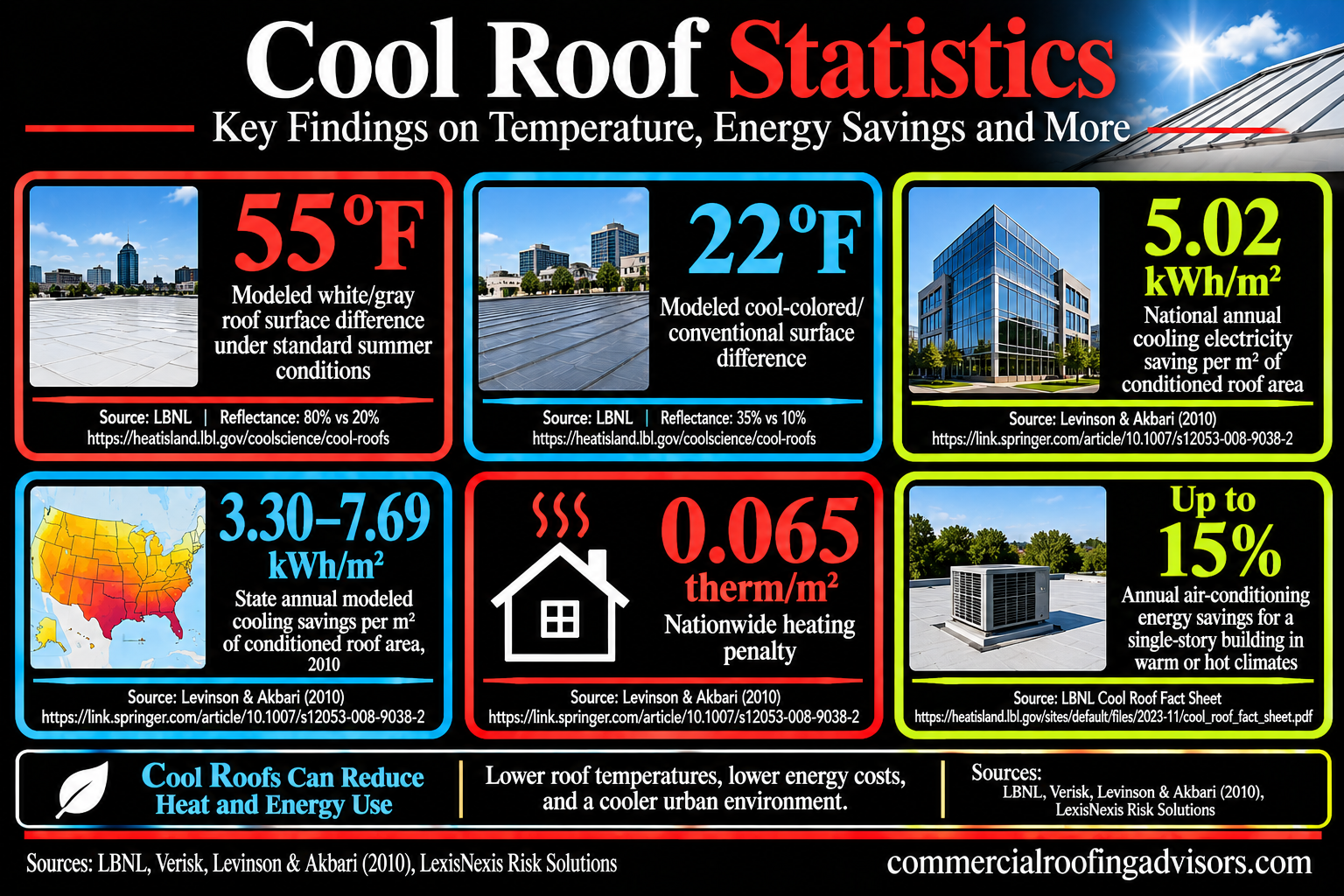
- LBNL calculates about 55°F lower surface temperature for its clean-white versus gray summer comparison, with 80% versus 20% solar reflectance.
- A separate LBNL cool-colored comparison gives about 22°F lower surface temperature, using 35% versus 10% reflectance.
- Levinson and Akbari's 2010 commercial-building model estimated average annual cooling electricity savings of 5.02 kWh per square meter of conditioned roof area nationwide.
- That 2010 model's state results ranged from 3.30 kWh/m² in Alaska to 7.69 kWh/m² in Arizona.
- The same 2010 analysis estimated a nationwide heating penalty of 0.065 therm/m² annually.
- LBNL's published cool-roof fact sheet describes up to 15% annual air-conditioning energy savings for a single-story building in warm or hot climates. It is a conditional upper figure, not a typical result for every building.
How much cooler can a reflective roof be?
LBNL's clean-white and gray roof calculation gives about a 55°F surface difference under a standard summer afternoon and medium-wind condition. Its inputs are 80% reflectance for the white roof and 20% for the gray roof.
The laboratory describes a separate 22°F comparison between cool-colored and conventional roofs with a similar visible color. Neither calculation measures indoor air temperature. Both illustrate how surfaces with different solar properties respond to the same specified weather.
An infographic should keep the word “surface” beside the temperature. Showing the number inside a building outline could imply a result that the calculation does not establish.
How much commercial-building cooling electricity did research estimate?
The 2010 Levinson and Akbari study estimated 5.02 kWh/m² in annual cooling electricity savings nationally. It simulated four office and retail prototypes across 236 US cities.
The researchers compared weathered white and gray surfaces, with reflectance values of 0.55 and 0.20. Its state estimates ranged from 3.30 to 7.69 kWh/m² annually. The denominator is conditioned roof area. It is not total building floor area.
These are historical model outputs. Current insulation, occupancy, equipment efficiency and weather may differ. Multiplying a national figure by a property's roof size can provide a rough scenario, but it is not a measured building result or a replacement for an energy assessment.
How much energy saving does the common 15% figure describe?
LBNL's fact sheet describes savings of up to 15% of annual air-conditioning energy use for a single-story building in warm or hot climates. That does not describe 15% of a whole building's energy bill.
A tenant may use electricity for lighting, equipment and other activities that a reflective roof does not affect in the same way. Utility charges can include demand and fixed charges. A percentage reduction in cooling electricity cannot be copied directly into a percentage reduction in the total invoice.
The fact sheet does not supply a universal installation-year result. A source-backed proposal should state its building assumptions and make clear whether its figure is an upper estimate, a modeled average or a measured outcome.
How large was the modeled winter heating penalty?
The 2010 commercial-building analysis estimated a national average heating penalty of 0.065 therm/m² per year. A more reflective surface can reduce useful solar heat during the heating season.
Cooling electricity and heating fuel are different quantities. They need separate prices and a consistent period before their financial effects can be combined. A dollar result built from historical rates should retain those rates rather than being presented as a current quote.
For a property decision, the comparison should retain both seasons, the building's fuel mix and the roof assembly being evaluated. CRA's discussion of reflective roofing and operating costs explains how those inputs fit an owner's review.
Applying the research to an existing roof
The thermal comparison and the waterproofing decision belong in the same project file. An owner needs to know what surface is proposed, what is underneath it, and which findings could change the scope.
A roof coating assessment addresses whether an existing roof is a suitable restoration candidate. It should not begin with a savings percentage and work backward to a predetermined product.
Useful proposal records separate measured utility history, modeled future use, product ratings and installation cost. They state the comparison roof and identify maintenance assumptions. That lets the owner revisit the decision when operating conditions or prices change.
Reviewing options with Commercial Roofing Advisors
Commercial Roofing Advisors helps owners compare roof repair, restoration and replacement using documented conditions. A commercial roof evaluation provides a starting point for discussing energy goals alongside moisture, drainage and remaining service life.