Industrial Facilities
Industrial and manufacturing roofs are unlike any other commercial roof, and they are usually managed as if they were the same. A distribution center or plant may cover hundreds of thousands of square feet under a single membrane, carry rooftop loads no office building ever sees, and sit above operations where a leak does not mean a stained ceiling tile but a stopped line, ruined inventory, or a tripped electrical panel. We advise the owners and facility executives behind these buildings so the roof is managed as the production-critical asset it is, not as a maintenance afterthought that surfaces only when water finds the floor.
The Large-Span Roof Is a Different Problem
Scale changes everything about how a roof behaves and how it should be managed. On a 400,000-square-foot roof, drainage is not a detail; a slight deflection in the deck creates ponding that no spec sheet anticipated, and standing water accelerates membrane breakdown and overloads the structure. Thermal movement across a span that large stresses every seam and termination. A small defect that would be cosmetic on a strip mall becomes, multiplied across acres of membrane, a recurring source of intrusion. We help owners understand the condition of these roofs at the scale they actually exist, prioritizing the seams, drains, and details that drive failure rather than treating the field as uniform.
Production Continuity Comes First
For an operating plant, the roof's job is to protect what happens beneath it, and the cost of a failure is measured in downtime, not repair invoices. Water over a manufacturing line, a clean room, a server-dependent automation system, or temperature-sensitive stored product can cost far more in a single event than the roof did to install. We help owners map their roof condition against what sits below it, so capital and maintenance attention flows first to the bays over the most consequential operations. That same lens governs how work is scheduled, because reroofing an active facility means coordinating around production windows, dust and fume control, and crane access without shutting the building down.
- Risk mapped to what lies beneath each roof area, not square footage alone
- Phasing that respects production schedules and minimizes operational disruption
- Protection planning for sensitive processes, inventory, and equipment during work
- Drainage and ponding analysis specific to long-span deck behavior
Rooftop Equipment, Penetrations, and Foot Traffic
Industrial roofs are working surfaces. They carry large HVAC and process units, exhaust stacks, dust collectors, conduit, gas lines, and the constant foot traffic of trades servicing all of it. Every one of those is a penetration, a point load, or a chance for someone to damage the membrane without telling anyone. The most common source of leaks on these roofs is not the membrane aging out; it is uncontrolled rooftop activity around equipment. We help owners establish control over the roof as an asset, documenting penetrations, identifying where foot traffic and service access are degrading the system, and putting protocols in place so that the contractor who replaces a compressor does not create next year's leak.
- Inventory of rooftop equipment, penetrations, and their flashing condition
- Walk-pad and access planning where service traffic is damaging membrane
- Review of trade and vendor rooftop work before it threatens the system
- Coordination of equipment replacements with roofing condition and warranty
Choosing the Right System at Scale
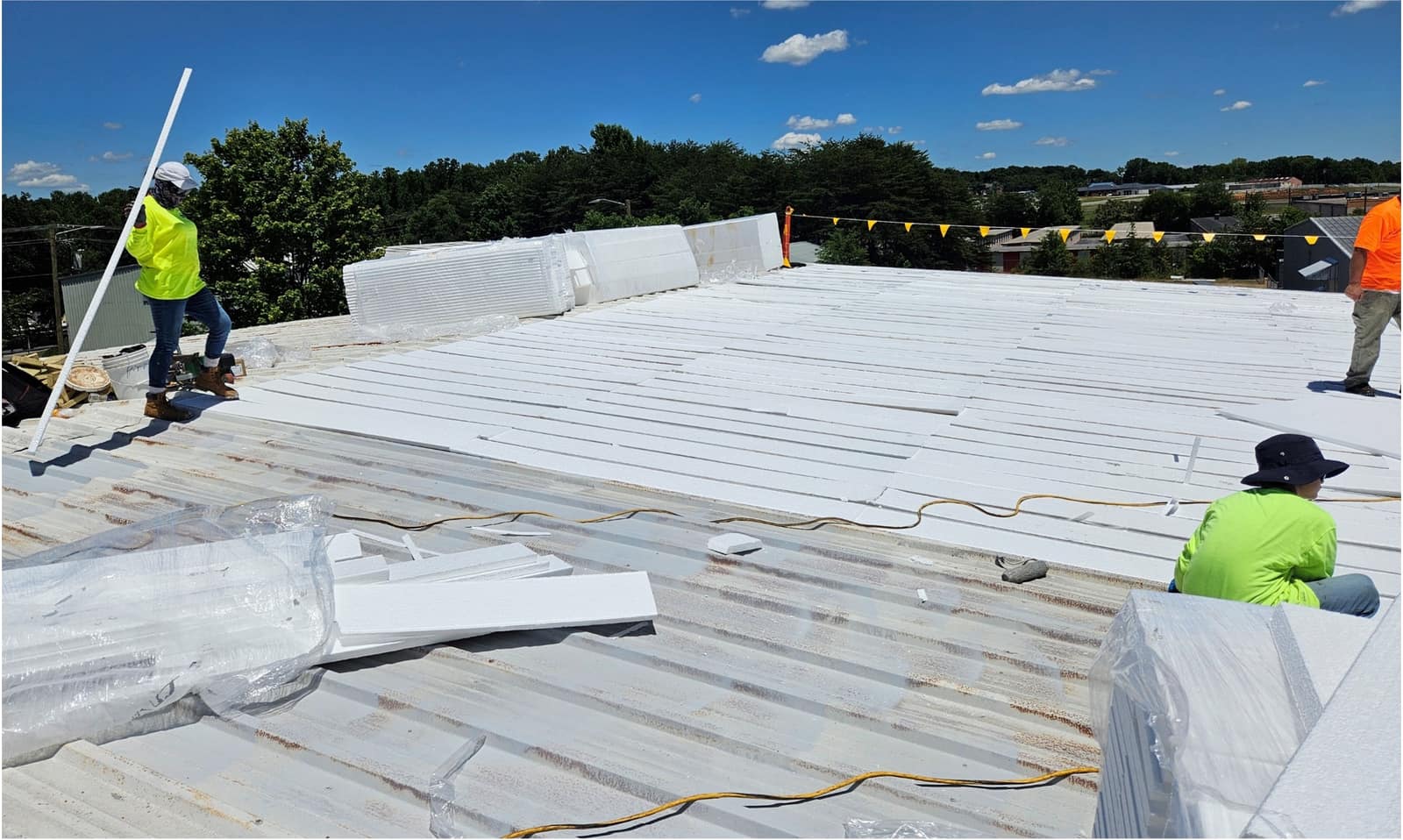
System selection on a large industrial roof carries consequences that small differences in cost multiply into large numbers. A reflective single-ply such as TPO or PVC can meaningfully reduce cooling load on a conditioned plant, while PVC offers chemical and grease resistance that matters above food processing or facilities with airborne contaminants. EPDM remains durable where reflectivity is not the priority. For roofs where a full tear-off would mean an unacceptable shutdown, a recover system or a spray-applied coating or SPF restoration may extend service life with far less disruption. We advise owners on which path fits the building's structure, its operations, its energy goals, and its remaining hold period, with no system of our own to push.
Capital Timing and Warranty Discipline
Replacing a large-span industrial roof is among the largest single capital events a facility will face, and it should never be a surprise. We help owners forecast that spend years ahead with field-verified condition rather than nominal warranty dates, and decide deliberately between restoration that buys time and full replacement that resets the clock. We also audit the warranty exposure these roofs accumulate, because the same constant rooftop activity that causes leaks also routinely voids manufacturer coverage. Knowing which warranties are intact, and protecting them, can be the difference between a covered repair and a capital request.
How We Work With Industrial Owners
We act as the owner-side roof advisor for industrial and manufacturing facilities, independent of any installing contractor or membrane line. We can baseline a single plant or an entire footprint of distribution and production buildings, build the condition and warranty record, forecast the capital, and advise every repair, restoration, and replacement decision against the operations the roof protects. When it is time to put work out to bid, we write the scope, evaluate proposals on equal terms, and oversee the work so the membrane that goes down is the one the owner is paying for. The goal is simple: keep the building dry, keep the line running, and keep the capital deliberate.
Planning a Warehouse Roof Lift or Roof Raise
Increasing clear height is a structural project, but the condition of the existing warehouse roof affects the project scope and budget. Before the lift is priced, owners should document membrane and deck condition, wet insulation, drainage, rooftop equipment, roof-to-wall details, and warranty obligations. The structural engineer and qualified lifting contractor determine whether and how the building can be raised; the roof review establishes what should be preserved, repaired, restored, or replaced as part of that work.
Explore CRA commercial roof lifting for the project path, then use our warehouse roof lifting checklist to separate the roof scope from the lift and other building-system scopes before comparing options.