
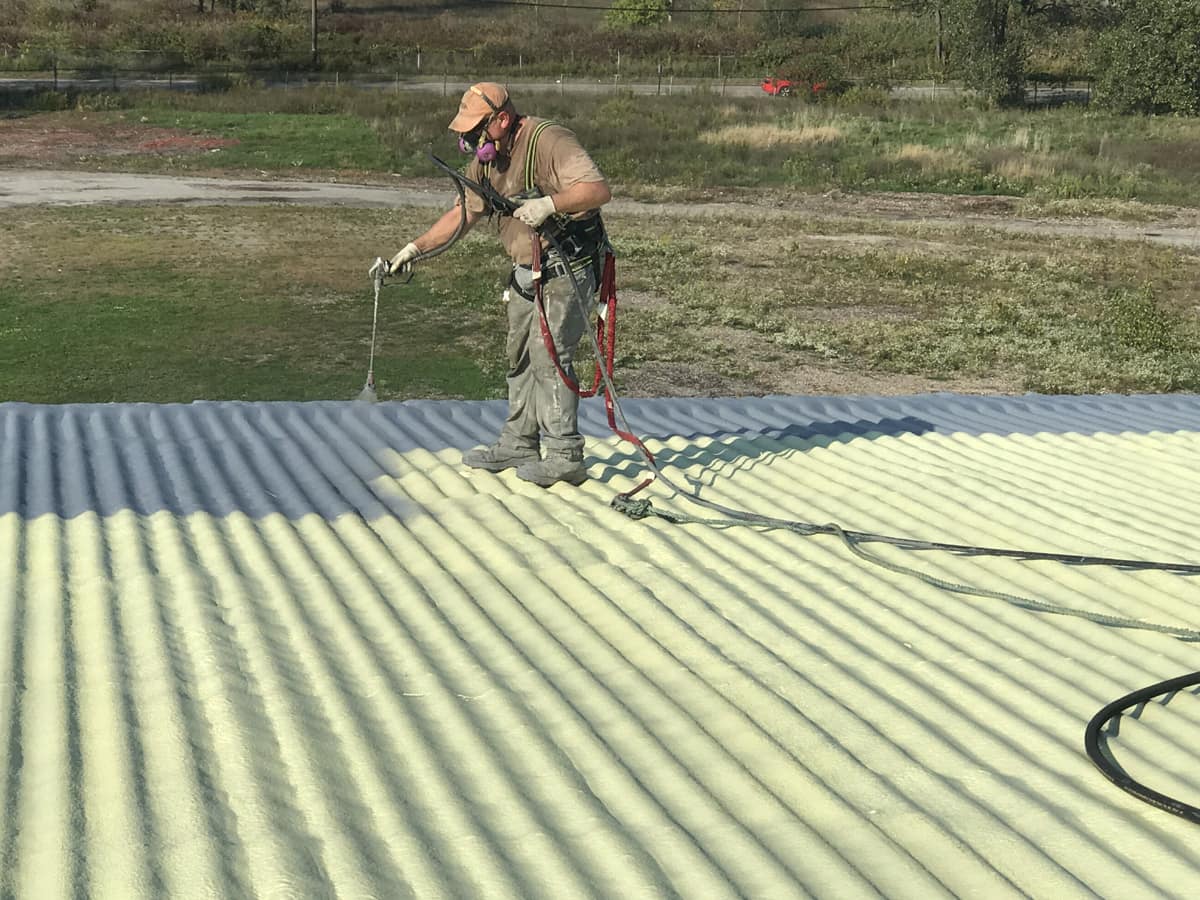
Extend Roof Life
A roof coating can add years of service to an existing commercial roof at a fraction of the cost of replacement, and it can also be money poured over a roof that should have been torn off. The difference comes down to whether the existing assembly is a legitimate candidate, and that is exactly the judgment coating contractors are not positioned to make objectively. We advise owners, asset managers, and facility executives on when restoration is the right capital move and when it is a costly way to defer the inevitable. A coating is a tool with a specific use case, not a universal alternative to replacement, and treating it as the latter is where owners lose money.
What Restoration Coatings Actually Do
A fluid-applied coating is a monolithic membrane installed over an existing roof to restore watertightness, reflectivity, and weather resistance without removing what is underneath. The common chemistries each have a fitting application. Acrylic coatings are cost-effective and highly reflective and perform well in climates without standing water. Silicone coatings excel at resisting ponding water and ultraviolet exposure and are a frequent choice for roofs with drainage limitations. Polyurethane coatings offer abrasion resistance for roofs with heavy foot traffic. Each is applied over a prepared and repaired substrate, which means the coating is only as sound as the preparation beneath it.
Restoration works best on roofs that are aging but fundamentally intact, weathered TPO, PVC, EPDM, modified bitumen, BUR, and metal roofs that have surface wear but a structurally sound, dry assembly. On the right roof, a coating reestablishes a seamless waterproof surface, lowers rooftop temperature and cooling load through reflectivity, and resets the service-life clock for a meaningful span. It can also restart a warranty through the coating manufacturer, which has real value for an owner planning a multi-year hold.
When a Coating Is the Wrong Answer
No coating performs over wet insulation. This is the rule that disqualifies more candidates than any other, and it is the one contractors are most tempted to ignore. If moisture is trapped in the substrate, sealing a coating over the top traps it permanently, the wet insulation continues to degrade and corrode the deck, and the owner has spent restoration money on a roof that still needs full replacement, now with an extra layer to remove. A coating also cannot rescue a membrane that has failed structurally, a roof with widespread seam separation, deteriorated decking, or so many penetration failures that the preparation cost approaches replacement cost.
- Trapped or widespread substrate moisture, confirmed by infrared scanning or core cuts, is an automatic disqualifier.
- Severe ponding from inadequate drainage, which no coating chemistry corrects on its own.
- Structural deck deterioration or failed fastening, which requires opening the assembly, not sealing it.
- Membrane so degraded that surface preparation and repair approach the cost of tear-off and replacement.
- An assembly already near the end of life where a few added years do not justify deferring a planned replacement.
The Capital Timing Decision
For an owner, restoration is fundamentally a capital-timing decision. A coating typically costs a meaningful fraction of replacement and is often treated differently for accounting and tax purposes, since it can be characterized as maintenance rather than a capital improvement. That treatment, combined with the lower outlay, makes restoration attractive when it buys real, reliable years. The question is whether those years are reliable. A coating on a sound candidate that delays a replacement by a planned interval is a strong return. A coating on a marginal roof that fails early forces the owner into an emergency replacement anyway, having spent the restoration cost for nothing.
The decision also depends on the hold period. An owner planning to dispose of an asset within a short window may find restoration the right move to deliver a watertight roof at sale without committing replacement capital. An owner holding long term needs to weigh whether one restoration cycle, or eventually a full replacement, produces the better lifetime cost. These are not contractor questions; they are ownership questions that require an independent read on condition.
Evaluating the Candidate Before Committing
Because the entire economics of restoration depend on the condition of the existing roof, the decision must rest on an honest condition assessment rather than a coating salesman's walkthrough. We evaluate substrate moisture through infrared scanning and core samples, verify that drainage is adequate or correctable, assess the membrane's structural soundness, and quantify the preparation and repair required before any coating goes down. That preparation cost is decisive, because a coating proposal that omits the real repair scope understates the true cost and overstates the value.
We then compare the all-in restoration cost, including preparation, against the expected added service life and against the cost and timing of replacement. Only when restoration delivers reliable years at a genuine discount to replacement, on a roof that qualifies, does it earn the capital.
How We Help Owners
We give owners the independent judgment that the coating decision requires. Because we do not apply coatings or sell roofing, our recommendation follows the condition of your roof rather than the product we would otherwise be selling. We confirm whether the assembly is a legitimate restoration candidate, expose the preparation and repair scope that proposals tend to hide, and frame the choice as a capital-timing decision tied to your hold period and portfolio plan. When restoration is right, we help you scope and oversee it so the work is done to the standard the warranty demands. When it is not, we tell you plainly, and steer the capital toward the replacement that actually protects the asset.
When a Roof Coating Advisor Should Be Involved
A roof coating advisor helps the owner test whether restoration is actually supported by the existing assembly. The review should address moisture, adhesion, seams, penetrations, drainage, roof traffic, coating thickness, warranty terms, and the years of service the owner needs. A coating can be a strong life-extension decision when those conditions line up; it is a poor substitute for replacement when the substrate is wet or the assembly is failing.
We keep the recommendation tied to lifecycle value rather than the lowest first price. That means comparing coating, recover, repair, and replacement paths against the building's use, capital timing, and ownership horizon.
A coating recommendation should leave the owner with a clear test for success: which areas are being restored, what preparation is required, how thickness will be verified, who owns future inspections, and when the system should be reviewed again. That documentation protects the value of the restoration decision after the work is complete.
The review should also state how the coating will be inspected after installation and what maintenance keeps its warranty enforceable. That turns a restoration project into a managed roof performance decision.
Define scope and pricing boundaries
Pricing is easier to evaluate when the scope shows which conditions were measured, which were observed but not opened, and which remain concealed. Unit prices or allowances can address uncertainty without pretending the quantity is already known. Exclusions should not function as an escape hatch. Each exclusion needs a reason and, where practical, a defined way to resolve it through testing, access, document review, engineering, or a unit-price condition discovered during construction. When assumptions are visible, the owner can decide whether to investigate further before award or carry a controlled contingency. Either choice is stronger than discovering that two supposedly comparable bids covered different roofs.
Why local exposure changes the field plan
Local weather exposure combines seasonal rainfall, wind, rooftop temperature movement, and changing access conditions. The timing of that exposure can reveal a weak detail, yet the weather event and the leak source are not automatically the same thing. The review should connect the time and location of water entry with roof zones, elevations, drainage paths, and construction transitions. That map helps distinguish one isolated defect from several conditions activated by the same rainfall. A useful report does not hide uncertainty. It names the unverified areas, explains why they were inaccessible, and states which follow-up observation or test would resolve the question.
Document the condition before choosing the scope
For Commercial Roofing Advisors, the field file should capture roof type and age, core or moisture findings, repair boundaries, substrate condition, adhesion results, drainage, penetrations, edge details, preparation, thickness assumptions, and exclusions. Each note needs a roof-area reference so a photograph or recommendation can be found again after the visit. The practical method is to confirm the existing assembly, investigate moisture, test adhesion where appropriate, define repairs and preparation, and verify that drainage and details can support the proposed system. Where destructive or electronic testing is proposed, the scope should identify its purpose, limitations, and restoration procedure before work begins. Observed facts, recommended actions, completed work, and open items should never share one unlabeled list. Separating them lets an off-site approver see exactly what was authorized and what still needs a decision.
Treat each roof assembly on its own terms
A detail that is repairable on modified bitumen may require different preparation or materials on coated roof areas or single-ply membrane. Existing layers, surfacing, attachment, and earlier repair products matter before new materials are selected. Preparation and repair language must fit the substrate. Cleaning, drying, reinforcement, fastening, priming, welding, adhesion, and cure requirements should not be copied from one roof system to another without verification. Drainage stays in the analysis because a sound patch cannot correct water held against a curb, an overloaded outlet, or settlement at a low point. System language should support whether the roof is a viable restoration candidate, whether only selected areas qualify, or whether recover or replacement is the more responsible path instead of functioning as a product catalog.
Roof work has to fit real operations
A technically correct detail is only part of the job at commercial properties such as warehouses, occupied commercial facilities, and retail properties. The plan also has to protect people, inventory, equipment, and normal access below the roof. The pre-work review should locate safe access, occupied areas, shutdown constraints, fire or security procedures, rooftop equipment, pedestrian controls, and interior protection. The building contact should know which decisions are needed before mobilization. Operating controls are roof-quality controls. Water, debris, odor, noise, or an unsecured access point can harm the owner even when the installed detail itself is correct, so those risks need owners and closeout checks.
Make repair, restoration, and replacement distinct decisions
The decision point is whether the roof is a viable restoration candidate, whether only selected areas qualify, or whether recover or replacement is the more responsible path. The evidence may support a small permanent repair, a broader corrective scope, a restoration evaluation, recover design, or tear-off, but the report needs to show why. The option matrix should address present failure, remaining risk, investigation still required, installation disruption, anticipated service interval, and future maintenance. Unknown inputs should be visible rather than buried in an allowance. A smaller scope is not automatically prudent, and a larger scope is not automatically safer. The defensible option is the one whose boundaries match the documented condition and the owner's operating requirements.
Turn the visit into a usable next step
The work becomes more valuable when it leads to a documented comparison of repair, restoration, recover, and replacement rather than a coating-first recommendation. A service call, inspection, and capital project should use one continuous property and roof-area history. A persistent roof file connects dates, weather, symptoms, findings, repairs, costs, and follow-up. Trends become visible: recurring locations, growing wet areas, drainage issues, or a rising frequency of unrelated failures. Commercial Roofing Advisors can keep inspection and maintenance active while repair, restoration, or replacement moves through a separate project opportunity. The path remains response, evidence, the right scope, closeout, and the next scheduled roof decision.
A useful response starts before roof access
The first conversation about an aging but potentially serviceable roof where owners need to know whether repairs and a coating or recover system can extend useful life without concealing wet or failed materials should establish the property address, contact on site, roof-access method, affected interior area, when water was first observed, whether entry is active, and any immediate safety concern. Interior photographs can preserve stain limits and active-drip locations before ceiling materials are moved. Roof photographs from facility staff may help with orientation, but they do not replace safe field verification or authorize untrained personnel to enter the roof. That intake determines whether the immediate need is interior protection, controlled roof access, weather-limited stabilization, drainage attention, or a scheduled diagnostic visit. It also gives the crew a safer and more focused starting point.
Owner decision checklist
- Map the interior symptom to a named roof area before selecting a repair detail.
- Record temporary measures separately from permanent work and list every open item.
- Verify drainage, penetrations, walls, edges, earlier repairs, and transitions around the affected area.
- State the observed roof assembly, unknown construction, access limits, and testing assumptions.
- Connect the recommendation to repair, restoration, replacement, maintenance, or capital-planning thresholds.
- Set the next inspection or follow-up date so the roof history continues after this visit.
Commercial roof decision questions
Does this condition automatically mean the roof must be replaced?
No. The review should establish whether the roof is a viable restoration candidate, whether only selected areas qualify, or whether recover or replacement is the more responsible path. Replacement becomes a defensible recommendation only when the field evidence, moisture, assembly condition, repair history, deck or attachment concerns, and lifecycle comparison support it.
What should the roof scope document?
It should document roof type and age, core or moisture findings, repair boundaries, substrate condition, adhesion results, drainage, penetrations, edge details, preparation, thickness assumptions, and exclusions. It should also label temporary and permanent work separately, state assumptions and exclusions, and identify the inspection or service step that follows the current scope.
How does an urgent call become a maintenance or capital plan?
The immediate visit creates the first roof-area record. A follow-up inspection establishes condition and priorities. Completed repairs, recurring observations, drain service, warranties, and future recommendations are then retained so maintenance stays scheduled and larger work can be placed into the appropriate capital year.
From service call to roof plan
Use the next decision, not the biggest sale.
Stabilize the problem, document the roof, compare the viable paths, and keep the resulting roof history active.