
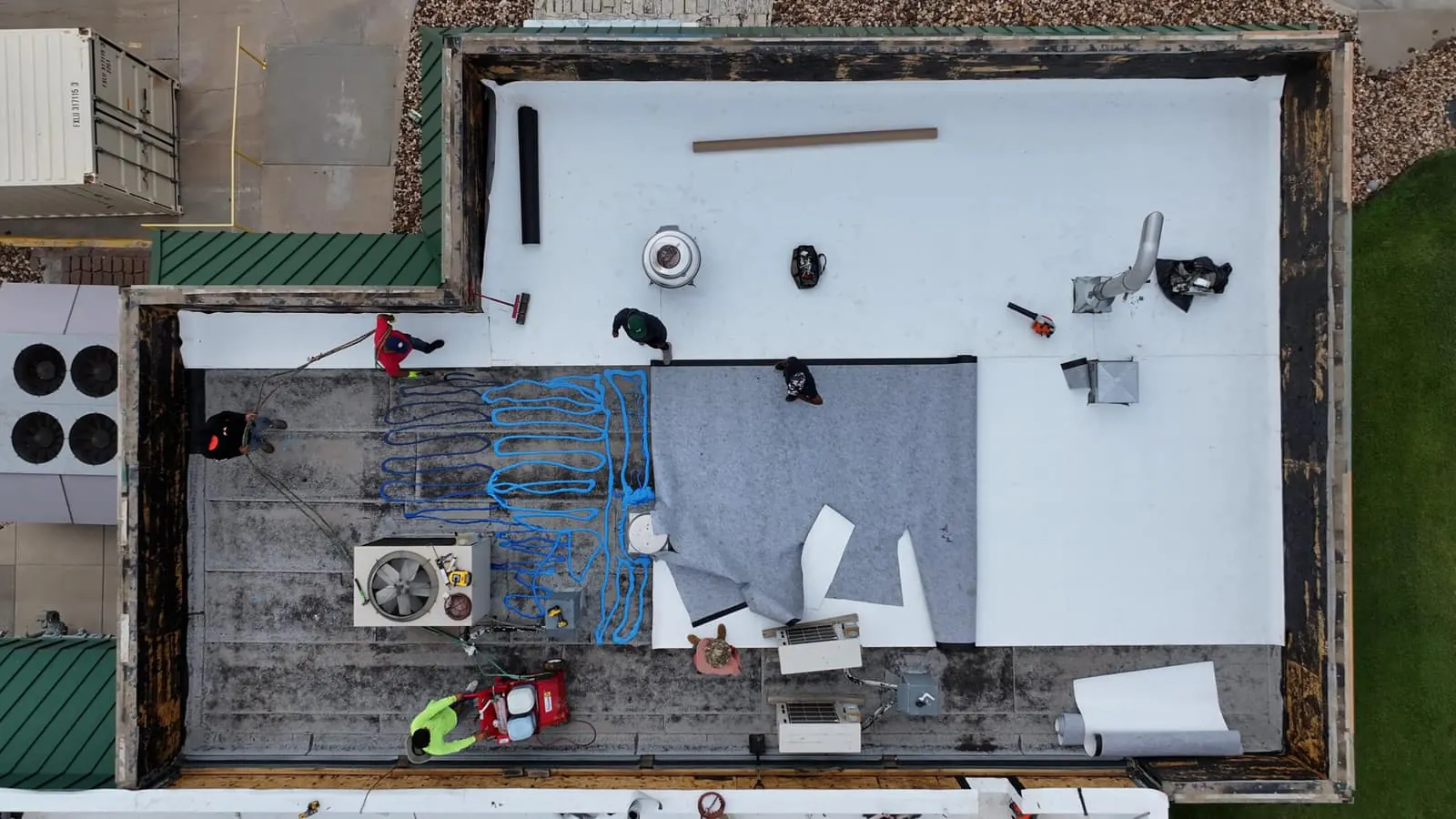
Commercial TPO roofing uses a reinforced single-ply sheet with hot-air-welded seams. Commercial Roofing Advisors helps San Antonio building owners decide whether repair or replacement makes sense and which roof details should appear in the TPO scope.
Check membrane welds across the working day
Surface temperature and wind can affect the settings for hot-air equipment. San Antonio’s climate records provide useful context for scheduling, while crews need to observe conditions on the roof itself. Have the installer make test welds under current conditions and repeat them after changes that can affect welding.
Ask for an inspection record that distinguishes long machine welds from hand-welded work. At corners and overlapping sheets, each transition needs the specified detailing and a check after the seam cools.
Carlisle SynTec test weld and seam probing procedures
Confirm attachment at exposed edges
Thermoplastic polyolefin is the membrane. Its name alone tells an owner little about how the whole assembly will perform. Specify a tested system appropriate for the building, including deck, insulation, cover board where specified and the attachment called out at the perimeter and corners.
A broad industrial roof near Port San Antonio may include canopies or low additions exposed differently from the main roof. Identify changes in height and use early so the bid captures the different edge and fastening details.
City of San Antonio overview of the Port San Antonio industrial campus
Decide what a patch can accomplish
An isolated puncture in sound TPO may be repairable with compatible material if the existing sheet can accept a sound weld. Recurring separations around several curbs or moisture beneath the membrane call for a wider look. Document the old sheets and any coating or sealant before specifying a repair that depends on welding to them.
Questions from San Antonio building owners
Can TPO be welded to PVC at a shared wall?
Treat them as different membranes. Have the roofing manufacturer or designer specify an approved transition, such as a properly flashed divider or separate terminations.
Does a thicker TPO sheet fix a wind problem?
Wind resistance depends on the tested assembly and how it connects to the structure. Check the deck, perimeter and corner attachment alongside the sheet thickness.
Can an HVAC contractor add a curb after the TPO job?
Coordinate curb construction, equipment location and flashing with the roof warrantor before the penetration is made. Keep the new detail and location with the roof records.
Will a roof under warranty still need inspection after hail?
Ask the roof warrantor how to document suspected damage and who may examine or repair it. Start with exposed flashing, scuppers and areas around rooftop equipment whenever access is safe.