
Resources
Roof lifespan statistics need to distinguish installed age, tested performance, expected service life and warranty duration. Those measures describe different stages of a roof's life. None can be substituted for a documented estimate of the time remaining on a particular building.
The EPDM Roofing Association's March 2026 research summary states an expected service life of at least 38 years for properly designed, installed and maintained EPDM membranes. It combines professional survey responses with laboratory and field evidence. That conditional estimate is not an observed national average for every EPDM roof.
This reference separates that evidence from residential age data, selected TPO investigations and commercial replacement records. It keeps the study dates and sample limits beside the findings.
Key Roof Lifespan Statistics at a Glance
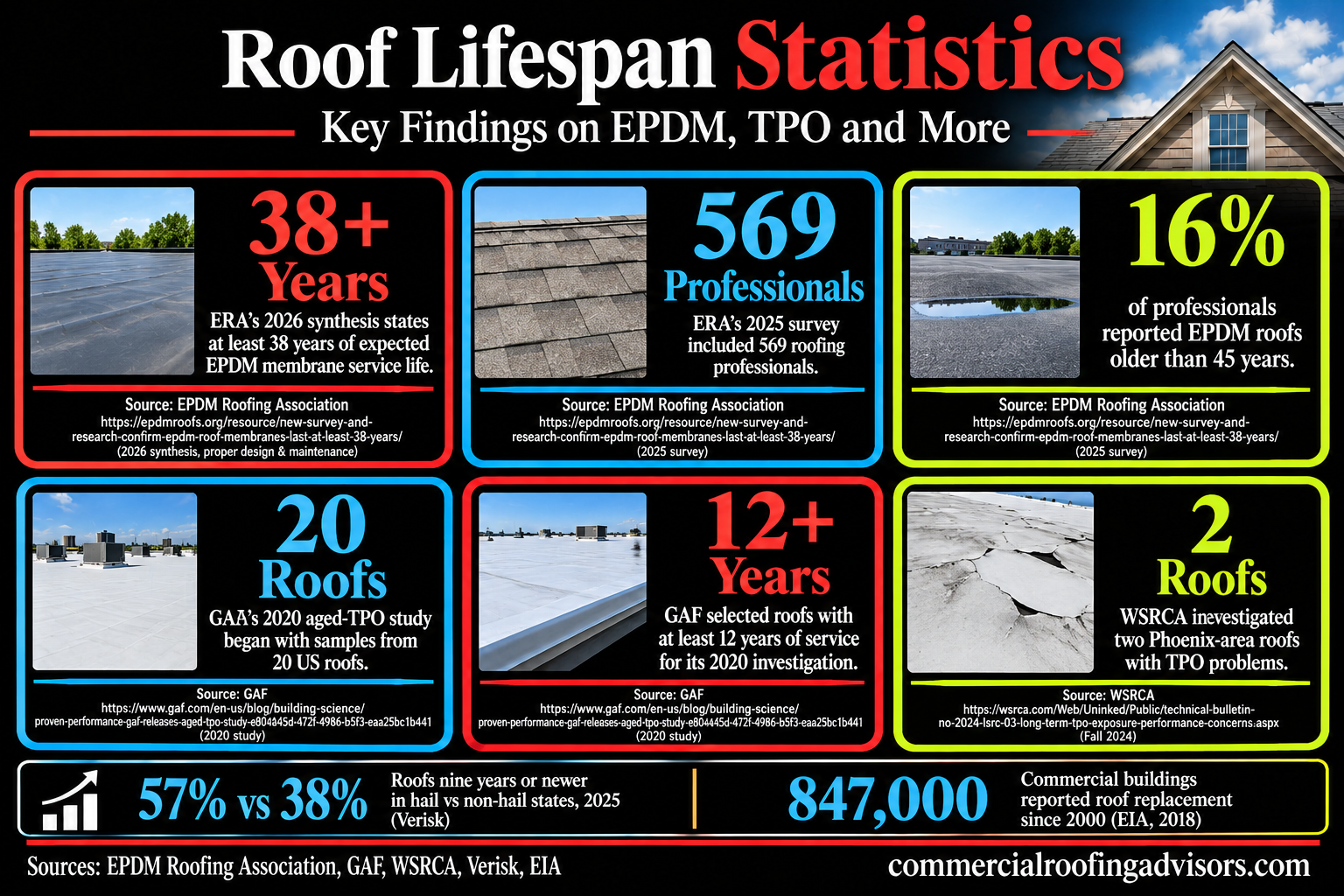
- ERA's 2026 synthesis states at least 38 years of expected EPDM membrane service life under stated design, installation and maintenance conditions. EPDM Roofing Association
- ERA's supporting 2025 survey included 569 roofing professionals. EPDM Roofing Association
- In ERA's 2025 survey, 16% of professionals reported encountering performing EPDM roofs older than 45 years. EPDM Roofing Association
- GAF's 2020 aged-TPO study began with samples from 20 US roofs. GAF's original study summary
- GAF selected roofs with at least 12 years of service for its 2020 investigation. GAF's original study summary
- WSRCA investigated two Phoenix-area roofs with reported TPO problems in its fall 2024 bulletin. WSRCA
- In Verisk's 2025 housing-stock comparison, 57% of roofs in designated hail states were nine years old or newer, compared with 38% in non-hail states. Verisk's US Roof Report
- An estimated 847,000 commercial buildings reported a roof replacement since 2000 as of the 2018 survey, in EIA Table B1.
What Lifespan Ranges Do Home-Inspection Guidelines Give?
InterNACHI's standard home-component life-expectancy chart, checked in 2026, lists 20 years for three-tab asphalt shingles and 30 years for architectural asphalt shingles.
The same undated guidance lists the following estimates under normal wear and recommended maintenance, rather than observed national averages.
| Roof covering | Guideline life in years |
|---|---|
| Metal | 40 to 80 |
| Slate | 60 to 150 |
| Modified bitumen | 20 |
| TPO | Seven to 20 |
| EPDM rubber | 15 to 25 |
Source for every row is InterNACHI's estimated life-expectancy chart, checked October 31, 2026. These are general home-inspection guidelines, not warranties or replacement deadlines.
The EPDM range in this chart differs from ERA's later, system-qualified synthesis. The two sources use different approaches and should remain labeled separately. Averaging their figures would produce a number with no study behind it.
For a specific roof, use a condition assessment and the actual product history to refine the planning range. A guidance table can prompt that review; it cannot replace it.
What Service Life Does the EPDM Research Support?
ERA's 2026 review supports an expected membrane service life of at least 38 years for properly designed, installed and maintained EPDM, according to its longevity statement.
The qualification belongs with the figure. It describes the association's synthesis of available evidence, rather than the age at which a random national sample of roofs failed.
The review brings together different forms of evidence. Field investigations test material already exposed on buildings. Laboratory aging tests examine performance under controlled conditions. Professional surveys record practitioners' experience and expectations. Agreement across those sources can support planning, but it does not turn them into a single lifetime-tracking study.
A property-specific forecast still needs the assembly's condition and maintenance history. Owners comparing EPDM roofing systems should keep those site findings separate from the material's longer-term potential.
How Many Professionals Contributed to the EPDM Survey?
ERA's 2025 survey included 569 professionals, consisting of 240 roof consultants, 150 designers and architects, 128 contractors and 51 other professionals, according to its March 2026 release.
The survey records professional experience with EPDM systems. Its question about the oldest roof a respondent has encountered is a measure of observed longevity examples. It does not tell readers the share of all roofs that survived to that age.
This distinction prevents a misleading headline. A respondent recalling an old roof contributes evidence that long service is possible. The response does not provide the full denominator of roofs installed, failed, removed or still in service.
The study is published by a trade association representing EPDM manufacturers. Readers should retain that context alongside its findings and methods.
What Did the Aged-TPO Field Study Examine?
GAF's 2020 investigation initially examined samples from 20 roofs with at least 12 years of service, according to its original study summary.
GAF's 2020 study description says the sample came from one manufacturer and was predominantly smooth-back membrane in 45-mil and 60-mil thicknesses. Owner access and availability affected selection. It covered several building uses and attachment methods, but it was not a random national survival sample.
GAF reported that the aged membranes in the study were performing well and met many requirements used for new membranes. That is useful evidence about the tested roofs. It does not establish a universal TPO replacement interval.
A roof that remains available for sampling is already a survivor. Roofs removed earlier are not represented in the same way. Any claim about average lifespan needs to account for both the surviving and removed populations.
What Did the Phoenix TPO Investigation Find?
WSRCA's fall 2024 investigation concerned two Phoenix-area roofs already reported to have problems, according to its technical bulletin.
The properties used different membrane thicknesses and underlying assemblies. WSRCA's 2024 laboratory comparisons found approximately 20% to 26% less thickness above the reinforcement in exposed material than in protected material within laps.
That finding is a comparison within the sampled roofs. It is not the percentage of all TPO roofs that fail, and it does not establish how every current product ages.
The selection issue is the reverse of a study focused on old, functioning roofs. A problem investigation helps explain a failure mechanism in the inspected assemblies. It cannot describe the national prevalence of the problem without a representative sample.
Read the TPO system guide with the proposed product and assembly in hand. Brand, formulation, thickness, attachment and detailing should remain visible in a performance discussion.
How Different Are Roof Ages in Hail and Non-Hail States?
Verisk reported 57% of roofs in designated hail states as nine years old or newer, compared with 38% in non-hail states, in its 2025 US Roof Report.
That comparison describes the age mix of the housing stock. It does not mean hail exposure extends roof life. Age distributions can reflect replacement activity, past weather events, new construction and the population included in the database.
The same Verisk report estimates that about 29% of US homes with asphalt shingles had less than four years of remaining useful roof life, using Roof Condition Score data pulled in January 2026. Remaining life in that analysis is an estimate, rather than a record of roofs that had already failed.
Residential findings should stay labeled residential. They do not give a replacement date for a warehouse, school or office roof.
How Many Commercial Buildings Reported a Roof Replacement?
EIA estimated that 847,000 commercial buildings reported a roof replacement since 2000 as of the 2018 CBECS, according to Table B1.
That is a multi-year renovation indicator. It does not say that a roof lasts 18 years, that every building was present for the full period, or that the reported event was the only replacement in the building's history.
The table cannot supply a yearly replacement probability. A building stock contains different construction dates, roof installation dates and ownership histories. Converting a count across a broad interval into an annual failure rate would require information the table does not provide.
For an owner's reserve plan, record the actual installation year for each roof section and the dates of recover, restoration and major repairs. Building age alone is an unreliable stand-in for roof age.
How Long Can a Warranty Run?
Carlisle's current warranty-submittal resources, checked for this 2026 reference, list 25-year and 30-year options for specified TPO, EPDM and PVC systems.
Those are available warranty terms subject to the relevant system requirements and documents. They are not test results showing that every roof lasts that long.
A warranty review should identify what is covered, who owes the obligation, what exclusions apply and what the owner must maintain. A product warranty and an installer workmanship warranty may cover different responsibilities.
A remaining-service-life assessment answers another question. It examines the roof as it exists now. A document issued at installation cannot show whether later damage, wet insulation or changed rooftop operations have shortened the useful period.
Turn Lifespan Evidence Into a Decision
Use lifespan research as a planning input, then test the assumption against the property. Keep membrane age, major interventions, condition observations and warranty dates as separate fields in the roof record.
Ask the evaluator to describe the evidence behind a remaining-life range and the conditions that could change it. Tie repairs and inspections to that forecast so the plan can be updated when new findings appear.
Commercial Roofing Advisors provides roof evaluations and capital planning for that process. The aim is a documented repair, restoration or replacement decision built around the assembly on the property.