
Resources
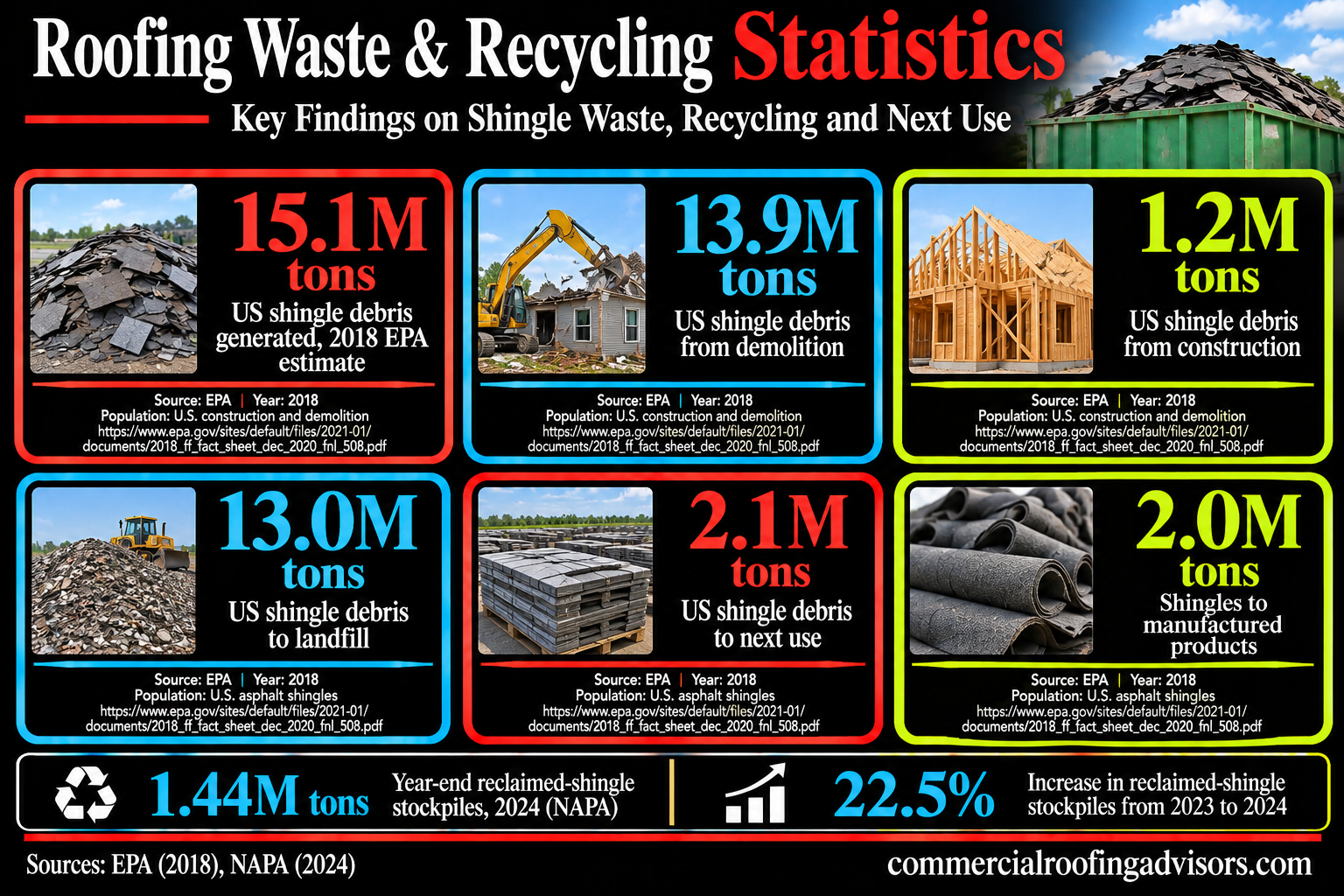
EPA estimated that US construction and demolition generated 15.1 million tons of asphalt-shingle debris in 2018. The reporting year matters. It is a national historical estimate, not a measurement of roofing waste produced in 2026.
Newer recycling surveys measure different parts of the material flow. NAPA's 2024 construction-season survey summary reports about 1.44 million tons of reclaimed asphalt shingles in year-end stockpiles. Stockpiled material is not the same as material incorporated into pavement.
The figures below distinguish generation, disposal, intended next use and inventory. That makes roofing waste statistics more useful than a single recycling percentage assembled from incompatible datasets.
Key Roofing Waste Statistics at a Glance
- EPA's 2018 tables estimate 15.1 million US short tons of asphalt-shingle debris.
- EPA's 2018 tables assign 13.9 million tons of US shingle debris to demolition.
- EPA's 2018 tables assign 1.2 million tons of US shingle debris to construction.
- EPA's 2018 tables estimate 13.0 million tons of US shingle debris went to landfill.
- EPA's 2018 tables estimate 2.1 million tons of US shingle debris went to next use.
- EPA's 2018 tables assign 2.0 million tons of shingles to manufactured-products next use.
- NAPA's 2024 survey summary estimates 1.44 million tons of reclaimed asphalt shingles stockpiled nationwide at year-end 2024.
- NAPA's 2024 survey summary reports year-end reclaimed-shingle stockpiles increased 22.5% from 2023 to 2024.
How much asphalt-shingle waste did EPA estimate?
EPA's 2018 estimate was 15.1 million tons, comprising 13.9 million from demolition and 1.2 million from construction. The agency reports US short tons.
The category is asphalt shingles, not every commercial roofing material. It should not be applied to all membranes, metal panels, insulation and other components removed during roofing work.
An owner planning a commercial replacement needs the actual assembly identified. Material names in a disposal schedule should match the materials being removed. CRA's commercial roof evaluation can help document the existing roof before the replacement scope is set.
How much went to landfill or another use?
EPA's 2018 management table assigns 13.0 million tons to landfill and 2.1 million tons to next use. Its next-use category includes several destinations rather than one closed-loop roofing process.
The table is an estimate of national material flows. It is not a certificate of recycling for an individual project. A disposal or recovery claim for a building needs records for that building's load, receiver and destination.
The distinction helps when reviewing a contractor's proposal. “Recyclable” describes a material's potential. “Accepted by a facility” describes a receiver's terms. “Recycled” describes an outcome that needs evidence.
How much reclaimed shingle material was stockpiled in 2024?
NAPA's survey summary estimates about 1.44 million tons of reclaimed asphalt shingles stockpiled at the end of 2024, up 22.5% from 2023. That figure describes inventory, rather than annual pavement use.
A stockpile can contain material received in different periods. Its size depends on both incoming material and what processors use or remove. A rising stockpile alone does not establish a rising recycling rate or a larger number of completed recycling projects.
The public NAPA summary does not provide a complete material-flow table for every roofing product. Its reclaimed asphalt shingles category should not be relabeled all roofing waste.
Why do published shingle-recycling figures differ?
The datasets cover different years and different stages of recovery. EPA's table measures 2018 generation and destinations. NAPA's public summary measures 2024 industry stockpiles.
Dividing those two quantities would not yield a defensible national recycling rate. The numerator and denominator would differ in time and meaning. A current recycling-rate claim needs a common period, compatible material definitions and a stated destination.
Historical estimates can still help describe scale. They should retain their original years instead of being rewritten as current annual totals. A page reviewed in 2026 can accurately report an older measurement when its date remains clear.
What should owners document for a roof-recycling claim?
A useful project record identifies the removed material, measured weight, receiving facility, transport documentation and the use or disposal route reported by the receiver. The owner should ask what evidence will be delivered with the completed work before relying on a diversion claim.
ARMA's recycling guidance tells readers to confirm a recycler's current acceptance requirements and capabilities. Availability should be checked for the actual project, rather than inferred from a national industry statement.
A roof replacement scope can keep removal, handling and destination requirements visible alongside the roofing work. An owner comparing proposals can then compare the same requested records, rather than a mixture of promised outcomes and general recycling claims.
Planning work with Commercial Roofing Advisors
Commercial Roofing Advisors helps owners compare repair, restoration and replacement based on roof condition. Its capital planning service connects the agreed roofing scope with the property's budget and project sequence.