
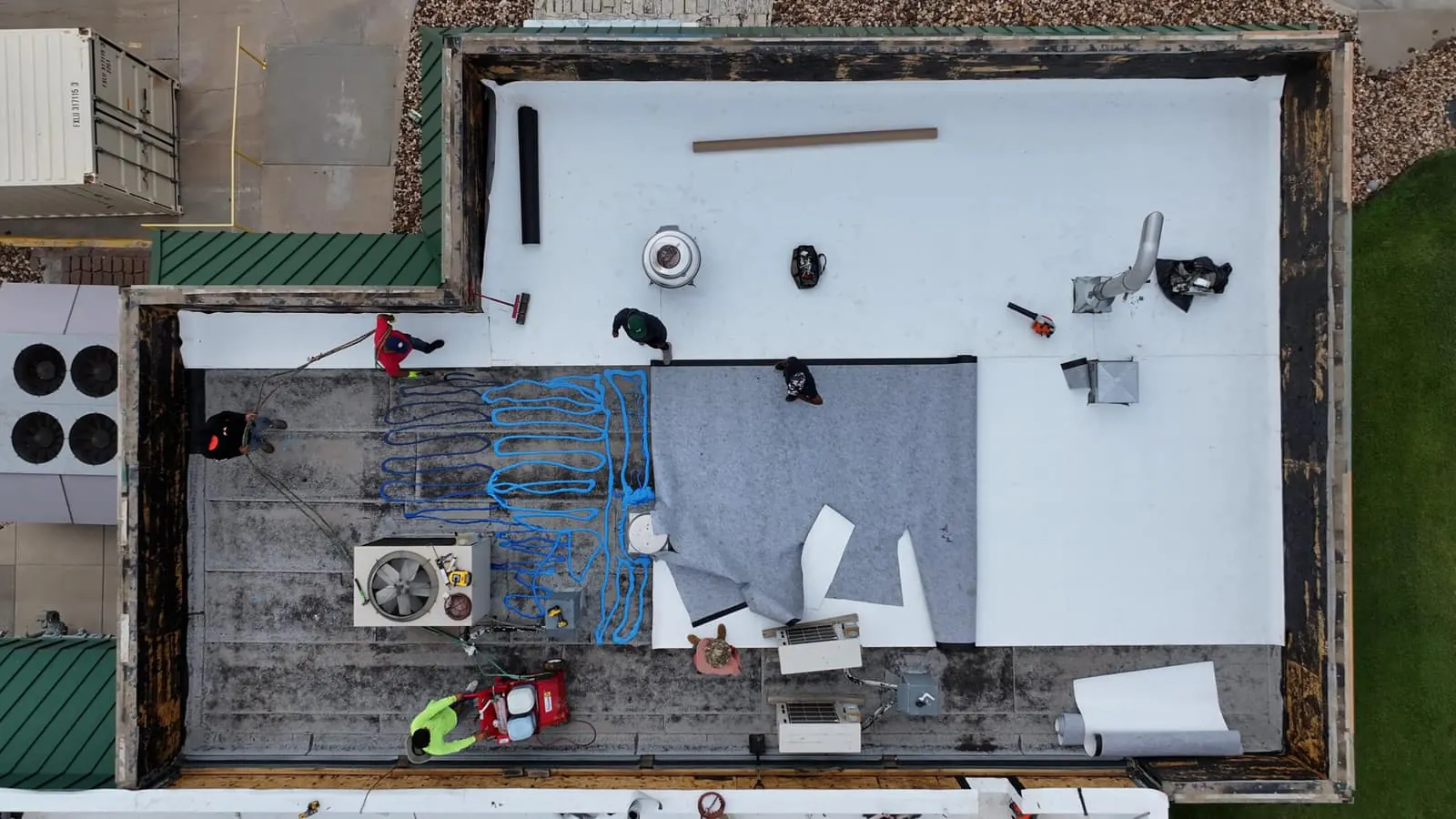
Commercial TPO roofing in Austin uses hot-air-welded sheets. When an existing membrane has pulled away from a curb or opened at a lap, Commercial Roofing Advisors helps owners determine how far that failure extends and whether a compatible repair or a new assembly makes sense.
Separate one seam defect from a larger attachment problem
Walk the seam line far enough to see what the membrane is doing on either side. Loose material around several curbs, buckled areas or movement across a large roof zone can point to a broader problem. Trace attachment and transitions before deciding how many feet of seam to repair.
On an occupied office in North Burnet/Gateway, gather plans from recent tenant fit-outs. A penetration thought to be abandoned may still serve another suite, and an old weld may be beside a new flashing detail whose installation history differs.
Austin Planning North Burnet/Gateway area
Ask for weld checks under the conditions on the roof
Specify sample welds and cooled seam checks for machine and hand work. A test at setup is useful, and conditions that affect the process, such as changes in temperature and welding speed, can call for a fresh sample.
At an existing TPO patch, confirm a trial weld on prepared material. Ask the crew to record the locations that need reinforcement, inspection at corners or different treatment where previous repairs left a coating.
Carlisle SynTec guidance on test welds and seam probing
Agree on the perimeter and material transitions
Ask for the tested assembly and how it will be fixed to the deck, including any differences at roof corners and edges. Establish the fastening pattern from the specified assembly and building conditions before crews begin.
Where the TPO roof meets a section with a different membrane, request a detail that shows how the two sides will end or transition. Address who checks the completed connection and how both sections can be serviced later.
Questions from Austin building owners
What if a TPO leak starts at the same curb after every fit-out?
Review the curb height, flashing attachment, sheet movement and records for the equipment changes. Correct the detail sending water under the roof before deciding to weld a larger patch.
Can a TPO surface take new flashing after an old coating repair?
The proposed weld needs clean, sound material. Have the installer test the prepared surface and check compatibility with the manufacturer's approved repair details.
Who should check a TPO weld around small penetrations?
Name the responsible installer or inspector before work starts. Have them verify the cooled seams at the hand-welded boots and corners, where machine weld records alone offer little detail.