Roof Systems
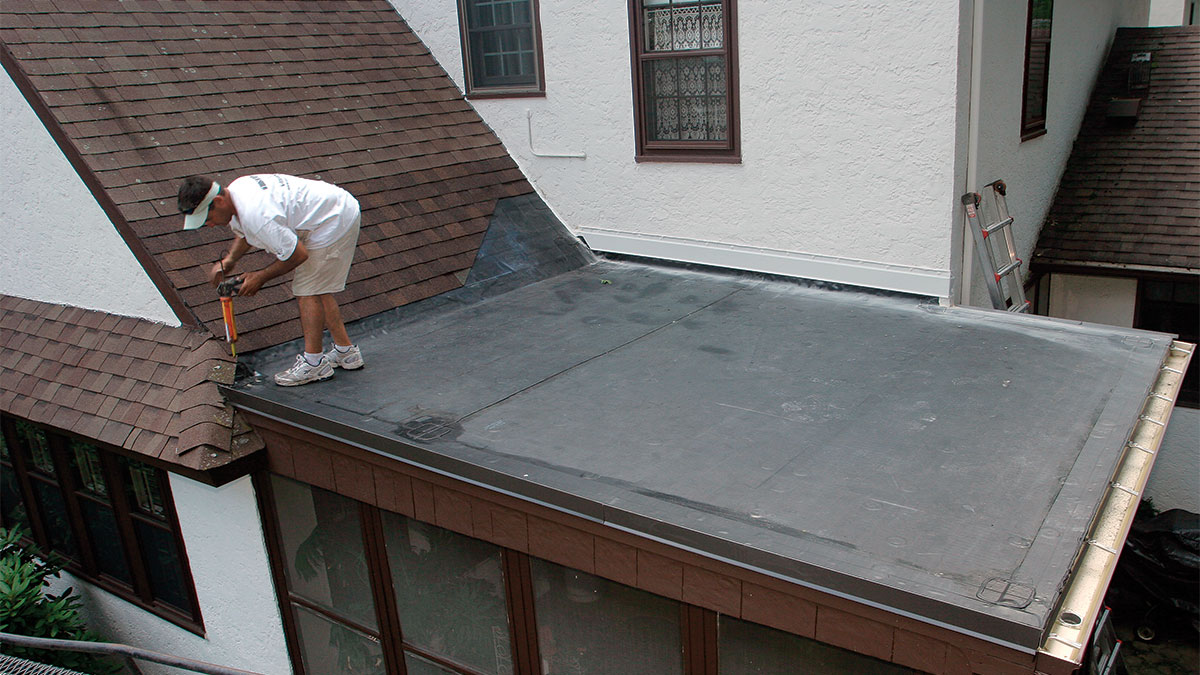
EPDM, the black synthetic rubber membrane that has covered low-slope commercial roofs for decades, is the workhorse of the single-ply world. It lacks the reflective brightness of welded membranes and the marketing energy that surrounds newer products, but it brings something those systems are still earning: a long, well-documented field history. As owner-side advisors, we find EPDM is often underrated by owners chasing newer chemistries, and our job is to give it a fair, clear-eyed hearing.
What EPDM Is and How It's Built
EPDM stands for ethylene propylene diene monomer, a synthetic rubber engineered for weathering and elasticity. It is produced in large sheets, most familiarly in black, though a white-surfaced version exists, and it is installed over insulation and attached to the deck in one of three ways: fully adhered with bonding adhesive, mechanically fastened, or held down with ballast such as river rock or pavers. Because the sheets come in very wide rolls, EPDM can cover large roof planes with relatively few field seams.
Unlike thermoplastic membranes, EPDM is a thermoset material and cannot be heat-welded. Its seams are joined with seam tape or adhesives, and this is the defining characteristic an owner must understand. The membrane itself is exceptionally durable and forgiving, but the seams are the historical and ongoing point of vulnerability, which is why modern factory-applied tape systems and skilled detailing matter so much.
Lifespan and Performance
EPDM has one of the longest and best-documented service records in commercial roofing, with well-installed systems commonly delivering 20 to 30 years and many original installations exceeding that. The rubber membrane is highly resistant to UV degradation, ozone, and weathering, and it remains flexible across an exceptionally wide temperature range. That flexibility is EPDM's standout performance trait, particularly its ability to stay supple and stable in deep cold where other membranes stiffen.
The performance tradeoff is thermal. The traditional black surface absorbs solar heat rather than reflecting it, which raises rooftop and membrane temperatures and can increase cooling loads in hot climates. In cold, heating-dominated regions that heat absorption can actually be a modest benefit, which is one reason EPDM's geographic fit differs from reflective membranes.
Where EPDM Fits Best
EPDM's strengths line up cleanly with certain buildings and climates, and recognizing that fit is half of specifying it well.
- Cold and heating-dominated climates, where its cold-weather flexibility and heat absorption are assets
- Large, simple roof planes with few penetrations, where wide sheets minimize seams
- Owners prioritizing proven longevity and lower installed cost over reflectivity
- Buildings where a forgiving, repairable membrane is valued over a welded one
- Ballasted applications on structurally capable decks seeking economical, durable cover
EPDM is a weaker fit for hot, cooling-dominated climates seeking energy savings, for roofs with grease or solvent exposure that degrades rubber, and for highly complex roofs where numerous taped details multiply the seam risk.
Strengths and Limitations for an Owner
The honest owner-side ledger for EPDM is shaped by its maturity: most of its surprises are already known.
- Strength: Decades of proven field performance and a well-understood aging curve.
- Strength: Excellent UV, ozone, and weathering resistance with long flexible life.
- Strength: Superior cold-weather flexibility compared with most membranes.
- Strength: Generally lower installed cost and straightforward, repairable detailing.
- Limitation: Taped or adhered seams are the primary failure point and depend on installation quality and aging adhesives.
- Limitation: Black surface absorbs heat, raising cooling loads in hot climates.
- Limitation: Vulnerable to damage from petroleum, grease, and solvents.
- Limitation: Punctures from traffic or debris require timely patching, though repairs are simple.
Warranty and Maintenance Realities
EPDM is commonly offered with manufacturer warranties in the 20 to 30 year range, typically tiered by membrane thickness and contingent on certified installation and periodic inspection. As with every roofing warranty, scrutinize whether coverage is material-only or includes labor, and note the exclusions for ponding water, traffic damage, and unauthorized modifications. Because EPDM's risk concentrates at the seams, a warranty that requires and documents inspections is working in your favor.
Maintenance for EPDM centers on the seams and details. Inspect taped seams, flashings, and penetrations at least twice a year and after storms, watch for any lifting or aging at seam edges, and keep petroleum products and grease off the membrane. The good news for owners is that EPDM is among the easiest membranes to repair: a clean patch over a puncture or a re-detailed seam is well within a competent roofer's routine, so small problems caught early stay small.
How We Advise Owners Evaluating EPDM
When owners ask whether EPDM is dated or simply dependable, our answer leans toward dependable, with conditions. We favor EPDM where its proven life and cold-weather performance match the climate, and where the roof is simple enough that seam count stays low. In hot, cooling-driven markets we either steer toward a reflective membrane or specify a white EPDM or coating and run the energy numbers so the decision is made on data, not habit.
Above all, because EPDM lives or dies at its seams, we weight installer skill and the seam system heavily and insist on documented inspection from day one. For the right building, EPDM remains one of the most cost-effective, long-lived, and forgiving roofs an owner can choose, a quiet performer whose track record speaks louder than any sales pitch. Our role is to make sure it is specified into the conditions where that track record holds.
Put the system choice into an owner decision
Before approving a roof system, align field condition, moisture findings, drainage, attachment, warranty terms, operational constraints, and hold period. Commercial Roofing Advisors can review those inputs without tying the recommendation to one material or contractor.