Code & Ratings
Hail is one of the few perils that can take a sound commercial roof from fully serviceable to a total loss in a single afternoon, and it is also one of the most contested at claim time. Impact and hail resistance ratings exist to give owners, insurers, and code officials a common language for how a roof assembly is likely to perform when stones strike it. For a building owner, these ratings are not academic. They influence which systems you should specify in hail-exposed markets, how an insurer prices and underwrites your roof, and whether a future claim is paid as a repair, a partial replacement, or denied as cosmetic. We help owners read these ratings correctly and put them to work in specification and risk decisions.
What Impact Ratings Actually Measure
Impact resistance ratings describe how a roofing material or assembly responds to a controlled striking force, meant to simulate hail or falling debris. The two frameworks owners encounter most are the steep-slope impact classification used for products like shingles and certain membranes, and the property-insurer-driven testing tied to underwriters such as FM Global. The steep-slope classification assigns products to ascending impact classes, with the highest class representing the greatest resistance to cracking or fracture under a standardized steel-ball or ice-ball impact.
It is important to understand what these tests do and do not prove. A rating confirms that a representative sample survived a defined impact under laboratory conditions. It does not guarantee a given roof will be undamaged by a specific storm, because real hail varies in size, density, velocity, and angle, and an aged roof is not the same as a fresh test coupon. Treat a high rating as a meaningful reduction in expected damage, not as immunity.
How Low-Slope Commercial Assemblies Achieve Resistance
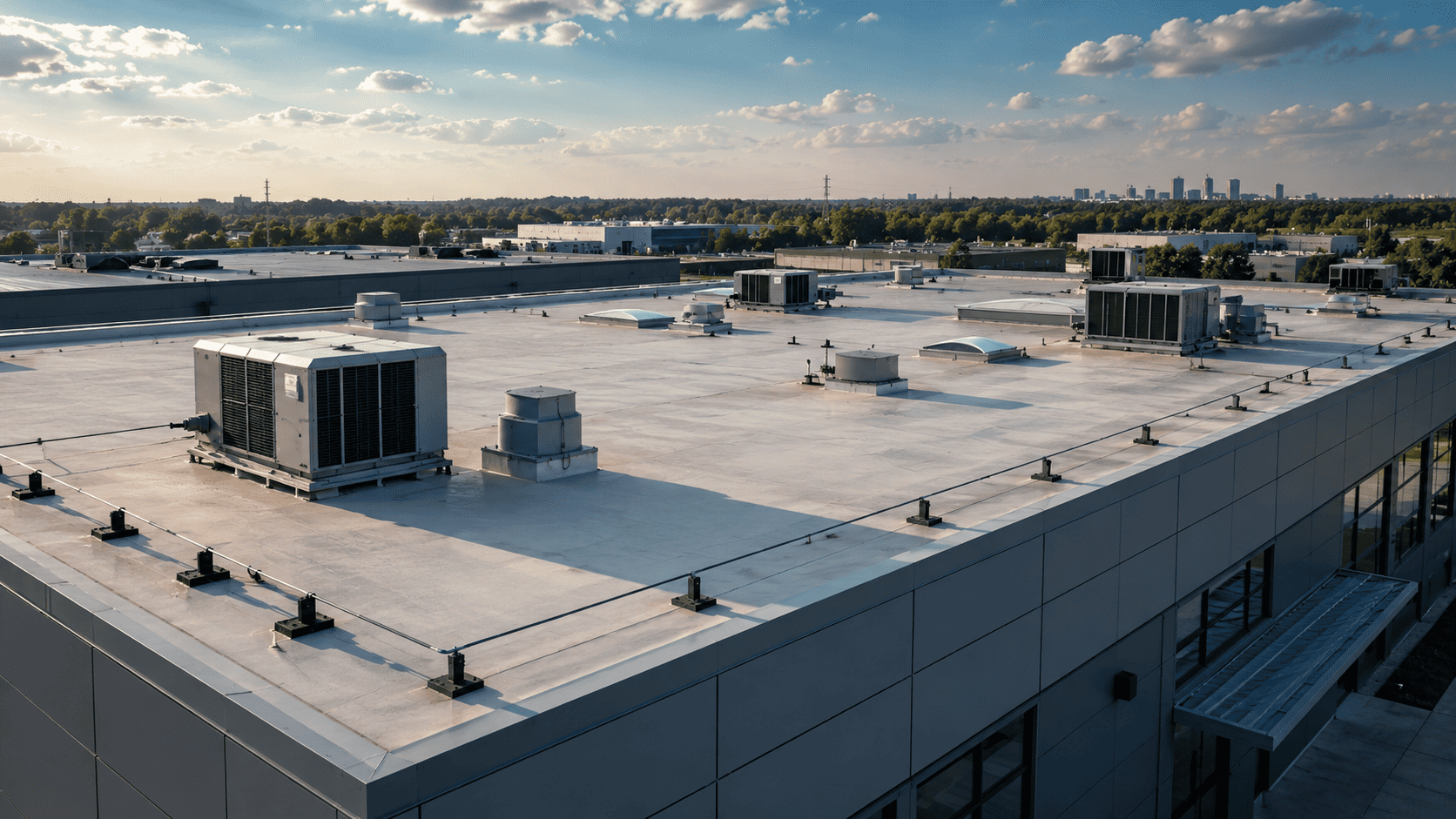
Most commercial buildings have low-slope roofs, where hail performance is a property of the whole assembly rather than a single product. Membrane type, thickness, the insulation and cover board beneath it, and how the system is attached all contribute. A thicker membrane over a dense cover board resists puncture and the fracturing of the substrate far better than a thin membrane laid directly over soft insulation.
Owners specifying for hail-prone regions typically weigh several assembly choices that improve impact performance:
- Thicker membranes, which carry more reserve against puncture and surface fracture.
- A high-density cover board between insulation and membrane, which spreads impact energy and resists denting of the substrate.
- Modified bitumen or built-up systems with granular or reinforced surfacing, which tolerate repeated minor impacts.
- Ballasted or protected-membrane configurations, where pavers or aggregate shield the waterproofing layer.
- Fully adhered attachment over mechanically fastened systems in some cases, reducing flutter that can aggravate damage.
FM Global and similar property-insurer testing rates assemblies for severe-hail and very-severe-hail exposure, and many insured portfolios in hail belts are effectively required to meet a defined exposure level. We advise owners to specify to the insurer's expected exposure class, not merely to code minimum, because the gap is often paid back in lower deductibles and cleaner claims.
Where Higher Ratings Are Required or Rewarded
Few building codes mandate a specific hail rating the way they mandate wind or fire performance, but the requirement frequently arrives through insurance and lender conditions instead. Carriers writing property in the hail-prone corridor of the central United States routinely attach roof requirements, separate wind-and-hail deductibles, or cosmetic-damage exclusions to their terms. Lenders and REIT asset managers often impose their own minimum assembly standards across a portfolio to control loss volatility.
The practical signal for an owner is that in a hail-exposed market, the rating is rarely optional in economic terms. You may be free to install a lower-rated system, but you will pay for it through higher premiums, larger deductibles, exclusion language, or reduced recovery when a storm hits.
The Insurance Implications Owners Miss
Hail is where roofing meets the fine print of a property policy. Three mechanics decide whether a rated roof actually protects your balance sheet:
- Separate wind/hail deductibles, often a percentage of insured value rather than a flat dollar amount, which can be far larger than owners assume on a big building.
- Cosmetic-damage exclusions, which let a carrier decline payment for dents and bruising on metal or membrane that do not breach watertightness.
- Actual cash value versus replacement cost settlement on aging roofs, where depreciation can gut the recovery on an older but still-rated system.
A higher-rated assembly helps on the loss-frequency side by surviving more storms intact, and it strengthens your negotiating position when a carrier argues damage is cosmetic. But the rating does not override deductible structure or settlement basis. Owners who pair a strong assembly with a clear understanding of their policy language recover far more reliably than those who assume the rating alone carries them.
Capital Planning Around Hail Exposure
For a portfolio in a hail belt, roofs are a recurring capital exposure, not a one-time install. The smart posture is to standardize on assemblies rated to your carrier's expected exposure, document the rating and installation for every roof, and budget for the deductible you would actually face after a regional storm event. A modest upcharge for a thicker membrane and a real cover board is small against the deductible and downtime of a hail loss, and it improves insurability at renewal.
We also encourage owners to retain the submittal data, product approvals, and as-built records that prove the rating of each roof, because that documentation is exactly what a carrier or adjuster will ask for when a claim is filed.
How We Advise Owners on Impact and Hail Ratings
Working owner-side, we translate impact and hail ratings into specification and risk decisions rather than leaving them buried in a product cut sheet. We review your hail exposure and insurance terms, recommend assemblies rated to the exposure class your carrier expects, and pressure-test pricing so you are not paying for resistance you do not need or skimping where a storm will find the gap. When a claim arises, we help you read deductible structure, cosmetic exclusions, and settlement basis so you understand what recovery to expect. Our role is to make the rating do real work for your buildings, not just appear on a warranty.