
Regional Guide
The Mid-Atlantic asks a commercial roof to be good at everything. A building in Philadelphia, Baltimore, Northern Virginia, or the Jersey shore lives through hot, humid summers, coastal nor'easters, cold but not extreme winters, and a long shoulder season of repeated freeze and thaw. None of these forces is as singular as desert heat or Gulf hurricanes, but the combination is relentless, and it punishes roofs that were specified for one season and ignored the rest. We advise building owners, REITs, and facility executives on how to specify, inspect, and budget for roofs that handle the region's full range, and this guide lays out what we tell them.
The stressors that actually drive failure here
Mid-Atlantic roof failures rarely come from a single catastrophe. They come from the accumulation of mixed-season stress, with moisture as the common thread. These are the forces we plan around.
- Nor'easters and coastal storms, which combine sustained high winds with heavy, wind-driven rain that finds any weakness in flashings, terminations, and edge metal.
- High summer humidity, which drives condensation inside under-insulated or poorly vented assemblies and accelerates organic growth and surface degradation.
- Freeze-thaw cycling, which is especially active here because temperatures hover around freezing for much of winter, working water into seams and masonry and expanding it repeatedly.
- Wide seasonal temperature range, which expands and contracts the assembly and fatigues seams, fasteners, and sealant joints over time.
- Heavy, wet snow and ice loading, which adds weight and, when it melts unevenly, produces ponding and ice damming at drains and parapets.
- Salt exposure near the coast, which corrodes fasteners, edge metal, and rooftop equipment faster than inland conditions.
Which systems and details hold up
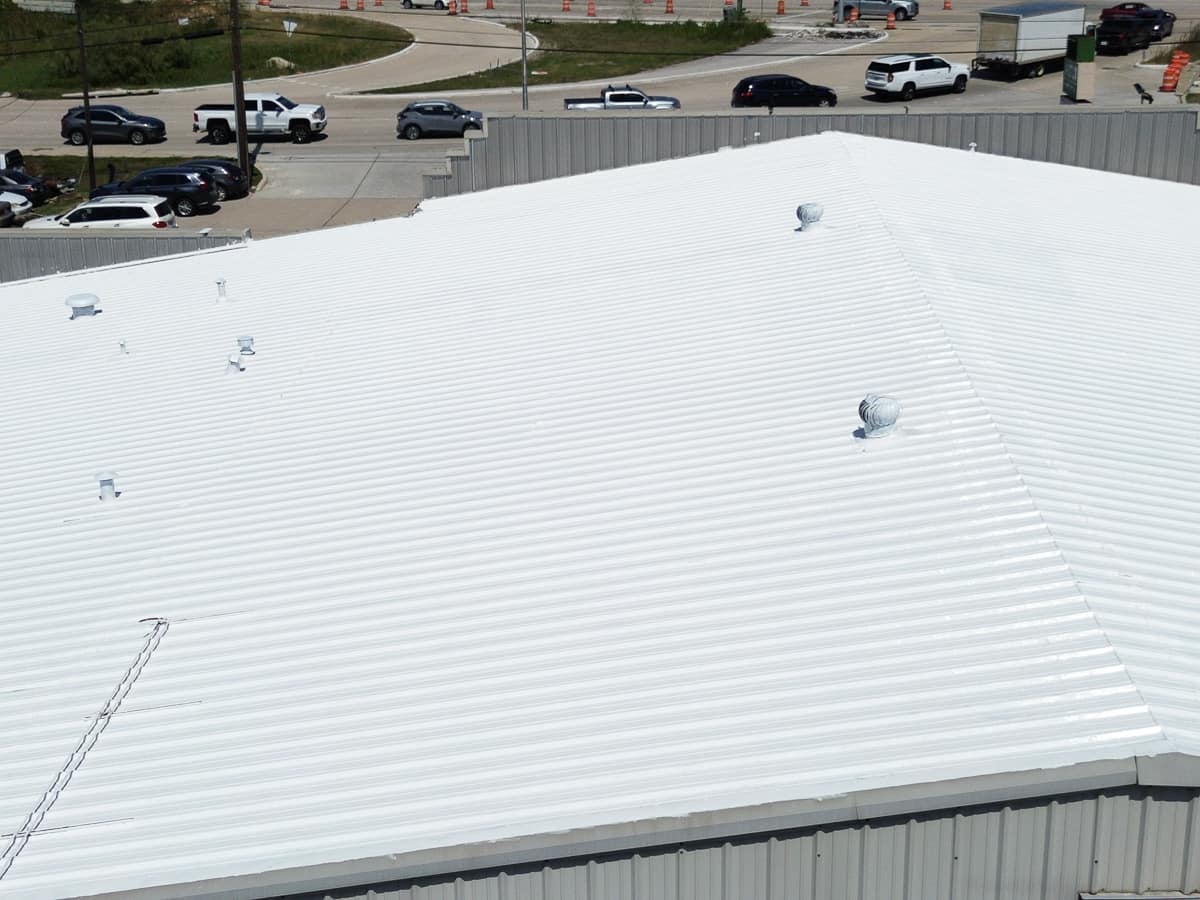
Because moisture and wind are the dominant threats, the systems that perform best here are the ones detailed tightly at every seam and edge. Single-ply membranes such as TPO, PVC, and EPDM all serve the region well when specified at adequate thickness and installed by crews who weld or seam them correctly. PVC earns a place on roofs with chemical or grease exposure, such as restaurants and certain manufacturing, where it outlasts other membranes. Reflective white TPO and PVC reduce summer cooling load, which matters during the region's humid heat, while EPDM brings a long cold-climate track record and easy thermal tolerance.
For wind, we specify systems detailed for the building's actual exposure, with enhanced fastening at perimeters and corners where nor'easter uplift concentrates, and well-secured two-piece coping and edge metal because wind and wind-driven rain attack the perimeter first. A cover board beneath the membrane adds puncture and impact resistance and improves the wind rating of the assembly. Where moisture is the concern, a properly designed vapor strategy and adequate, dry insulation prevent the condensation that quietly soaks a deck from the inside. Positive drainage is non-negotiable: the Mid-Atlantic's freeze-thaw means standing water is not just a nuisance but a freeze risk at every drain and low spot.
Inspection cadence for this climate
We advise a twice-yearly baseline. A spring inspection catches the damage winter's freeze-thaw and ice loading leave behind: split seams, cracked sealants, spalled masonry, backed-out fasteners, and clogged or ponding drains. A fall inspection confirms the roof is watertight and drains are clear before winter and before nor'easter season concentrates wind-driven rain on the assembly.
Major storms warrant their own inspection regardless of the calendar. After a nor'easter or high-wind event, we recommend a documented survey of perimeters, flashings, and equipment curbs, with dated photographs, because wind damage is often subtle and insurance claims carry filing windows. Given the region's humidity, we also advise periodic infrared or moisture scanning on flat membranes every few years to locate wet insulation before it spreads, since trapped moisture here can persist and migrate rather than dry out. Keeping every report on file builds the paper trail that protects both the asset and any future claim.
Capital-planning implications
Mid-Atlantic roofs tend to age steadily rather than fail suddenly, which is good news for planning but bad news for owners who let small problems compound. A well-detailed commercial membrane in this climate commonly delivers a usable service life in the range of twenty to thirty years, but that range assumes the roof is kept drained, sealed, and dry inside. Moisture intrusion that goes unaddressed can cut years off a roof and turn a flashing repair into a deck replacement.
We advise owners to reserve against condition and exposure, not age alone. A coastal roof taking salt and nor'easter wind ages faster than an inland roof of the same membrane, and its reserve should reflect that. Where a roof is sound but aging and the substrate is verified dry, a restoration coating can extend service life and defer capital replacement, which is often a strong move in this region precisely because the climate is moderate enough for a good coating to perform. The discipline is confirming, through inspection, that the seams are intact and the insulation is dry before committing coating dollars, so the spend buys real life rather than covering a wet roof.
How we advise owners here
We work owner-side and do not install roofs, so our guidance is shaped by the building's interest rather than a crew's schedule. In the Mid-Atlantic that independence helps owners avoid two common mistakes: deferring moisture problems because the leak has not reached a tenant yet, and over-replacing a roof that a sound coating or targeted repair could carry for years. We help owners read condition, exposure, and moisture together so the decision matches the roof's actual state.
Our work also covers the documentation and warranty side that the region's storm activity makes essential. After a nor'easter we make sure damage is captured in time to claim it. During acquisition due diligence we assess a roof's age, condition, drainage, and coastal exposure so a buyer prices the asset accurately and is not surprised by hidden wet insulation after closing. And across a portfolio we standardize inspection cadence, moisture scanning, and reserve assumptions so coastal and inland roofs are each funded for the exposure they actually carry. The Mid-Atlantic does not break roofs in one blow. It wears them down in a hundred small ways, and our job is to make sure each roof an owner holds is specified, watched, and funded to outlast that wear.