
Roof Systems
Thermoplastic polyolefin, or TPO, has become one of the most specified single-ply membranes for low-slope commercial buildings, and for good reason: it is reflective, weldable, and competitively priced. But "popular" is not the same as "right for your roof." As advisors who sit on the owner's side of the table, our job is to help you understand what TPO actually is, where it earns its reputation, and where the real-world tradeoffs live before you commit capital to it.
What TPO Is and How It's Built
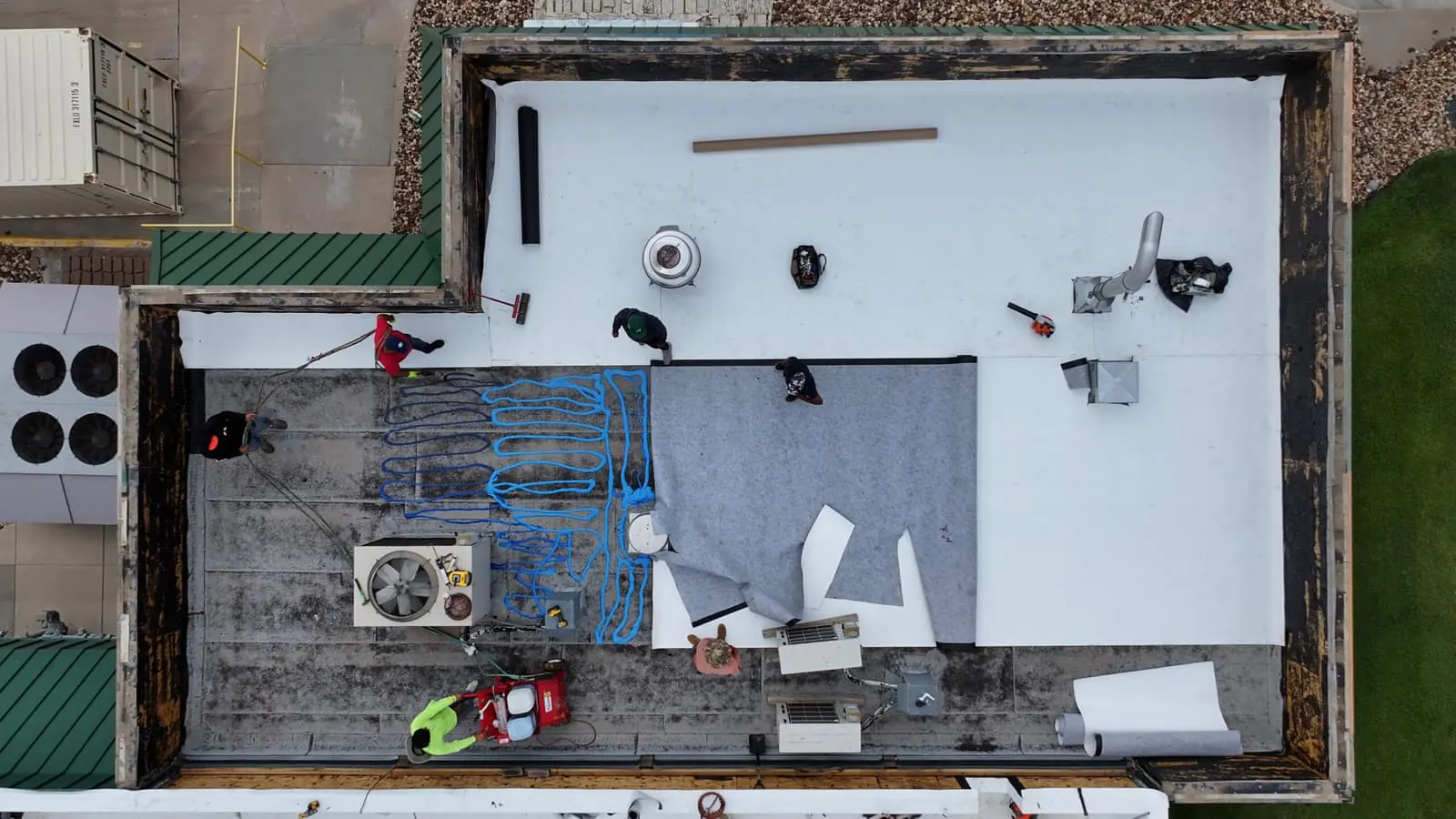
TPO is a single-ply thermoplastic membrane manufactured from a blend of polypropylene and ethylene-propylene rubber, with a polyester scrim reinforcement layer sandwiched in the middle for tensile strength. It typically arrives in wide rolls and is installed over insulation and a cover board, then attached to the deck by mechanical fasteners, adhesive (fully adhered), or a ballast system. The defining characteristic is the seam: because the material is thermoplastic, adjacent sheets are joined with hot-air welding rather than tape or adhesive, creating a continuous, monolithic bond that is generally as strong as the membrane itself.
Membrane thickness matters more than most owners realize. TPO is commonly sold in 45, 60, and 80 mil thicknesses, and the thickness above the scrim, the weathering layer, is what determines how long the surface resists UV and abrasion. Two roofs that look identical on day one can age very differently if one was specified at 45 mil and the other at 80.
Lifespan and Performance
A properly installed TPO roof of adequate thickness typically delivers a service life in the range of 15 to 25 years, with thicker membranes and well-maintained roofs landing at the higher end. TPO's signature performance trait is reflectivity: the bright white surface reflects a large share of solar radiation, which can meaningfully reduce cooling loads on a single-story building with significant roof area and air-conditioned interior space. In cooling-dominated climates, that energy benefit is real and measurable on a utility bill.
Performance is closely tied to formulation, and this is where buyer caution is warranted. TPO is a relatively younger chemistry than other membranes, and manufacturers have revised their formulations over the years to improve weathering. The practical implication is that the brand and product line you choose, and its track record, matter as much as the membrane type itself.
Where TPO Fits Best
TPO is a strong candidate for large-footprint, low-slope buildings where reflectivity pays off and budgets are disciplined. Distribution centers, big-box retail, warehouses, and many office and institutional buildings are natural fits. It is most compelling in:
- Cooling-dominated and mixed climates, where the reflective surface reduces summer heat gain
- Large open roof planes with few penetrations, where wide rolls and welded seams install quickly
- Budget-sensitive projects that still want a heat-welded, fully bondable membrane
- Buildings pursuing energy code or reflectivity credit targets
It is a weaker fit for roofs with heavy grease or chemical exhaust, extensive rooftop traffic, or complex geometry with many penetrations, where a more chemically resistant or detail-friendly system may serve better.
Strengths and Limitations for an Owner
The honest case for and against TPO comes down to a handful of tradeoffs that you, not the contractor, will live with over the asset's hold period.
- Strength: Heat-welded seams create a continuous, reliable watertight bond when welded correctly.
- Strength: High solar reflectivity lowers cooling costs and rooftop temperatures.
- Strength: Competitive material and labor cost relative to other welded single-plies.
- Limitation: Weld quality is entirely installer-dependent; a poorly trained crew produces cold welds that fail prematurely.
- Limitation: Formulation history means long-term aging data is less settled than for older membranes.
- Limitation: Thinner membranes are vulnerable to punctures from foot traffic, hail, and debris.
- Limitation: Once the weathering layer erodes, the membrane can craze and crack, and surface repairs become difficult.
Warranty and Maintenance Realities
TPO is commonly offered with manufacturer warranties in the 15 to 30 year range, often tiered by membrane thickness and whether the installer is a certified applicator. Read these documents closely. Many are material-only or carry significant exclusions, and the longer terms usually require the thickest membrane plus a certified contractor and registered inspections. A warranty is a conditional promise, not a maintenance plan, and it will not cover damage from neglect, ponding water, or unauthorized rooftop work.
Maintenance for TPO is straightforward but non-negotiable. Seams and flashings should be inspected at least twice a year and after major storms, debris should be cleared so the reflective surface keeps working, and any new rooftop equipment or penetrations should be flashed by a qualified contractor to preserve the warranty. Catching a separated seam early is the difference between a minor weld repair and a saturated insulation deck.
How We Advise Owners Evaluating TPO
When an owner asks us whether TPO is the right call, we steer the conversation away from the membrane label and toward the specifics. We push for an adequate membrane thickness, typically 60 mil or greater for roofs that will see any traffic, because the marginal cost is small against the service-life gain. We weigh the installer's welding credentials and references as heavily as the price, since TPO's performance is made or unmade on the deck. And we model the energy savings honestly against your climate and HVAC profile rather than assuming the reflective benefit applies everywhere.
Used in the right building, with a thick enough membrane and a crew that can weld, TPO is a sound, cost-effective choice that will serve an owner well for two decades or more. Specified thin and installed casually, it is a roof that disappoints on a schedule. Our role is to make sure you land on the right side of that line.
Put the system choice into an owner decision
Before approving a roof system, align field condition, moisture findings, drainage, attachment, warranty terms, operational constraints, and hold period. Commercial Roofing Advisors can review those inputs without tying the recommendation to one material or contractor.