
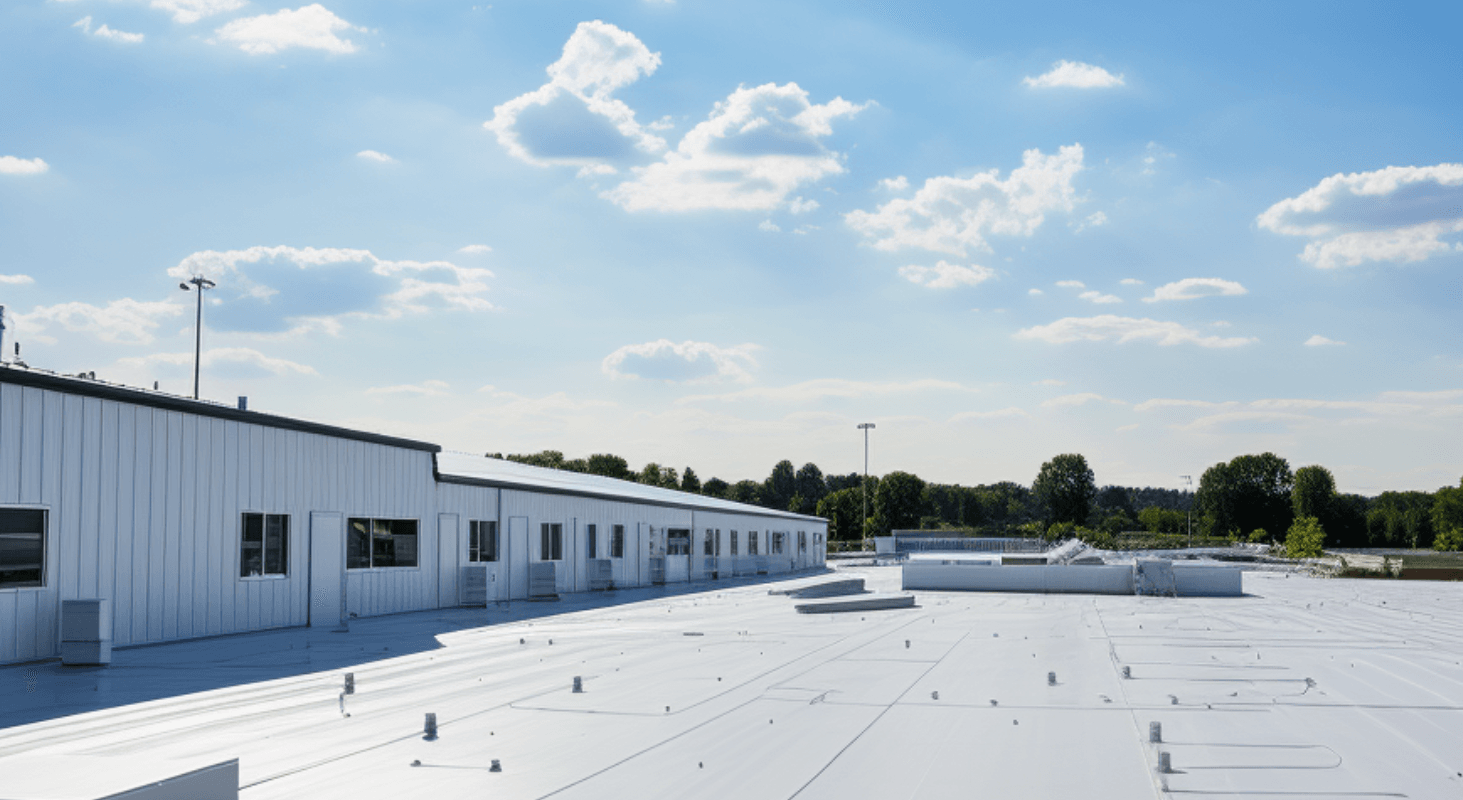
Rooftop Equipment
On most commercial buildings the single largest source of preventable roof damage is not weather. It is the equipment sitting on the roof and the people who service it. Rooftop units, refrigerant lines, kitchen exhaust fans, satellite mounts, and the foot traffic they generate concentrate stress in exactly the places a membrane is least able to absorb it. We see the pattern repeatedly across portfolios: a roof system with a decade of warranty life remaining fails early, not because the membrane wore out, but because the equipment on top of it was never coordinated with the roof below it. For owners, this is one of the few major roof risks that is almost entirely controllable through documentation and discipline.
Why Equipment Is the Roof's Worst Neighbor
A roof membrane is engineered to handle weather, thermal cycling, and ponding within design limits. It is not engineered to handle a refrigerant technician dragging a tank across a TPO field in July, or a condensate line discharging acidic water onto the same square foot of EPDM for years. Equipment introduces three damage mechanisms a weather-driven roof never sees: point loading, chemical attack, and uncoordinated penetrations. Each one defeats the membrane locally while the surrounding roof looks pristine, which is why these failures are so often missed until water is already inside the building.
The economics are unforgiving. A rooftop unit replacement is a mechanical project that rarely accounts for the roof it sits on. The crane sets the new unit, the curb is reused or modified, and the membrane around the curb is left torn, the old flashing is left unsealed, and no one inspects it because the HVAC scope ended at the unit. The roof now has a defect with no owner of record, and the roofing warranty almost certainly does not cover damage caused by another trade.
The Failure Points We Look For First
When we assess a roof with significant rooftop mechanical equipment, certain locations carry nearly all the risk. These are the spots that justify close inspection on every visit, and the ones that belong in any condition report with photographs and dates:
- Curb flashings on packaged rooftop units, where reused curbs and failed termination bars are the most common leak origin
- Condensate discharge points, where chronic acidic water erodes coatings and stains and softens membrane over time
- Refrigerant and gas line sets, especially where unblocked pipe runs sit directly on the membrane and abrade it with thermal movement
- Walkways and unprotected service paths between the roof hatch and the equipment, where repeated foot traffic punctures and compresses insulation
- Disconnects, conduit, and electrical penetrations sealed with deteriorated pourable sealer pockets rather than proper flashing
- Exhaust fans and grease-laden kitchen ductwork, where grease degrades single-ply membranes and BUR alike
Foot Traffic Is a Roof System, Not an Afterthought
Service traffic deserves its own line in any equipment-damage discussion because it is the most underestimated. Every quarter a chiller is serviced, a filter is changed, or a unit is diagnosed, and someone walks the same route across the membrane carrying tools and parts. Without walk pads, that path compresses the insulation, fatigues the membrane, and on a mechanically attached single-ply roof can work the fasteners loose. The damage is cumulative and invisible until a seam splits or a fastener backs out and tents the membrane.
Protected walkways from the roof hatch to every serviceable unit are inexpensive relative to the membrane they protect, and they materially reduce premature failure. On TPO and PVC roofs we look for factory walk pad rolls heat-welded down; on EPDM, bonded walkway sections; on modified bitumen, granulated traffic pads. Where these are absent and equipment is heavily serviced, we treat the roof as having an accelerated wear timeline regardless of its nominal age.
Coordinating Equipment Work With Roof Warranty
Most manufacturer membrane warranties contain language that voids coverage where damage results from work by other trades or from alterations made without the manufacturer's involvement. This is the trap that catches owners. An HVAC contractor sets a new unit, the membrane is cut and poorly reflashed, and the building owner only learns the warranty is compromised when a claim is denied. The fix is procedural and entirely within the owner's control:
- Require that any rooftop equipment work that disturbs the membrane be flashed back in by a manufacturer-approved roofing contractor, not the mechanical trade
- Obtain photo documentation of the roof condition before and after every equipment project, dated and filed against the asset
- Notify the membrane manufacturer of penetrations or curb modifications so warranty status is preserved in writing
- Confirm the roofing repair is added to the warranty record rather than left as an undocumented field patch
What Belongs in the Owner's Record
Equipment damage is a documentation problem before it is a leak problem. The owners who avoid premature roof replacement are the ones who can show, asset by asset, what equipment sits on each roof, who last serviced it, and what condition the membrane around it is in. A useful equipment-and-roof record ties the two systems together rather than treating them as separate vendors and separate files. It identifies each penetration and curb, notes the responsible trade, and carries dated photographs of the flashing details after every disturbance.
For a portfolio, this record is also a capital-planning tool. A roof carrying heavy, frequently serviced mechanical equipment with no walkways and reused curbs is not the same risk as a clean roof of the same age, even if both pass a casual visual scan. Knowing which is which lets an owner sequence repairs, schedule walkway installation, and tie roofing scope to upcoming HVAC replacements so the membrane is restored properly the first time. The goal is not to inspect more often. It is to make sure that every time the roof is touched by another trade, the building owner ends the day with the roof in known, documented, warranty-intact condition.