
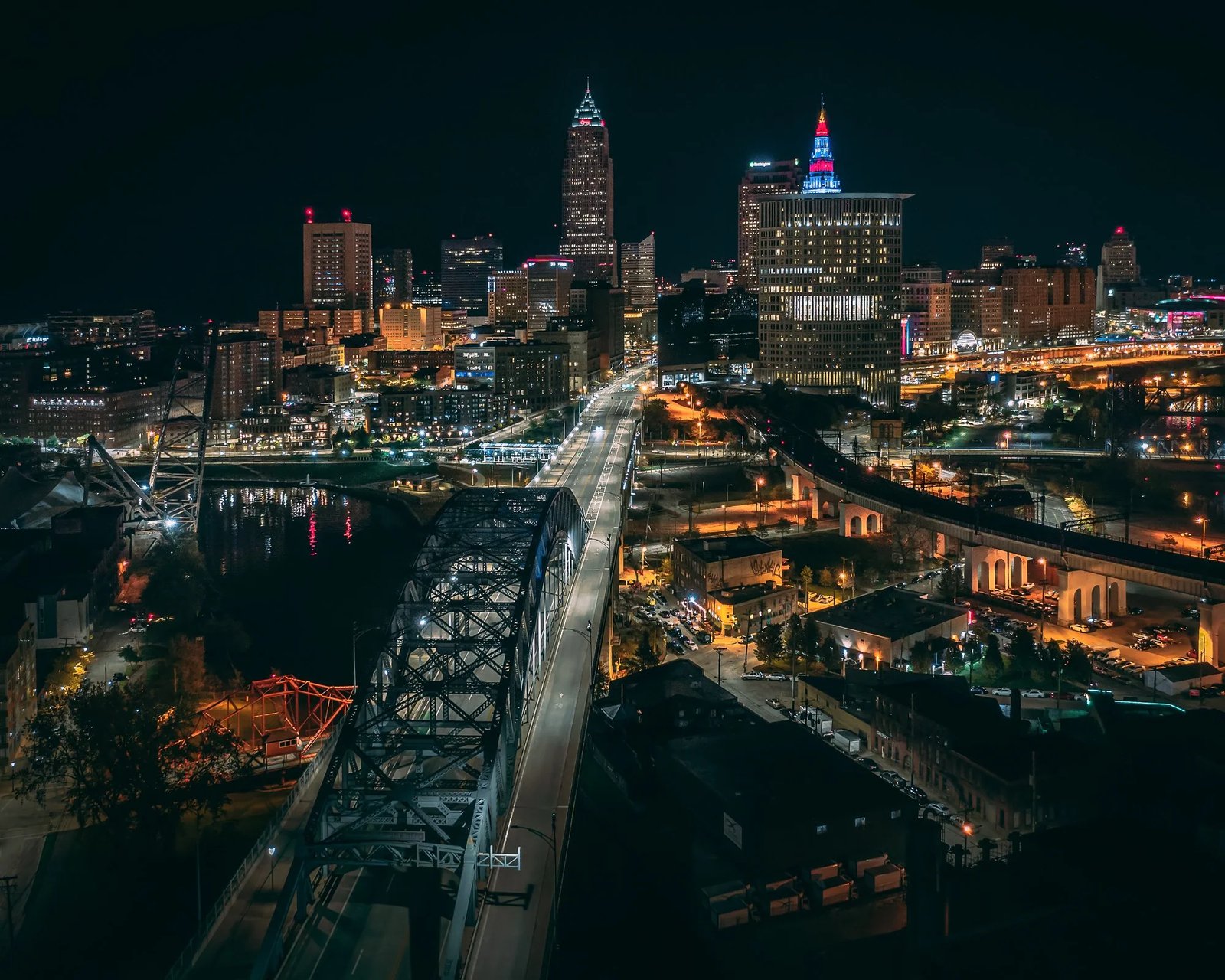
Cleveland commercial roofing
Cleveland's position on the Lake Erie shore hands its commercial roofs a stressor most inland metros never face: lake-effect snow. Bands of heavy, wet snow driven off the lake can bury a roof well past what the regional forecast suggests, and for the low-slope membranes covering the aging industrial and manufacturing stock along the Cuyahoga River and the I-77 and I-480 belts, the distribution footprints out toward the suburbs and the Snowbelt to the east, the downtown office core, and the medical and research buildings around the Cleveland Clinic, University Circle, and Case Western, winter is defined by snow load, ice, and a hard freeze-thaw cycle. Summers add humid heat and periodic severe storms, but it is the lake — its snow, its wind, and its long gray freeze-thaw season — that shapes the risk an owner here carries. We advise building owners, REITs, and asset managers on documented condition, capital planning, and contractor oversight built for it.
Lake-effect snow, ice, and freeze-thaw
The first winter question in Cleveland is load. Lake-effect bands can drop heavy, water-laden snow in totals that vary sharply across the metro, and the eastern Snowbelt suburbs routinely see far more than downtown, so a portfolio spread across the region cannot be managed to a single snow assumption. That snow, plus the ice from repeated melt and refreeze, adds real structural weight, and wind off the lake drifts it against parapets and mechanical screens where the structure is least prepared. Meltwater refreezing at cold eaves, drains, and scuppers builds ice dams that back water under the membrane, and every thaw drives moisture into any seam the cold had already opened. On the region's older industrial roofs — many decades into their service life — those details are frequently the weakest link.
For an owner, the practical consequence is that drainage and detail integrity have to be verified before winter and snow load watched through it, especially on older assemblies and in the higher-snowfall eastern suburbs. A drain that runs clear in autumn but ices over in a January lake-effect stretch is a leak waiting for the next thaw.
The buildings and owners we work with
Cleveland's commercial base blends a large legacy industrial and manufacturing inventory with a world-class medical and research sector and a downtown office and institutional core, plus newer logistics footprints on the metro's edges. Older industrial and office roofs — a substantial share of the stock — are about sequencing replacements deliberately before winter forces the timeline; newer distribution roofs are about protecting an existing investment through disciplined maintenance and snow-season readiness. We track these as distinct risk profiles for owners holding several buildings across Greater Cleveland and the Snowbelt as part of our Ohio commercial roof advisory coverage, rather than treating the metro as one roof.
Owner-side reporting and capital planning
The foundational deliverable is a standardized condition report for every roof an owner holds. We document membrane type and age, seam and flashing condition, insulation moisture where ice-dam and melt intrusion are suspected, drainage capacity against real lake-effect snow and ice loading, and realistic remaining service life, with defects photographed and located so reports are directly comparable year over year. Because we sit on the owner's side of the table, our reporting is not built to sell a re-roof; a system with serviceable life left should be maintained and monitored, not replaced because a crew is available after a hard winter.
From that baseline we build multi-year capital forecasts that put every roof on a funded timeline, and we track warranty terms and the compliance obligations that Cleveland's freeze-thaw and rooftop mechanical work can quietly put at risk. When spring reveals winter's damage across a portfolio, an owner with documented baselines is positioned to scope and competitively bid the real work rather than react to whichever contractor calls first, and when a Cleveland asset is bought, sold, or refinanced, a current roof record removes a recurring point of friction from due diligence.
Cleveland market coverage
We provide owner-side commercial roof advisory across Cleveland, Ohio and the surrounding metro.