
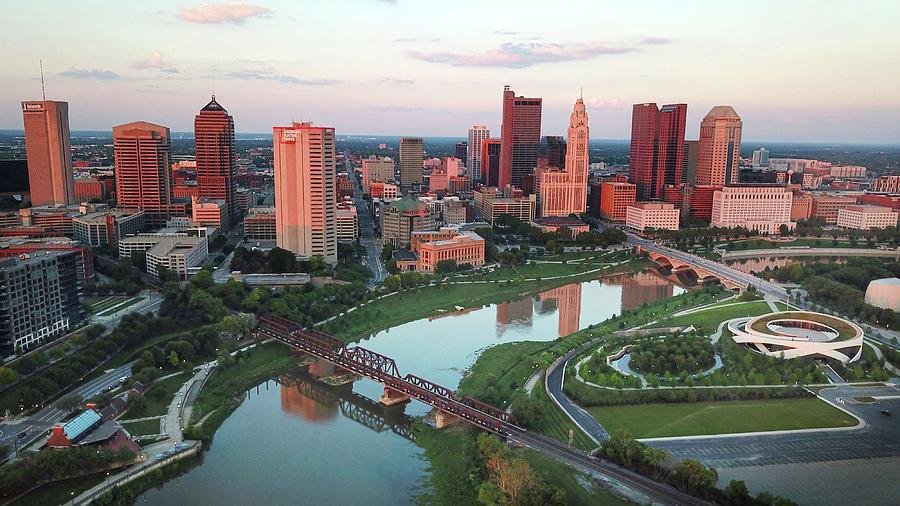
Columbus commercial roofing
Columbus has become one of the Midwest's fastest-growing logistics and technology markets, and the roofs have grown with it — vast new low-slope footprints stretching across the Rickenbacker inland-port district, the I-70 and I-71 distribution corridors, and the Intel and advanced-manufacturing build-out northeast toward Licking County, alongside the downtown office core, the Arena District and Short North commercial blocks, and the medical and higher-education stock around Ohio State and the Wexner medical campus. All of it works through a humid continental climate: warm, muggy summers with heat, UV, and convective thunderstorms; a spring storm season that brings hail and straight-line wind; and winters cold enough for real freeze-thaw and periodic snow load. On the enormous membrane footprints that now define this market, small unaddressed details compound quietly across acres before anyone inside notices. We advise building owners, REITs, and asset managers on documented condition, capital planning, and contractor oversight built for it.
Scale, storms, and the freeze-thaw winter
What makes Columbus distinctive is the sheer size of its newer roofs. On a fulfillment or manufacturing building measured in acres, a deferred repair is not a small line item and a forced replacement can dominate a year's capital budget on its own, so a minor drainage or seam defect that would be trivial on a small roof becomes an expensive, slow-moving problem here. Summer heat and UV age those large membranes steadily, convective storms overwhelm undersized or clogged drainage and turn low spots into chronic ponding, and the spring hail-and-wind season bruises membranes and lifts edges and parapets whose attachment was never verified. Winter then drives freeze-thaw into any detail the storms opened and backs meltwater up behind ice at drains and cold edges.
For an owner, the operative point is that condition on a large flat roof has to be watched deliberately, because the failure signals are subtle relative to the size of the asset. A single detail leaking over the wrong bay of a distribution center can damage inventory and operations far out of proportion to the cost of the repair that would have prevented it.
The buildings and owners we work with
Columbus pairs an explosive logistics and semiconductor-driven manufacturing sector with a deep insurance, financial, and corporate base and a large university and medical footprint. Newer distribution and fabrication roofs are mostly about protecting a major existing investment through disciplined maintenance and warranty compliance; older office, retail, and industrial roofs are about sequencing replacements deliberately. We track these as distinct risk profiles for owners holding several buildings across central Ohio as part of our Ohio commercial roof advisory coverage, rather than treating the metro as one roof.
Owner-side reporting and capital planning
The foundational deliverable is a standardized condition report for every roof an owner holds. We document membrane type and age, seam and flashing condition, drainage and ponding performance, hail and wind damage with photographs and locations, and realistic remaining service life, so reports are directly comparable year over year and after each storm. Because we sit on the owner's side of the table, our reporting is not built to sell a re-roof; a roof with serviceable life left should be maintained and monitored, not torn off because a crew is available.
From that baseline we build multi-year capital forecasts that put every roof on a funded timeline, and we track warranty terms across large single-ply systems where rooftop equipment additions, ponding, and undocumented storm damage most often void coverage. When a Midwestern storm season sends solicitations across central Ohio, an owner with documented condition data negotiates from a defensible baseline instead of a contractor's estimate, and when a fast-appreciating Columbus asset is bought, sold, or refinanced, a current roof record removes a recurring point of friction from due diligence.
Columbus market coverage
We provide owner-side commercial roof advisory across Columbus, Ohio and the surrounding metro.