
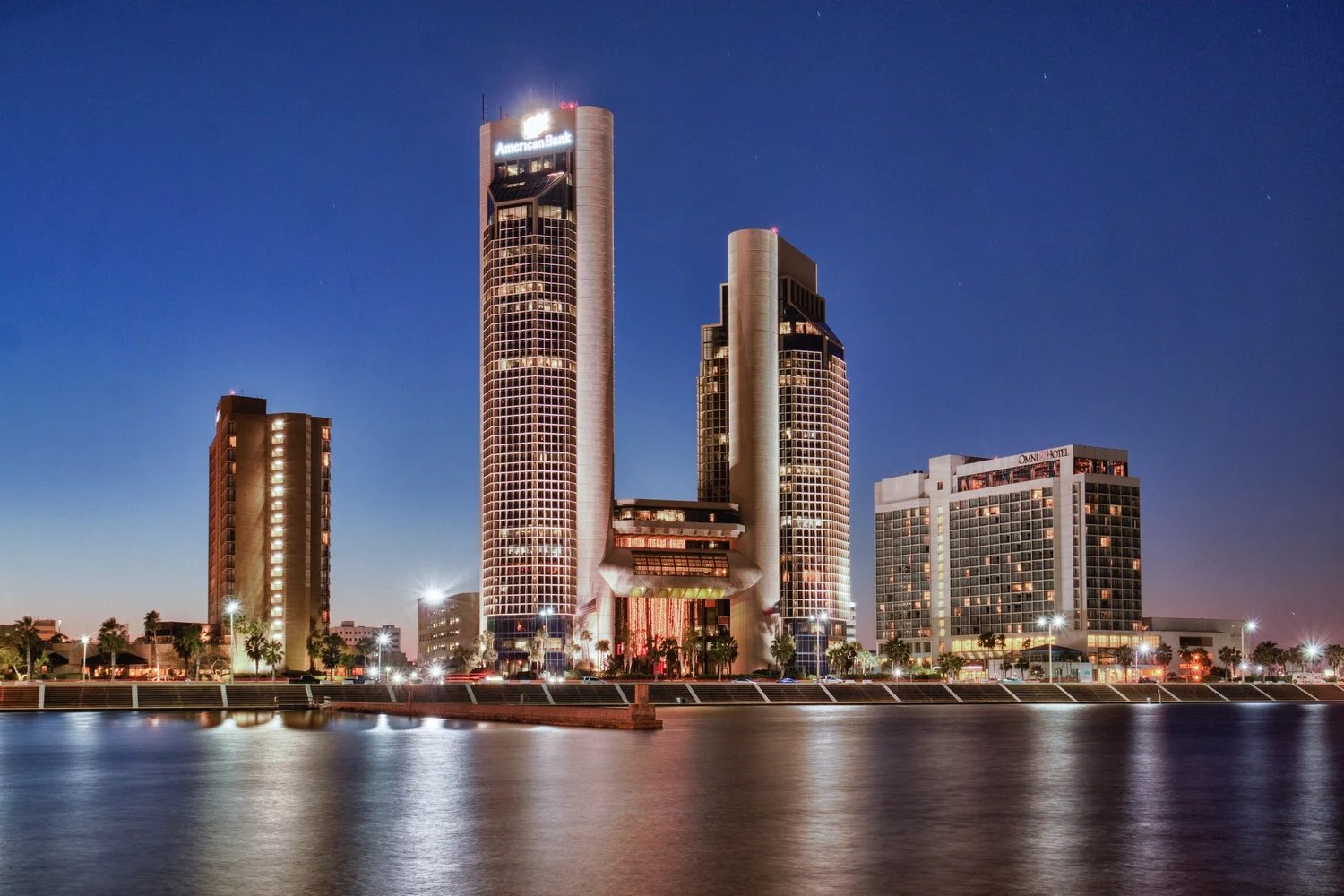
Corpus Christi commercial roofing
Corpus Christi's commercial roof stock is defined by its port and its petrochemical corridor, and it sits in one of the most demanding coastal environments in Texas. The Port of Corpus Christi — the largest U.S. crude export gateway — anchors a heavy industrial belt of refineries, LNG terminals, storage, and the warehousing that supports them along the ship channel and out toward Robstown and the I-37 corridor. Those roofs work under a Gulf Coast climate that combines relentless salt-laden humidity, punishing subtropical heat and UV, and a hurricane season that puts the Coastal Bend directly in the path of tropical-system wind and storm surge. Salt corrodes fasteners and edge metal; the constant onshore wind loads perimeters; and industrial airborne chemistry along the refinery corridor can attack membranes and metal in ways inland roofs never see. We advise the owners, REITs, and asset managers holding this inventory on documented condition, capital planning, and storm-season oversight.
Port, petrochemical, and coastal industrial roofs
Corpus Christi's roofs skew heavily industrial. The refinery and terminal complex along the ship channel, the LNG and energy export facilities, and the distribution and support warehousing around them carry large low-slope membranes in an environment where a detail failure spreads across acres and where the operations beneath are high-consequence. The medical district, downtown, and the bayfront hospitality and office property add roofs where a leak damages tenants and interiors directly. And the region's institutional and educational buildings contribute more mixed assemblies. These are distinct, high-stakes risk environments, and we track them as such rather than treating "Corpus Christi" as one climate.
What the Coastal Bend does to a roof
The failure drivers here are coastal and severe. Salt exposure corrodes fasteners, flashing, edge metal, and rooftop equipment far faster than inland, undermining attachment before the membrane looks worn. Hurricane and tropical-system wind uplift lifts edges, parapets, and inadequately attached perimeters, and storm surge threatens low-lying facilities directly. Sustained heat, UV, and humidity age membranes and push condensation into poorly detailed assemblies, while the constant onshore wind loads and works at every perimeter. Along the refinery corridor, industrial airborne exposure can accelerate degradation of certain membranes and metals. On the coast these forces compound — a roof weakened by salt corrosion and chronic humidity is far more likely to fail when the next named storm arrives, which is why deferred, undocumented condition is so dangerous in the Coastal Bend specifically.
Owner-side reporting and post-storm documentation
For a coastal owner, documentation is protection. We produce standardized condition reports for every roof — membrane type and age, attachment and seam condition, corrosion of fasteners and edge metal, flashing and penetration detailing, drainage performance, and realistic remaining service life — photographed and located so reports compare year over year and post-storm damage can be established against a credible baseline. That baseline is decisive after a hurricane, when insurers and manufacturers demand proof that damage came from the event rather than years of salt and neglect. Because we sit on the owner's side, the reporting is vendor-neutral: a roof with life left is maintained and monitored, not replaced to fill a crew's schedule. From those baselines we build multi-year capital forecasts that put every roof on a funded timeline. This is part of our Texas commercial roof advisory coverage.
Warranty exposure and independent oversight
Warranty exposure is acute on the Gulf Coast. Single-ply warranties carry strict conditions, and Corpus Christi realities — storm and hail damage undocumented and unfiled within the required window, ponding that exceeds warranty limits during tropical rainfall, tenant-added rooftop penetrations, corrosion-driven detail failures, and missing maintenance records — routinely void coverage on high-value assets just when owners need it. We track warranty terms, expiration dates, and compliance obligations across the portfolio and flag the routine actions that keep coverage intact. After a major storm we inspect portfolio-wide, scope and competitively bid genuine repairs, and hold contractors to documented condition rather than to their own estimate — the position of strength an owner needs when every hurricane season floods the coast with storm-chasing solicitations.
Corpus Christi market coverage
We provide owner-side commercial roof advisory across Corpus Christi, Texas and the surrounding metro.