
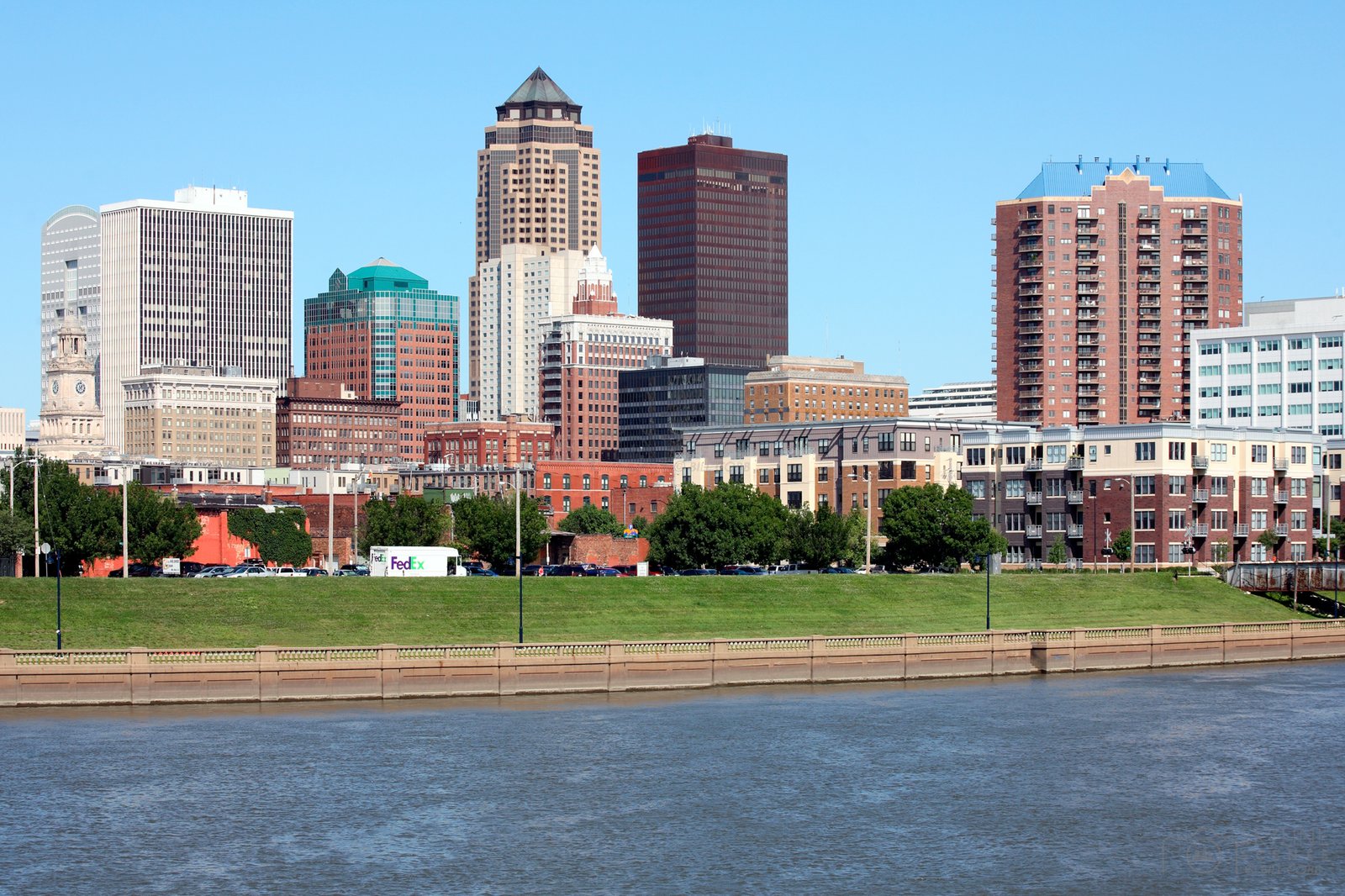
Des Moines commercial roofing
Des Moines sits squarely in the part of the country where commercial roofs are decided by storms, not by age. Spring and summer bring some of the most reliable severe-hail activity in the Corn Belt, and the August 2020 derecho that flattened crops and roofs from Cedar Rapids to the capital proved that straight-line wind here can behave like a hurricane with no coastline. Between those events, the roof works through a genuine four-season load: intense summer heat and UV, then a long freeze-thaw winter that reopens whatever the hail cracked. The metro's building stock — the downtown insurance towers and skywalk-linked offices, the West Des Moines and Clive corporate campuses, and the vast distribution and food-processing footprints along the I-35 and I-80 interchanges — is overwhelmingly low-slope membrane, which is exactly what hail and wind punish first.
The hazard here is impact, then water
Hail is the defining risk in central Iowa, and its damage is deceptive. A storm can bruise a membrane, fracture an aged coating, and split field seams without producing a single interior leak that day. The failure shows up months later, when freeze-thaw drives water into the compromised spots and the deck begins to soften. Derecho and straight-line wind add uplift at edges and corners, lifting parapets and edge metal on buildings whose perimeter attachment was never verified. On the big warehouse and manufacturing footprints ringing the metro, a small detail failure spreads quietly across acres of membrane before anyone inside notices.
What makes this costly for owners is timing. Insurance claims after a hail or derecho event carry strict filing windows, and damage that isn't documented soon after the storm often can't be recovered. An owner without a pre-storm baseline is left arguing about what the roof looked like before, with no record to stand on.
Insurance towers, corporate campuses, and the warehouse belt
Des Moines is an insurance and financial-services town, and its downtown and West Des Moines cores hold a concentration of corporate office and data-adjacent facilities whose owners think in terms of long holds and predictable budgets. Out along the interstates, the story is distribution, ag logistics, and food processing — younger, larger single-ply roofs where the goal is protecting an existing investment through disciplined maintenance and warranty compliance. Those two groups need opposite strategies, and an owner-side condition report treats them as such: one built around extending life, the other around sequencing eventual replacement.
Documentation that survives a claim
Our role is to give owners, REITs, and asset managers a defensible record. We document membrane type and age, seam and flashing condition, drainage, and realistic remaining service life, and we photograph and locate every defect so this year's report is directly comparable to next year's — and so a post-storm claim has real evidence behind it. As part of our Iowa commercial roof advisory coverage, we inspect after major hail and wind events, flag the warranty conditions that ponding and unfiled storm damage quietly void, and competitively bid only the work that genuinely needs doing. In a market where every severe-weather season brings a flood of storm-chasing roofing bids, an owner with documented condition data is negotiating from strength instead of reacting to whoever knocked first.
Des Moines market coverage
We provide owner-side commercial roof advisory across Des Moines, Iowa and the surrounding metro.