
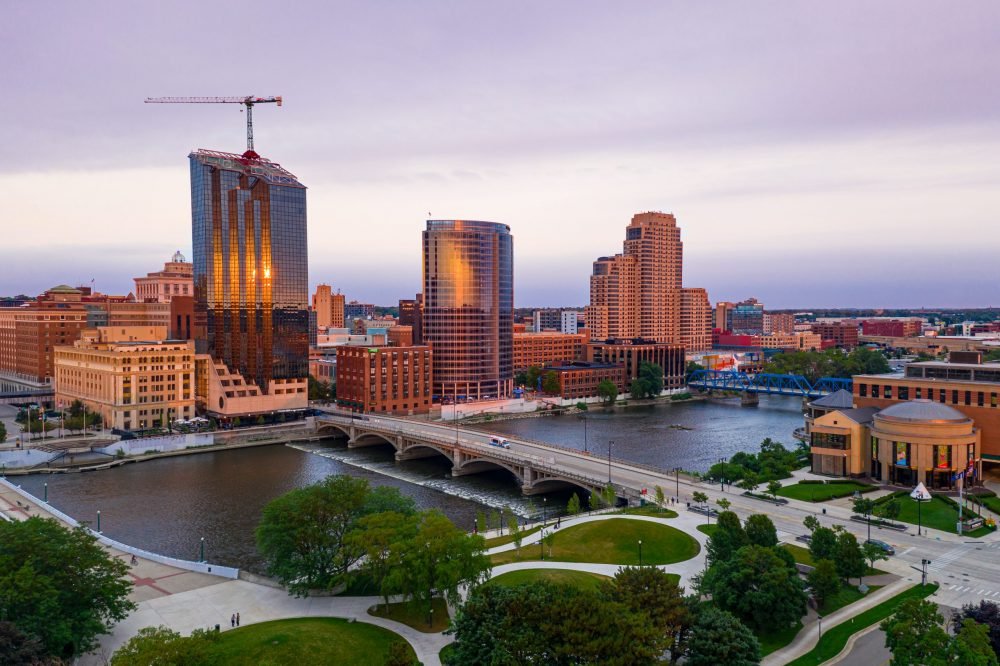
Grand Rapids commercial roofing
Grand Rapids sits in West Michigan's lake-effect snowbelt, and its commercial roofs carry one of the heaviest and most persistent winter loads in the eastern half of the country. Cold air crossing Lake Michigan dumps deep, wet snow on the metro for months, and the region's famously overcast winters mean that snow melts slowly and refreezes often — a punishing rhythm for low-slope membrane. The building stock taking that load is substantial: the office-furniture and advanced-manufacturing plants that made the region an industrial center, the fast-growing Medical Mile and healthcare campuses along Michigan Street, the downtown and Monroe North commercial core, and the distribution and industrial footprints reaching out toward Wyoming, Kentwood, and Walker. Most of it is single-ply or built-up roofing on wide, flat footprints — precisely what snow load and freeze-thaw work hardest.
Lake-effect snow and the slow-melt trap
The core hazard here is not a single storm but months of accumulation and cycling. Heavy snow sits on flat roofs, and the gray, near-freezing days that dominate a West Michigan winter melt it just enough to run toward drains, where it refreezes overnight. That forms ice dams at the perimeter and around penetrations that back water under the membrane, and it loads drainage systems well beyond what they handle in summer. Ponding that freezes solid stresses seams no autumn inspection caught, and rooftop equipment on the big manufacturing and medical buildings creates warm spots that drive uneven melt and refreeze.
The damage is cumulative and hidden. By the time an interior leak appears over a plant floor or a hospital corridor, the assembly is often already compromised, and the conversation has moved from maintenance to replacement.
Manufacturing, the Medical Mile, and long holds
Grand Rapids commercial ownership skews toward long-hold industrial and institutional stock — manufacturers who have occupied the same plants for decades, and healthcare and life-sciences owners building out the Medical Mile. These are owners who think in multi-year budgets and cannot tolerate operational surprises, and their roofs range from aging built-up systems on legacy plants to newer single-ply on recent construction. Those extremes need opposite strategies: extend and maintain the newer roofs, sequence the older ones into the capital plan deliberately. An owner-side condition report treats them separately rather than to a single assumption.
Independent documentation before the thaw
We give owners, REITs, and asset managers a standardized baseline — membrane type and age, seam and flashing condition, drainage performance, insulation moisture where warranted, and realistic remaining service life — with every defect photographed and located so a report written this year compares directly to next year's. As part of our Michigan commercial roof advisory coverage, we flag the warranty conditions that snow-load ponding and unauthorized rooftop work quietly void, and we competitively bid only the work a roof genuinely needs. In a snowbelt where every hard winter produces a wave of roofing solicitations, an owner with documented condition data decides on the evidence, not on a spring sales pitch after the damage is already done.
Grand Rapids market coverage
We provide owner-side commercial roof advisory across Grand Rapids, Michigan and the surrounding metro.