
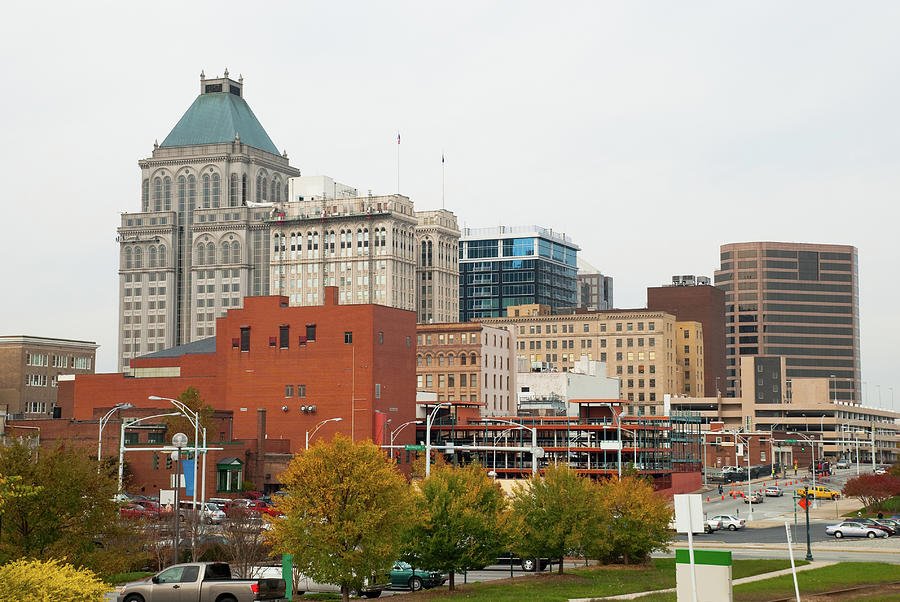
Greensboro commercial roofing
Greensboro sits at the freight crossroads of the Piedmont Triad, where Interstates 40, 85, and 73 converge and the roofs that matter are overwhelmingly low-slope membrane on large industrial footprints. The distribution and manufacturing corridors around Piedmont Triad International Airport, the Toyota battery megasite in nearby Liberty, and the older textile-era plants that fill the city's east and southeast have produced acres of single-ply and built-up roofing. These assemblies work through a humid subtropical year that rarely eases: long summers of heat and UV that bake seams, a spring and summer hail and thunderstorm season that dents and splits membrane in minutes, and winters with enough freeze-thaw to reopen the details summer already stressed. For owners holding warehouse, office, and light-industrial property across the Triad, that mix ages a portfolio unevenly, and a single deferred detail on a several-hundred-thousand-square-foot roof is never a small line item.
The Greensboro building stock we advise on
The metro's commercial inventory splits cleanly into two populations that demand opposite strategies. The newer logistics boom along the airport corridor, the Greensboro-Randolph megasite region, and the I-40/I-85 split has added enormous, relatively young membrane roofs on fulfillment and manufacturing buildings, where the job is protecting an existing investment through disciplined maintenance and warranty compliance. Against that sits a deep bench of older stock: the downtown office and mixed-use core, the legacy textile and furniture plants scattered through the city, and the retail and institutional roofs that predate the current construction wave. Those older systems are about sequencing replacements deliberately rather than fielding them as emergencies. We track both as distinct risk environments rather than treating one Greensboro roof age as one problem.
What actually drives roof failure in the Triad
Greensboro's climate punishes low-slope roofs through a handful of predictable mechanisms, and none of them are exotic. What makes them costly is that they act slowly and out of sight until a tenant reports interior damage.
- Prolonged summer heat and ultraviolet exposure that degrades membranes and accelerates seam and adhesive aging across long, humid Piedmont summers.
- Heavy convective thunderstorms and spring hail that bruise membranes, fracture aged coatings, and lift parapets and edge metal on buildings whose perimeter attachment was never verified.
- Undersized or debris-clogged drainage that turns a hard Triad downpour into chronic ponding, particularly on the sprawling flat footprints along the airport corridor.
- Freeze-thaw cycling through the winter that opens seams and flashing details the summer heat already fatigued.
- Organic debris from the region's heavy tree canopy collecting in drains and low points, holding moisture against the membrane and speeding surface breakdown.
Trapped moisture and creeping seam failure rarely announce themselves until the deck is compromised, and by then the conversation has already moved from maintenance to replacement. Our role is to catch that trajectory while the fix is still cheap, which on a Triad distribution roof can be the difference between a maintenance line and a capital event that dominates the year.
Owner-side condition reporting and capital planning
For an owner or asset manager, the foundational deliverable is an honest, standardized condition report for every roof in the portfolio. We document membrane type and age, attachment and seam condition, flashing and penetration detailing, drainage performance, insulation moisture where investigation is warranted, and the realistic remaining service life of each system. We photograph and locate defects so this year's report is directly comparable to next year's, which is what lets an owner watch a roof deteriorate rather than simply learn that it has failed. Because we sit on the owner's side of the table, our reporting is not built to sell a re-roof: a roof with serviceable life left should be maintained and monitored, not replaced because a crew happens to be available. This is part of our North Carolina commercial roof advisory coverage, and across a multi-building Triad portfolio it is what turns a reactive budget into a defensible multi-year capital plan.
Why an independent advisor protects Greensboro owners
Every severe-weather season in the Piedmont brings a wave of roofing solicitations, and a contractor's free "inspection" is a sales call by another name. An owner with documented condition data and a standing plan is in a far stronger position than one fielding storm-chasing bids with no baseline of their own. We inspect after major hail or wind events when a portfolio-wide pass is warranted, scope and competitively bid the work that genuinely needs doing, and hold contractors to the documented condition rather than to their own estimate. That independence also sharpens transactions: when a Greensboro industrial or office asset is bought, sold, or refinanced, a current and credible roof record removes a recurring point of friction from due diligence and keeps a six- or seven-figure roof from being quietly mispriced.
Greensboro market coverage
We provide owner-side commercial roof advisory across Greensboro, North Carolina and the surrounding metro.