
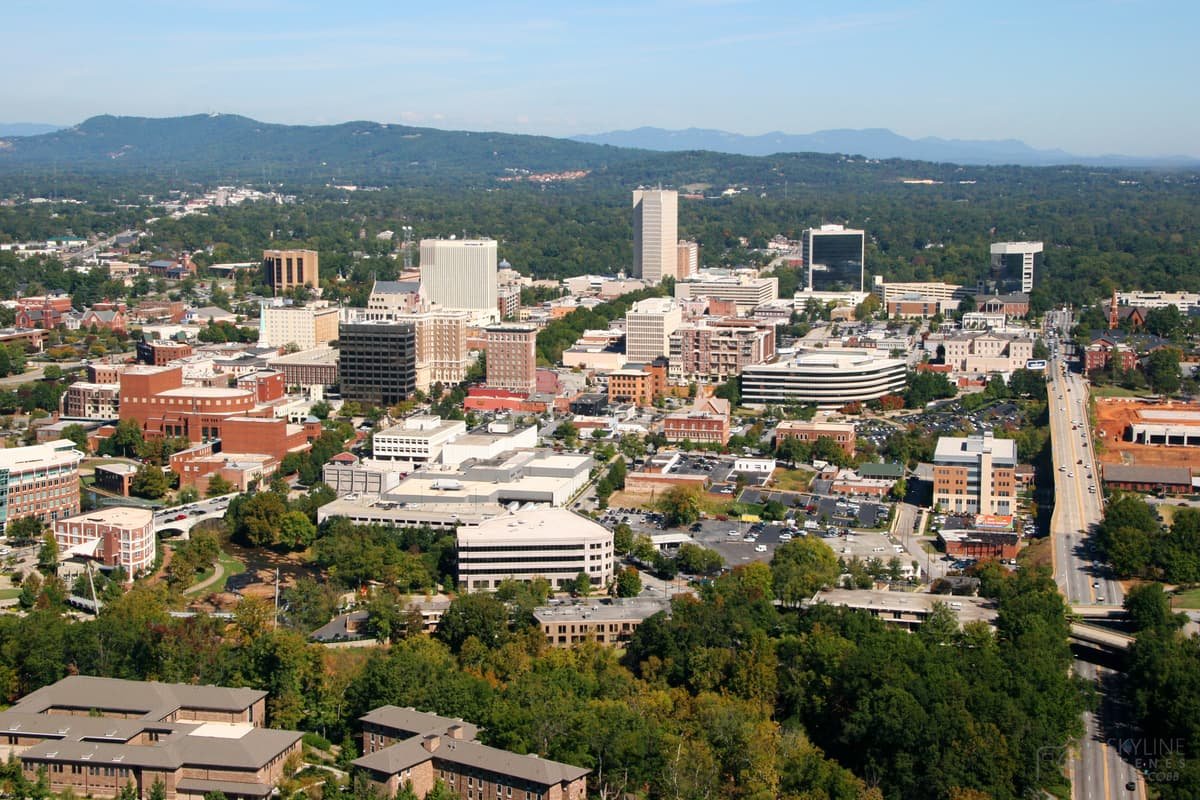
Greenville commercial roofing
Greenville anchors the Upstate manufacturing belt that runs along the Interstate 85 corridor between Atlanta and Charlotte, and its commercial roof stock reflects that: large low-slope membranes over automotive suppliers, advanced-manufacturing plants, and the fast-growing distribution footprint stretching toward Greer and the Inland Port. Those roofs work under a humid subtropical climate that punishes them year-round — long summers of heat and ultraviolet exposure that age single-ply membranes, frequent convective thunderstorms that test drainage and flashing, and a spring severe-weather season that brings hail and straight-line wind up out of the Piedmont. Add the freeze-thaw swings that Upstate elevation delivers in winter, and seams baked open in July are worked loose by January. We advise the owners, REITs, and asset managers who hold this inventory on documented condition, capital planning, and contractor oversight built for it.
The building stock along the I-85 corridor
The commercial roofs that matter most in Greenville are big, flat, and industrial. The manufacturing plants and supplier campuses that fill the I-85 corridor and the industrial parks around Greer, Duncan, and Fountain Inn carry hundreds of thousands of square feet of membrane apiece, and on footprints that size a single unaddressed detail failure spreads quietly across acres before anyone inside notices water. Downtown Greenville and the Woodruff Road commercial belt add office, medical, and retail roofs of different ages and assemblies. Each of these is a distinct risk profile, and treating them as one is how owners get surprised.
What actually drives roof failure here
Greenville's climate attacks roofs slowly and out of sight, which is exactly what makes it expensive. Prolonged heat and UV degrade membranes and accelerate seam and adhesive aging across the long Upstate summer. Heavy convective rainfall overwhelms undersized or clogged drains and turns minor ponding into chronic standing water. Spring hail and severe wind bruise membranes and lift perimeter edges on buildings whose attachment was never verified. And the region's freeze-thaw cycling opens seams and flashings that summer already fatigued. None of these announce themselves; trapped moisture and creeping seam failure stay invisible until the deck is compromised or a tenant reports interior damage, by which point the conversation has moved from maintenance to replacement.
Owner-side condition reporting and capital planning
For an owner or asset manager, the foundational deliverable is a standardized condition report for every roof in the portfolio — membrane type and age, attachment and seam condition, flashing and penetration detailing, drainage performance, and realistic remaining service life, all photographed and located so this year's report is directly comparable to next year's. Because we sit on the owner's side of the table, that report is not built to sell a re-roof; a roof with serviceable life left should be maintained and monitored, not replaced because a crew is available. From those baselines we build multi-year capital forecasts that put every Greenville roof on a funded timeline, so budgeting reflects real condition rather than last year's emergencies. This work is part of our South Carolina commercial roof advisory coverage.
Warranty exposure and independent oversight
Warranty exposure is where Upstate owners quietly lose the most money. Manufacturer warranties on single-ply systems carry strict conditions, and the routine realities of Greenville roofs — tenant-added rooftop equipment and penetrations, ponding that exceeds warranty limits during heavy rain, and undocumented hail damage never filed within the required window — put coverage at risk. We track warranty terms, expiration dates, and compliance obligations across the portfolio and flag the routine actions that keep coverage intact. And because severe-weather seasons reliably bring a wave of roofing solicitations to the I-85 corridor, an owner with documented condition data and a standing plan is in a far stronger position than one fielding storm-chasing bids with no baseline of their own. We scope and competitively bid the work that genuinely needs doing and hold contractors to the documented condition rather than to their own estimate.
Greenville market coverage
We provide owner-side commercial roof advisory across Greenville, South Carolina and the surrounding metro.