
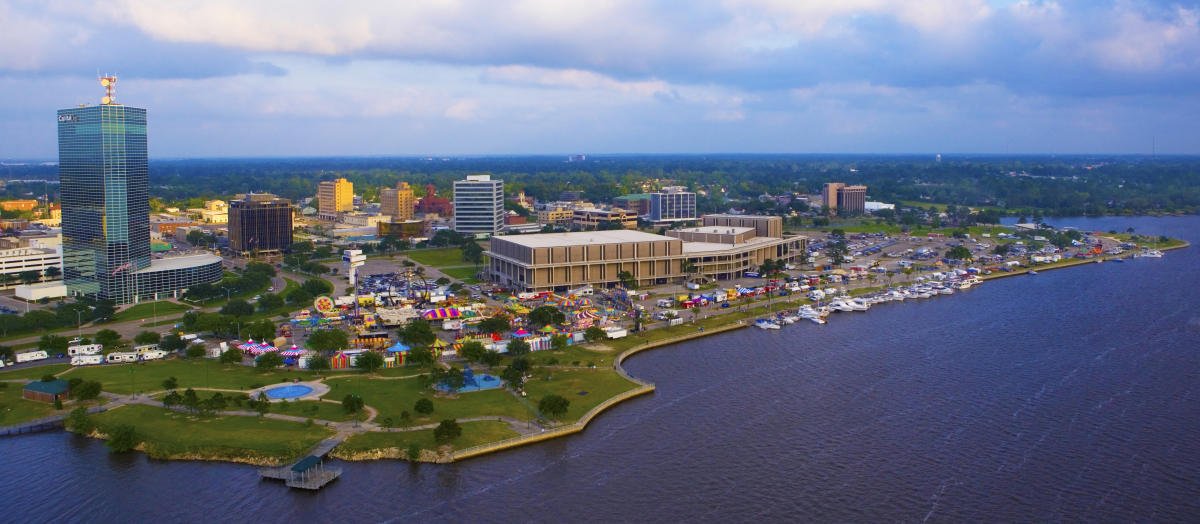
Lake Charles commercial roofing
Lake Charles carries one of the most hurricane-exposed commercial roof inventories in the country, a lesson the city learned brutally when Hurricanes Laura and Delta struck within six weeks in 2020 and damaged roofs across the entire metro. The building stock reflects the region's economy: sprawling low-slope membrane and metal on the petrochemical and LNG complexes along the Calcasieu Ship Channel and Sulphur, warehouse and industrial-support roofs near the port, and downtown office, casino, medical, and retail property around I-10. Every one of these roofs faces a Gulf-coast workload of extreme heat and humidity, relentless rainfall, and the direct threat of major-hurricane wind. We advise Lake Charles owners, REITs, and asset managers with independent condition reporting and capital planning built for that exposure.
Hurricane wind and the coastal load
Wind uplift is the dominant catastrophic risk in Lake Charles. A landfalling major hurricane drives extreme uplift at parapets, edge metal, and roof corners, peels back membranes whose perimeter attachment was never verified, and pushes rain horizontally into every detail that is not perfectly sealed. The region's recent storm history makes this concrete rather than theoretical: entire portfolios here have needed roof replacement in a single season. An owner who has documented condition and verified attachment before the season is in a completely different position, both structurally and in the claims process, than one scrambling after landfall.
Between storms, the everyday climate is punishing in its own right. Sustained Gulf-coast heat and intense humidity age membranes and drive condensation and trapped moisture into assemblies where vapor control was poorly detailed. Frequent heavy rainfall overwhelms undersized or clogged drainage and turns minor ponding into chronic standing water. Salt-laden coastal air corrodes fasteners, edge metal, and rooftop equipment faster than inland exposure. These slow forces set a roof up to fail when the next storm tests it.
Industrial and institutional roofs on the channel
Lake Charles's commercial stock is heavily industrial. Institutional and corporate owners hold enormous petrochemical, LNG, and refining roofs along the ship channel, where process penetrations, rooftop equipment, and constant trade access create leak paths and warranty risks that demand disciplined tracking. The metro also carries port-area warehouse and logistics buildings, downtown casino and hospitality property, and medical and retail roofs serving the region. Each type ages differently under the same coastal conditions, which is why we track every asset as its own risk profile. This work is part of our Louisiana commercial roof advisory coverage, with hurricane exposure driving the planning here more than anywhere else in the state.
Owner-side reporting, capital planning, and storm posture
The foundational deliverable is a standardized, honest condition report for every roof you hold. We document membrane or panel type and age, seam and attachment condition, flashing and penetration detailing, drainage performance, and perimeter and edge-metal security, then locate and photograph defects so this year's report is directly comparable to next year's. Because we sit on the owner's side of the table, that report is not built to sell a re-roof. A roof with life left should be maintained and monitored, not replaced because a crew is available after a storm.
From that baseline we build a multi-year capital forecast that puts every Lake Charles roof on a funded timeline and, critically, sequences wind-resilience improvements before the next season rather than after. Documented pre-storm condition also transforms the claims conversation, letting an owner prove genuine hurricane damage against a defensible baseline. We track warranty terms and the ponding, storm-documentation, and unauthorized-rooftop-work conditions that void coverage, and when work is warranted we scope it, competitively bid it, and hold contractors to documented condition rather than to their own estimate. In a market flooded with solicitations after every named storm, an owner with real data protects their capital far better than one fielding reactive bids.
Lake Charles market coverage
We provide owner-side commercial roof advisory across Lake Charles, Louisiana and the surrounding metro.