
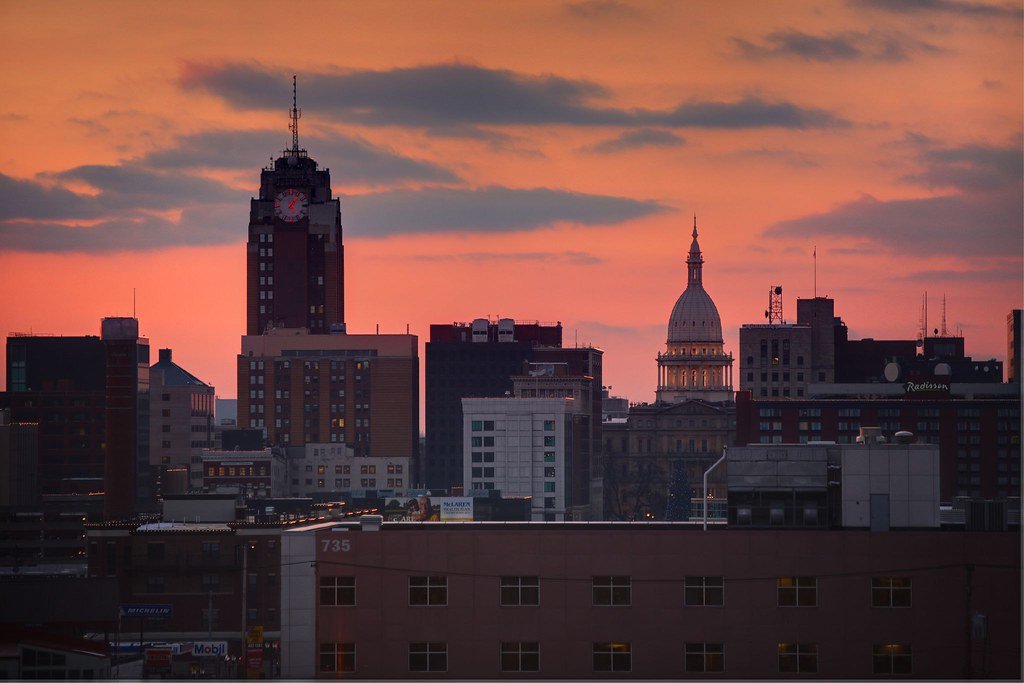
Lansing commercial roofing
Lansing carries the commercial roof profile of a state capital and an auto town at once, and both sit under a hard mid-Michigan winter. State government office buildings cluster around the Capitol complex and downtown; General Motors' Lansing Grand River and Delta Township assembly plants and their supplier base add enormous industrial roof footprints; Michigan State University in adjacent East Lansing anchors institutional and research space; and the retail and light-industrial stock spreads along the I-96, US-127, and Cedar Street corridors. These are overwhelmingly low-slope membrane roofs, and they spend the winter under snow, ice, and a freeze-thaw cycle that pries open seams and flashing details week after week. On a plant roof spanning hundreds of thousands of square feet, or a state office full of records and staff, the cost of a failure runs well past the patch. We advise Lansing owners and asset managers on documented condition and capital planning built for that climate.
Snow, ice, and freeze-thaw drive failure here
Mid-Michigan winters are long and cold, and freeze-thaw is the defining stressor. Meltwater works into laps, seams, and flashings during a thaw, freezes and expands overnight, and separates those details a fraction at a time across the season. Prolonged snow cover loads flat roofs for weeks, and as it melts and refreezes it forms ice dams at eaves, drains, and low points that back water beneath the membrane. Drifting concentrates that load unevenly, and a mid-winter warm spell sends meltwater hunting for every weak lap. Much of the damage stays hidden until spring, when roofs that read as sound in autumn begin to leak.
The warm months bring their own workload. Summer heat and UV age membranes and adhesives, convective thunderstorms test drainage that ice may already have compromised, and the swing between humid summers and sub-zero winters drives continual expansion and contraction that fatigues the whole assembly. On the region's large industrial roofs, that constant cycling is what turns a minor detail weakness into a slow, spreading leak.
The owners and buildings we serve here
Lansing's commercial stock ranges from the very large to the very institutional. Automotive assembly and supplier plants carry vast low-slope roofs with heavy rooftop mechanical loads where a deferred repair is never minor; state government buildings demand reliable, documented condition for public accountability; and MSU-adjacent research and office space adds penetration-dense roofs of its own. Alongside them sits a broad base of retail and warehouse roofs with their own aging profiles. Each type ages differently under Michigan's climate, so we track each roof as its own risk profile rather than applying one assumption across a portfolio. This work is part of our Michigan commercial roof advisory coverage, and the freeze-thaw exposure shapes it heavily.
Owner-side reporting and capital planning
The foundational deliverable is a standardized, honest condition report for every roof you hold. We document membrane type and age, seam and attachment condition, flashing and penetration detailing, drainage and ice-dam vulnerability, and trapped moisture where investigation is warranted, then locate and photograph defects so this year's report is directly comparable to next year's. Because we sit on the owner's side of the table, that report is not built to sell a re-roof. A roof with serviceable life left should be maintained and monitored, not replaced because a crew is available in the spring rush.
From that baseline we build a multi-year capital forecast that puts every Lansing roof on a funded timeline and sequences replacements deliberately instead of as emergencies. We also track warranty terms and the drainage, maintenance-record, and unauthorized-rooftop-work conditions that quietly void coverage. Because winter damage is often invisible until the thaw, we time inspections to catch trouble early, then scope and competitively bid the work that genuinely needs doing and hold contractors to the documented condition rather than to their own estimate. For an owner carrying large industrial or public buildings, that independence is what keeps roof decisions grounded in condition instead of in whoever happened to be on the roof last.
Lansing market coverage
We provide owner-side commercial roof advisory across Lansing, Michigan and the surrounding metro.