
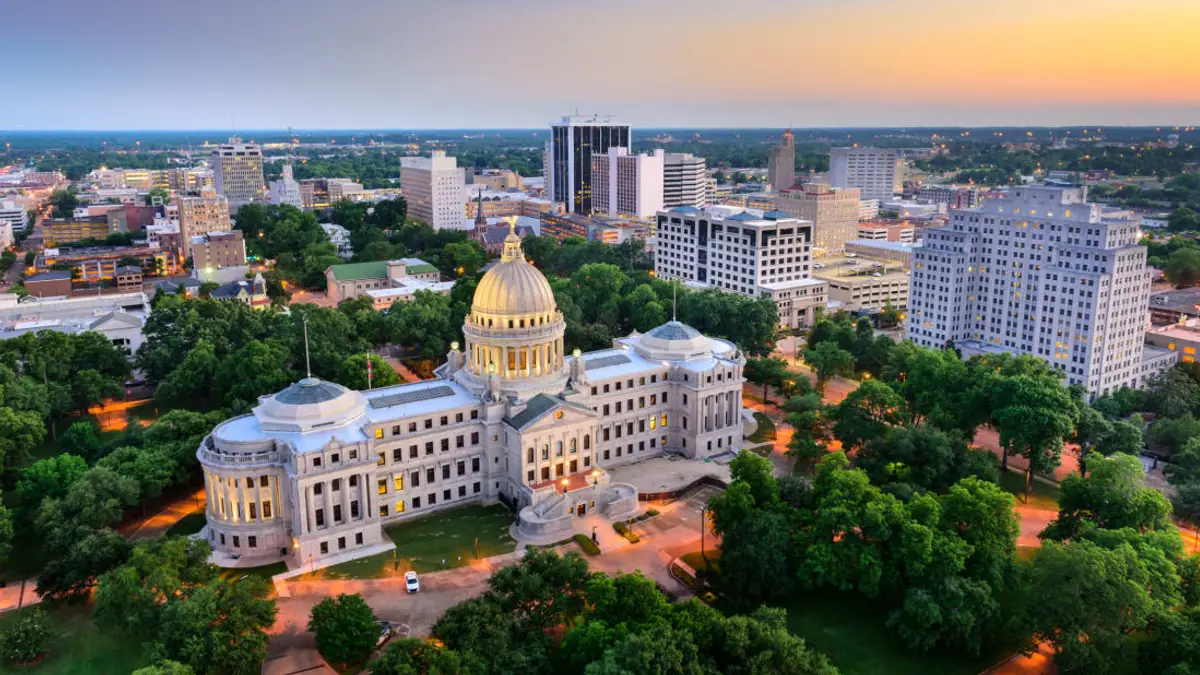
Mississippi statewide
Mississippi puts a commercial roof under a combination of stresses that few states match: Gulf hurricanes, salt-laden coastal air, relentless summer heat and UV, and humidity high enough to drive degradation and biological growth on the surface year-round. We advise building owners, REITs, and asset managers on commercial roofs across the state — from the Gulf Coast through the Pine Belt to Jackson and the Delta — strictly on the owner's side. We do not install. We assess condition, plan capital, and oversee warranties and contractors so the roof decision is grounded in documented evidence rather than in whoever knocked on the door after the last named storm.
Commercial roofing markets we serve in Mississippi
Explore owner-side commercial roof advisory in these Mississippi cities:
The markets we cover
Jackson anchors the central part of the state as the capital, a hub of government, legal, and healthcare facilities centered on the University of Mississippi Medical Center, the state's only academic health-science campus. The Gulf Coast carries a distinct and intensive commercial base: Gulfport and Biloxi run on a Port of Gulfport that ranks among the larger U.S. container ports, the Ingalls Shipbuilding operation in Pascagoula, a dense casino-and-gaming sector, and a working seafood industry. These are large, high-value, often hardened buildings on the most exposed coastline in the state. Hattiesburg — the Hub City — adds the University of Southern Mississippi and a regional commercial center, while the broader economy leans on advanced manufacturing, healthcare, and tourism statewide.
We coordinate across these markets because the same owner often holds buildings in more than one — a distribution facility near Jackson, a coastal retail or hospitality asset, a plant in the Pine Belt — and each sits in a different exposure zone. A roof on the immediate coast lives in a wind and salt environment that a building in the Delta or the Pine Belt simply does not, and the advisory standard has to reflect that rather than treat the state as uniform.
What Mississippi weather does to a roof
The catastrophic threat is the tropical system. Mississippi's coast has absorbed some of the most destructive hurricanes in U.S. history, and Katrina's damage reshaped how the region thinks about wind. Sustained hurricane-force wind and gusts attack a roof at its weakest points — perimeters, corners, parapets, and any inadequately fastened or aging field — and once the membrane or covering lifts at an edge, peeling progresses fast. Aging asphalt-shingle systems have been a persistent loss driver in coastal windstorms, and even inland, severe thunderstorms bring damaging straight-line wind and hail. The everyday threat is quieter but constant: subtropical summers of sustained 90-to-100-plus-degree heat, intense UV, and very high humidity accelerate UV breakdown of the surface and drive algae and biological growth across roof types.
On the coast, salt-laden air adds a corrosion load that shortens the life of fasteners, metal flashing, edge metal, and rooftop equipment. The points that fail first under this regime — flashing transitions, ridge and edge details, fastener heads, underlayment laps, and pipe-boot sealants — are precisely the details that decide whether a roof survives the next storm. The conditions we track most closely include:
- Wind-uplift resistance at perimeters, corners, and parapets, evaluated against the building's exposure and the post-Katrina wind requirements
- Flashing, edge-metal, and penetration detailing — the first failure points in both hurricanes and routine windstorms
- UV and heat degradation of the membrane or covering under sustained subtropical summer load
- Moisture, algae, and biological growth driven by high humidity, and the drainage that lets water linger
- Salt-driven corrosion of fasteners, metal components, and rooftop equipment on coastal assets
The owner-side advisory role
Our work begins with condition reporting an asset manager can use. We document each roof's assembly, age, attachment, flashing, and active and latent defects, photograph and locate problems, and translate findings into a remaining-service-life estimate and a clear repair-versus-replace position. Across a portfolio that produces a ranked picture — which roofs need attention before hurricane season, which can be maintained for several more years, and which are quietly accruing risk under a surface that still looks intact. Storm timing shapes everything here: the work an owner wants done is the work completed before a system enters the Gulf, not the scramble that follows landfall when every contractor in the region is overcommitted and materials are scarce.
From there we build the capital plan. Owners holding coastal hospitality, gaming, and retail assets, healthcare and institutional buildings around Jackson, manufacturing and distribution facilities, and shipbuilding and port-adjacent structures need replacement and major repair sequenced and budgeted ahead of the season. We phase the work, align it to operations, and write scopes so competing bids are genuinely comparable rather than priced against different assumptions about wind rating and attachment.
Warranty exposure and contractor oversight
Most large commercial roofs in Mississippi carry a manufacturer warranty, and owners routinely overestimate what it covers — and how it interacts with storm-damage insurance. Coverage is commonly voided by unaddressed ponding, by other trades cutting rooftop equipment in without coordination, and by undocumented maintenance, while a wind claim can turn on whether the system was installed and maintained to the warranted detail. We review the terms against actual roof condition, flag where exposure has crept in, and keep the documentation that lets a valid claim hold up after a storm. When work proceeds, we hold the line for the owner: confirming the contractor is approved for the specified system, verifying that attachment and flashing meet the wind requirements for the building's zone, and inspecting before final payment. The objective stays the same across every market we cover — fewer surprises, defensible numbers, and roofs built to reach the service life the owner paid for, storm season after storm season.
Managing roofs across a Mississippi portfolio
For an owner holding buildings across the coast, Jackson, and the Pine Belt, the value of an owner-side advisor is consolidation under a single standard that respects how different those exposures are. Left to drift, each building carries its own contractor relationship, its own inspection habits, and its own uneven records — a serious liability in a state where a wind claim can hinge on documentation. We replace that with one program: a common condition-scoring method applied to every roof, a maintenance calendar matched to the storm season, and one place the records live, so a coastal asset and an inland one are both ready when they need to be.
Timing here is grounded in the calendar's two pressures — the season and the sun. We schedule the substantive inspection for spring, before the Gulf becomes active, to confirm attachment, flashing, edge metal, and drainage are sound and to close out repairs while contractors and materials are still available. We schedule a second pass after the season, and an additional inspection after any direct storm impact, to document damage promptly for both warranty and insurance purposes. Through the long subtropical summer between, the priority is catching UV degradation, biological growth, and clogged drainage before they compound. The recurring tasks we hold owners to include:
- Pre-season inspection of wind-critical details — perimeters, corners, parapets, fasteners, and flashings — before the Gulf becomes active
- Prompt post-storm assessment and documentation after any direct impact, for warranty and insurance
- Monitoring of UV degradation, algae and biological growth, and ponding through the summer
- Salt-corrosion checks on fasteners, metal components, and rooftop equipment on coastal assets
- A single record of warranty terms, repairs, and inspection history per building, with a rolling capital forecast
Held together, this turns the roof from a line item that surfaces only after a storm into a managed asset with a known condition and a known trajectory — which is the difference between facing a season prepared and facing it from behind. It is the standard we bring to every building we advise on in Mississippi, on the coast and inland alike.