
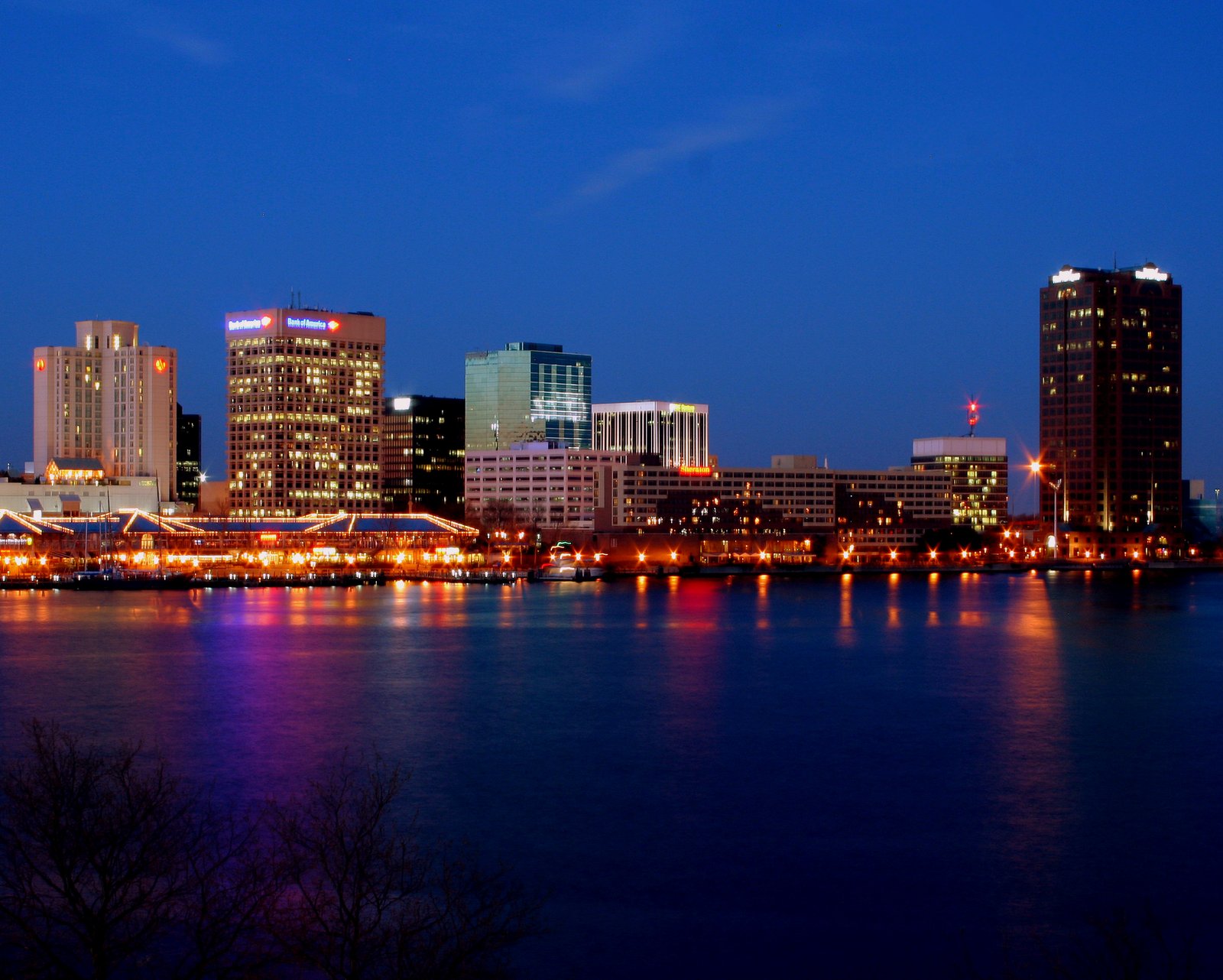
Norfolk commercial roofing
Norfolk sits at the center of Hampton Roads, one of the great natural harbors on the East Coast, and its commercial roofs carry the full weight of a coastal, hurricane-exposed climate. This is a low-lying, salt-saturated environment: tropical systems and nor'easters drive wind uplift and wind-driven rain, the harbor air corrodes fasteners and edge metal far faster than inland, humid subtropical summers bake membranes with heat and UV, and the region's chronic tidal and rainfall flooding stresses drainage on any roof that ponds. For owners holding roofs around the Port of Virginia and its massive marine terminals, the defense and shipbuilding facilities that dominate the local economy, and the warehouse, office, and institutional stock around downtown Norfolk and the Midtown corridor, that combination of storm, salt, and standing water punishes low-slope roofs at exactly the details that keep them watertight.
Hampton Roads building stock and its roofs
Norfolk's commercial inventory is shaped by the port and the military. Large single-ply and built-up roofs cover the warehouse, logistics, and intermodal buildings tied to the Port of Virginia, and the region's enormous defense, shipbuilding, and support facilities add industrial roofs with heavy rooftop equipment and demanding service conditions. Downtown Norfolk carries office and institutional buildings, the medical corridor adds hospital and clinical roofs, and older commercial districts bring aging assemblies into the mix. An owner holding across these categories faces a portfolio where a new port-adjacent roof and a decades-old downtown roof need opposite strategies, all under the same coastal exposure.
The scale of the port and industrial roofs drives the economics. On a distribution or industrial building covering hundreds of thousands of square feet, a small unaddressed defect compounds across acres of membrane, and a forced replacement can dominate a year's capital budget. In a hurricane-exposed market, that risk is compounded by the fact that a single storm can turn a manageable deficiency into an emergency across a whole portfolio at once.
What actually drives roof failure here
Norfolk's dominant failure drivers are coastal. Tropical systems and nor'easters generate wind uplift that finds any edge, parapet, or perimeter whose attachment was never verified, and wind-driven rain forces water past flashing and details that would hold in a calm downpour. Salt in the harbor air corrodes fasteners, termination bars, and edge metal, quietly weakening the very attachment that wind then tests. Humid subtropical heat and UV age the membrane through the summer, and the region's flooding and heavy rainfall overwhelm drainage on roofs that pond, turning minor standing water into chronic saturation. Trapped moisture within the assembly, common in this humidity, rots insulation and deck out of sight.
Because these mechanisms act slowly between storms and then strike suddenly during them, the trajectory matters as much as any single storm. Creeping corrosion and seam failure stay quiet until a hurricane exposes them, and by then the conversation has moved from maintenance to replacement. Our role is to catch the trend early and document storm-readiness, a discipline we apply across our Virginia commercial roof advisory coverage.
Owner-side reporting and storm readiness
For an owner or asset manager in Hampton Roads, the foundational deliverable is a standardized, honest condition report for every roof in the portfolio, with genuine attention to storm exposure. We document membrane type and age, seam and attachment condition, perimeter and edge-metal detailing, flashing and penetrations, drainage performance, and insulation moisture where investigation is warranted, flagging the corrosion and uplift vulnerabilities that a coastal storm will exploit. We photograph and locate every defect so this year's report compares directly to next year's, and so that after a named storm we can document damage promptly and support timely claims.
Because we sit on the owner's side of the table, our reporting is not written to sell a re-roof. A roof with serviceable life should be maintained and monitored, not replaced because a crew is available in the rush after a storm. That independence matters most in a coastal market, where severe weather reliably brings a wave of roofing solicitations and storm-chasing bids.
Why an independent advisor protects owners here
Warranty exposure is where Norfolk owners quietly lose the most. Manufacturer warranties on single-ply systems carry strict conditions, and this market puts them at risk: storm and wind damage that goes undocumented and unfiled within the required window, ponding and drainage conditions that exceed warranty limits, unauthorized rooftop work that voids coverage, and missing maintenance records the manufacturer demands before paying a claim. We track warranty terms, expiration dates, and compliance obligations across the portfolio and flag the routine actions that keep coverage intact. When work genuinely needs doing, we scope it, competitively bid it, and hold the contractor to the documented condition rather than to their own estimate, so a high-value coastal asset stays understood, budgeted, and protected by the people who own the risk.
Norfolk market coverage
We provide owner-side commercial roof advisory across Norfolk, Virginia and the surrounding metro.