
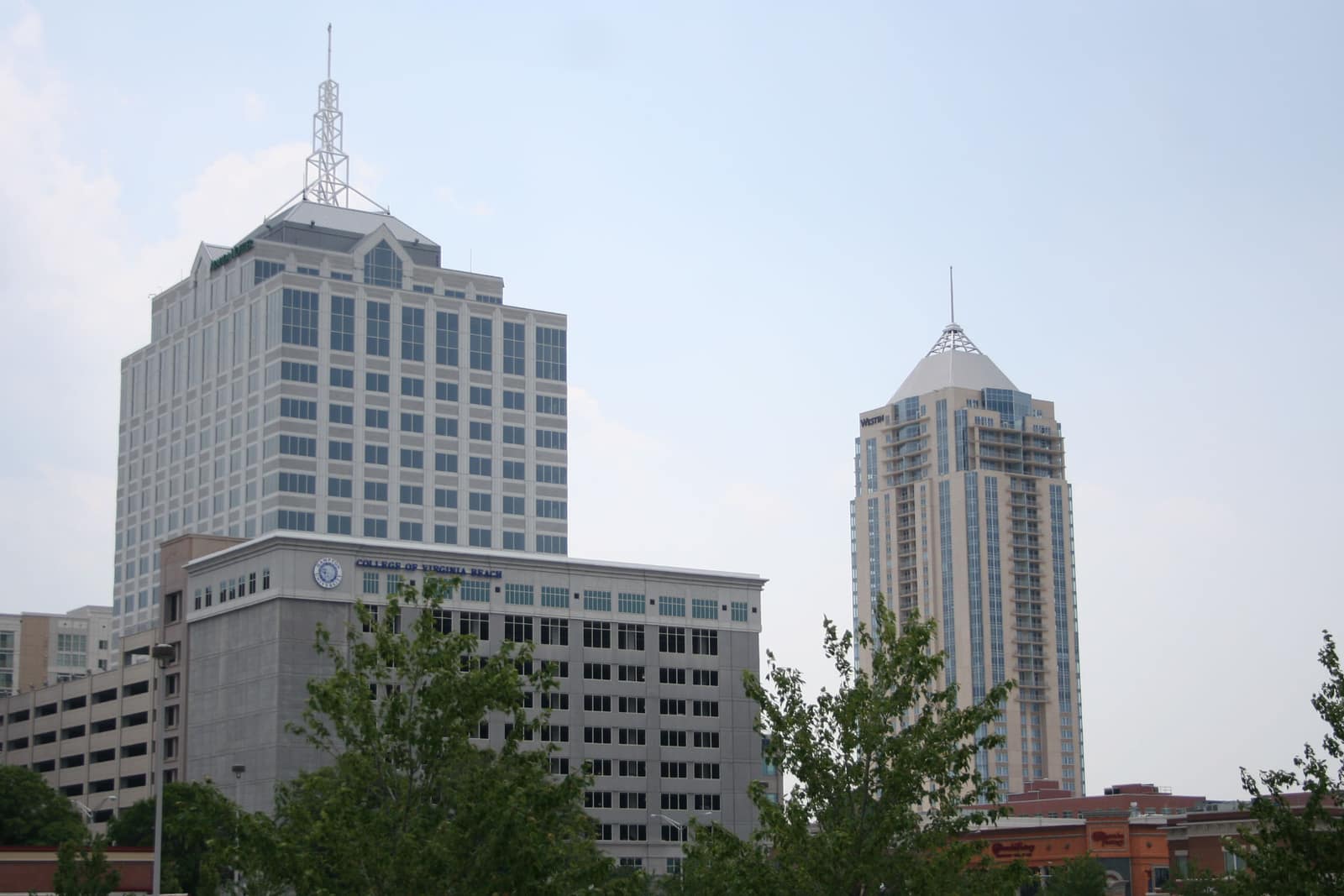
Virginia statewide
Virginia asks more of a commercial roof than most owners expect. A flat membrane in Ashburn is protecting hundreds of millions of dollars in servers and uninterruptible power; the same membrane in Norfolk is fighting salt air and tropical moisture; in the Shenandoah Valley it is cycling through freeze and thaw all winter. We advise building owners, REITs, and asset managers across the Commonwealth on the side of the table that carries the risk: we inspect, report, plan capital, and manage the roofs, and we do not bid the labor. That separation is the entire point of how we work.
Commercial roofing markets we serve in Virginia
Explore owner-side commercial roof advisory in these Virginia cities:
The markets we cover across Virginia
Virginia's commercial building stock is unusually varied, and the roofing risk profile shifts sharply as you move across the state. Northern Virginia is the dominant story. Loudoun County's Data Center Alley, anchored in Ashburn and extending through Sterling, Herndon, and the broader Dulles Technology Corridor toward Reston and Tysons, holds one of the largest concentrations of data centers in the world. Those are low-slope roofs over mission-critical loads, dense with rooftop mechanical units, conduit, and cabling penetrations, where a single leak is a containment event rather than a maintenance ticket.
South and east, the picture changes. The Hampton Roads metro, including Norfolk, Virginia Beach, Chesapeake, and Newport News, is grounded in the Port of Virginia and Naval Station Norfolk, with sprawling warehouse, distribution, and logistics roofs alongside military and industrial facilities. Richmond and the I-95 corridor carry the state's distribution and office inventory; Roanoke and the Shenandoah Valley add manufacturing and warehousing in a colder, higher-elevation climate. We map an owner's portfolio against these distinct zones rather than treating Virginia as one weather pattern.
What Virginia's climate does to commercial roofs
Virginia spans a humid subtropical climate that produces several different failure mechanisms depending on where a building sits. The Coastal Plain and Hampton Roads face the most aggressive combination: Atlantic tropical systems and hurricanes, nor'easters, sustained wind uplift, wind-driven rain, and persistent salt-laden air that corrodes fasteners, flashings, and metal edge detailing. Roofs near the water age faster at the perimeter and at every penetration, and uplift resistance at the edges and corners is where storm damage concentrates. After a named storm, the damage that ends careers is rarely the obvious torn membrane; it is the lifted edge metal, the loosened fastener rows, and the saturated insulation that no one inspected, all of which keep degrading for months before they surface as an interior leak.
Inland, the drivers are different but no less costly. Summer heat and ultraviolet exposure degrade membranes and accelerate adhesive and sealant fatigue, while severe thunderstorms bring hail that bruises single-ply and fractures aging built-up and modified bitumen surfaces. In the Blue Ridge, Shenandoah Valley, and the higher western counties, winter brings real snow load and repeated freeze-thaw cycling that opens seams, splits laps, and works water into any compromised flashing. The conditions we plan around include:
- Tropical systems, hurricanes, and nor'easters driving wind uplift and wind-driven rain across Hampton Roads and the Coastal Plain
- Coastal salt air corroding fasteners, edge metal, and flashings on tidewater buildings
- Summer heat and UV aging membranes statewide, with thermal cycling on large low-slope roofs
- Severe-storm hail bruising and splitting membranes inland and in the Piedmont
- Snow load and freeze-thaw cycling in the Shenandoah Valley, Roanoke, and the western mountains
The owner-side advisory role
When you own or manage commercial property, the roof is one of the largest deferred liabilities on the building and one of the least visible until it fails. Our work begins with condition reporting: documented, photographed assessments of each roof's membrane, flashings, drainage, penetrations, and rooftop equipment, scored so that an asset manager can compare assets across a portfolio rather than reading one roof in isolation. From there we build multi-year capital plans that tell you what to budget, when, and why, so reroofs and major repairs are scheduled deliberately instead of triggered by an emergency call. A capital plan also changes how a roof figures into a transaction: when an asset is bought, sold, or refinanced, a defensible record of remaining service life and near-term spending keeps the roof from becoming a last-minute negotiating surprise during diligence.
Warranty exposure is where Virginia owners lose the most money quietly. Manufacturer and workmanship warranties carry maintenance, inspection, and notification conditions that are routinely violated by ordinary rooftop activity, and a denied claim after a storm can convert a covered repair into a full capital expense. We track warranty terms, flag the conditions that void coverage, and document the maintenance record that keeps claims defensible. In Northern Virginia in particular, where data center and tenant fit-out work means constant rooftop traffic from mechanical and telecom trades, undocumented penetrations and unrepaired flashing are a routine and avoidable cause of denied claims, and the owner is usually the last to find out.
How a reporting cadence protects the asset
A single inspection is a snapshot; what protects an asset is a rhythm. We recommend a baseline assessment when we take on a roof, followed by scheduled inspections timed to Virginia's seasons, after the freeze-thaw winter in the western counties and after the tropical-storm season along the coast, plus a directed inspection after any major weather event. The point is to catch the small failure while it is still a repair: a split lap, a backed-up drain, a lifting flashing, before it admits water into the assembly and turns into a tear-off.
That cadence produces something an owner can actually manage from: a trend line for each roof rather than a series of disconnected service calls. We track how each assembly is aging against its expected service life, update the capital plan as conditions change, and tie every recommendation to a documented reason. For an asset manager juggling data center, logistics, office, and institutional roofs across the Commonwealth, the value is consistency, every roof measured the same way, on the same schedule, so the portfolio view is real rather than anecdotal.
Managing roofs across a Virginia portfolio
Virginia's economy concentrates owners into a handful of building types, and each one carries its own roofing stakes. The data center sector in Northern Virginia, federal and defense facilities throughout the state, the port-driven logistics and warehouse base in Hampton Roads, healthcare and higher-education campuses, and the office inventory along the Richmond and NoVa corridors all sit under roofs that fail differently and on different timelines. An owner with assets in several of these categories needs a single, consistent standard applied across all of them.
That is the role we fill. We standardize how every roof in a portfolio is inspected, scored, and reported; we sequence capital across the assets so spending is predictable; and when work is warranted, we help owners scope it, write specifications, qualify contractors, and verify that the installed work matches what was specified and what the warranty requires. Because we never hold the installation contract, our condition reports and recommendations answer to the owner's interest in the asset, not to a crew's interest in selling a new roof. For building owners and asset managers operating anywhere from Ashburn and the Dulles corridor to the port facilities of Hampton Roads, that independence is what makes the advice worth acting on.