
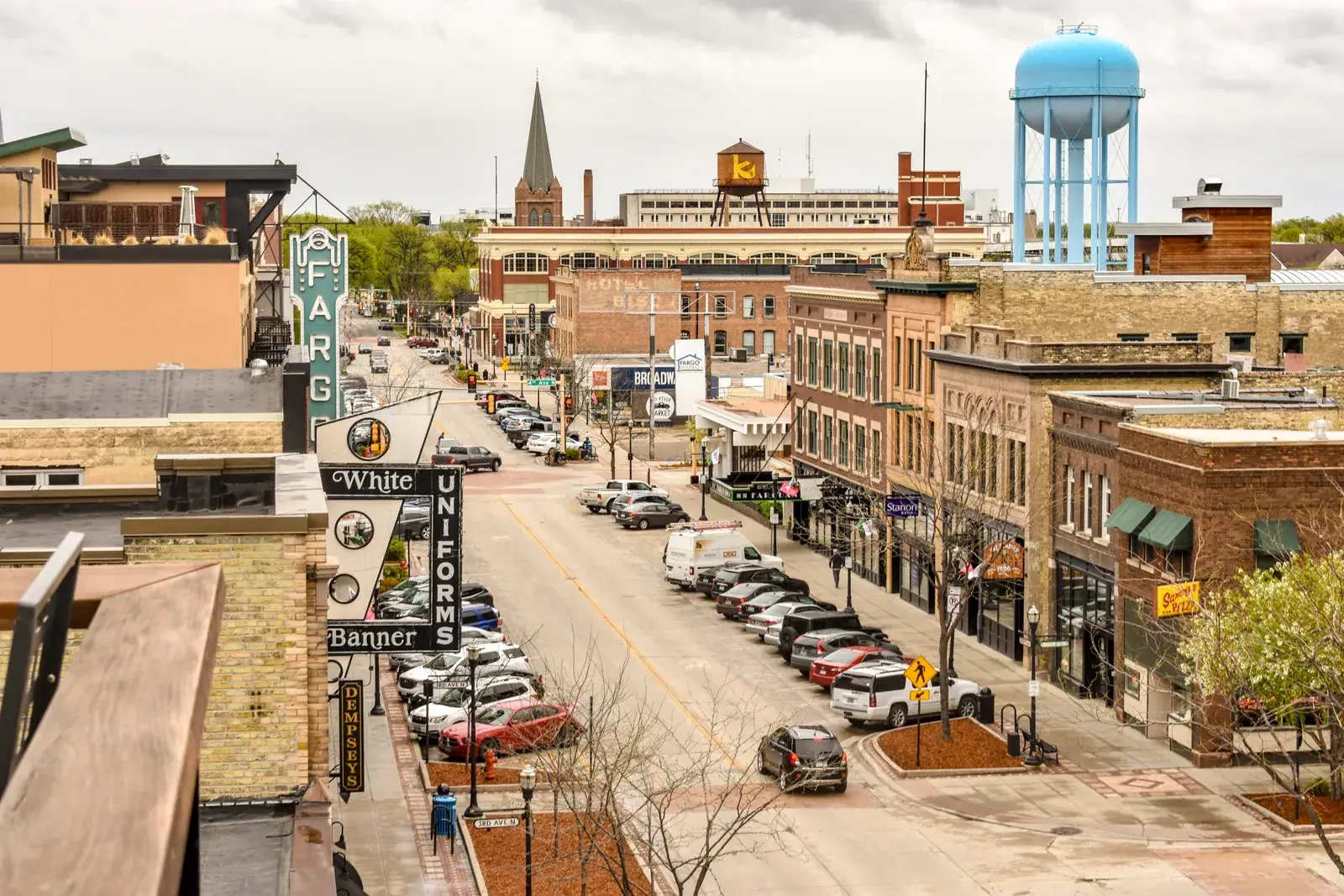
North Dakota statewide
North Dakota asks more of a commercial roof than almost any climate in the Lower 48, and it rewards owners who plan rather than react. We advise building owners, REITs, and asset managers on the roofs they hold across the state — from the manufacturing and distribution corridors of Fargo and West Fargo, to the government and healthcare campuses of Bismarck, the university and aviation footprint of Grand Forks, and the energy-driven building stock around Minot, Williston, Dickinson, and Stanley in the Bakken. We do not sell installation labor or staff a crew. Our role is independent: we inspect, document, forecast, and hold contractors and warranties accountable on your behalf.
Commercial roofing markets we serve in North Dakota
Explore owner-side commercial roof advisory in these North Dakota cities:
A climate that drives roofs to failure
North Dakota sits at the cold, dry, wind-swept edge of the Northern Plains, and that combination is unusually hard on low-slope commercial roofing. Long winters bring heavy ground snow loads that sit on flat roofs for months; the freeze-thaw cycling that follows works membranes, laps, and flashings loose far faster than a milder climate would. Spring melt overwhelms internal drains and scuppers that were never cleared, and standing meltwater finds every aging seam. Layered on top of that is relentless wind — the same steady plains wind that makes the state a national wind-energy producer also lifts membrane edges, fatigues fasteners, and turns a small flashing defect into a peeled-back field section.
For owners, the failure pattern is predictable once you know what to watch. The hazards we document most often across North Dakota assets include:
- Snow and ice loading that exceeds the roof's drainage capacity and stresses structural deck and parapets
- Ice damming at eaves and around rooftop equipment, forcing water back under the membrane
- Freeze-thaw splitting of aged membranes, sealants, and pitch pans
- Wind uplift at perimeters, corners, and poorly terminated edge metal
- Thermal shock from extreme temperature swings between deep winter and hot, dry summer
- Blocked or undersized drains that turn spring melt into ponding and interior leaks
The building stock we manage here
North Dakota's economy shapes the roofs we are asked to oversee. Agriculture anchors the state — roughly ninety percent of the land is farmland — so we routinely advise on grain handling, food processing, cooperative, and ag-equipment facilities with large metal and single-ply roof areas. The Bakken oil and gas play in the northwest drives a second tier of industrial buildings: shops, crew housing, fabrication, and logistics structures in and around Williston, Dickinson, and Minot, many built quickly during boom years and now reaching the age where roof systems need real planning rather than patching.
In the Fargo–West Fargo corridor, the state's chief manufacturing and distribution hub, we work across warehouse, light-industrial, retail, and office portfolios. Bismarck and Grand Forks add government, healthcare, higher-education, and aviation facilities to the mix. Each of these sectors carries a different roof profile — span, slope, membrane type, and rooftop equipment density — and an owner-side advisor's value is matching the right capital strategy to each, rather than treating a 200,000-square-foot distribution roof and a small clinic the same way.
Roof type follows function here in ways worth planning around. The large agricultural and distribution footprints tend toward metal panel and mechanically attached single-ply, where the exposures are fastener fatigue and seam stress under wind and snow. Older downtown and institutional buildings in Bismarck, Fargo, and Grand Forks often still carry built-up or modified-bitumen assemblies that age differently and reward restoration if caught in time. Knowing which system sits on which building, and how each behaves through a North Dakota winter, is the difference between a plan and a guess.
Condition reporting that holds up
Most of the surprises owners face in North Dakota are not surprises at all — they were visible at the last inspection and simply never documented in a form anyone could act on. We produce condition reports built for decision-making: photographed defects tied to roof location, a defensible remaining-service-life estimate for each roof section, moisture findings where infrared or core sampling is warranted, and a clear separation between what needs attention now, what can be scheduled, and what can be monitored. For portfolios, we standardize that reporting across every building so a regional asset manager can compare roofs on the same scale instead of reading a dozen inconsistent contractor write-ups.
Capital planning across a portfolio
The central question for an owner is rarely whether a given roof will fail — it is when, and how to fund the replacement without an emergency premium. We build multi-year capital plans that sequence repair, restoration, and replacement across a North Dakota portfolio by remaining service life, exposure, and budget year. That lets an owner phase spending, group nearby buildings to control mobilization cost, and avoid the worst outcome in this climate: a roof that fails mid-winter, when access is poor, costs spike, and a temporary repair is the only option. Planning also lets owners weigh restoration and coating against full replacement honestly, with the structure's deck condition and snow-load reality factored in rather than assumed.
North Dakota's working roof season is genuinely short, and that constraint should shape every owner's calendar. Major membrane work, adhesives, and many coatings have temperature minimums that the state's deep winter simply will not meet, which compresses the window for planned replacement and reroofing into a handful of months. An owner who discovers a failing roof in November is often left choosing between a winter emergency patch and waiting until spring with water already entering the building. We help owners stay ahead of that squeeze by scheduling inspections so decisions are made with months of lead time, and by sequencing the portfolio's known replacements into the buildable season rather than letting weather dictate the order.
The same logic governs winter response. When a leak or storm event does occur in the cold months, the realistic goal is a sound temporary stabilization that protects the interior and the deck until a permanent repair can be made properly. We advise on that triage — what to address immediately, what to monitor, and what to hold for spring — so an owner is not pressured into a full replacement at the worst possible time of year. Across the state, the owners who fare best are the ones who treat North Dakota's calendar as a planning input, not a surprise.
Warranty exposure and contractor oversight
Manufacturer and workmanship warranties are where owners quietly lose money, and the loss is almost always procedural. A warranty voided by uninspected foot traffic, unauthorized rooftop penetrations from an HVAC or solar contractor, or undocumented ponding is worth nothing when a claim is filed. We track warranty terms across the portfolio, flag the maintenance obligations that keep them valid, and make sure any new work — including the rooftop equipment changes common on North Dakota industrial buildings — is coordinated so coverage survives. When replacement or major repair is warranted, we help owners scope the work, evaluate bids on equal terms, and verify that what was specified is what gets installed. Because we hold no installation contract, that review answers to the owner alone.
Ownership structure complicates this further across North Dakota's industrial and agricultural property. Many Bakken-area buildings and distribution facilities are leased, and tenant-driven rooftop activity — added units, antennas, snow-removal crews walking the membrane — is exactly what erodes a warranty when no one is tracking it. We help owners set the documentation and notification habits that keep coverage intact across a tenant base, and we make the roof's condition legible to lenders and buyers when an asset trades. In a market where roofs are pushed hard by climate and use alike, that continuity of record is often what protects an owner's value at the moment it matters most.