
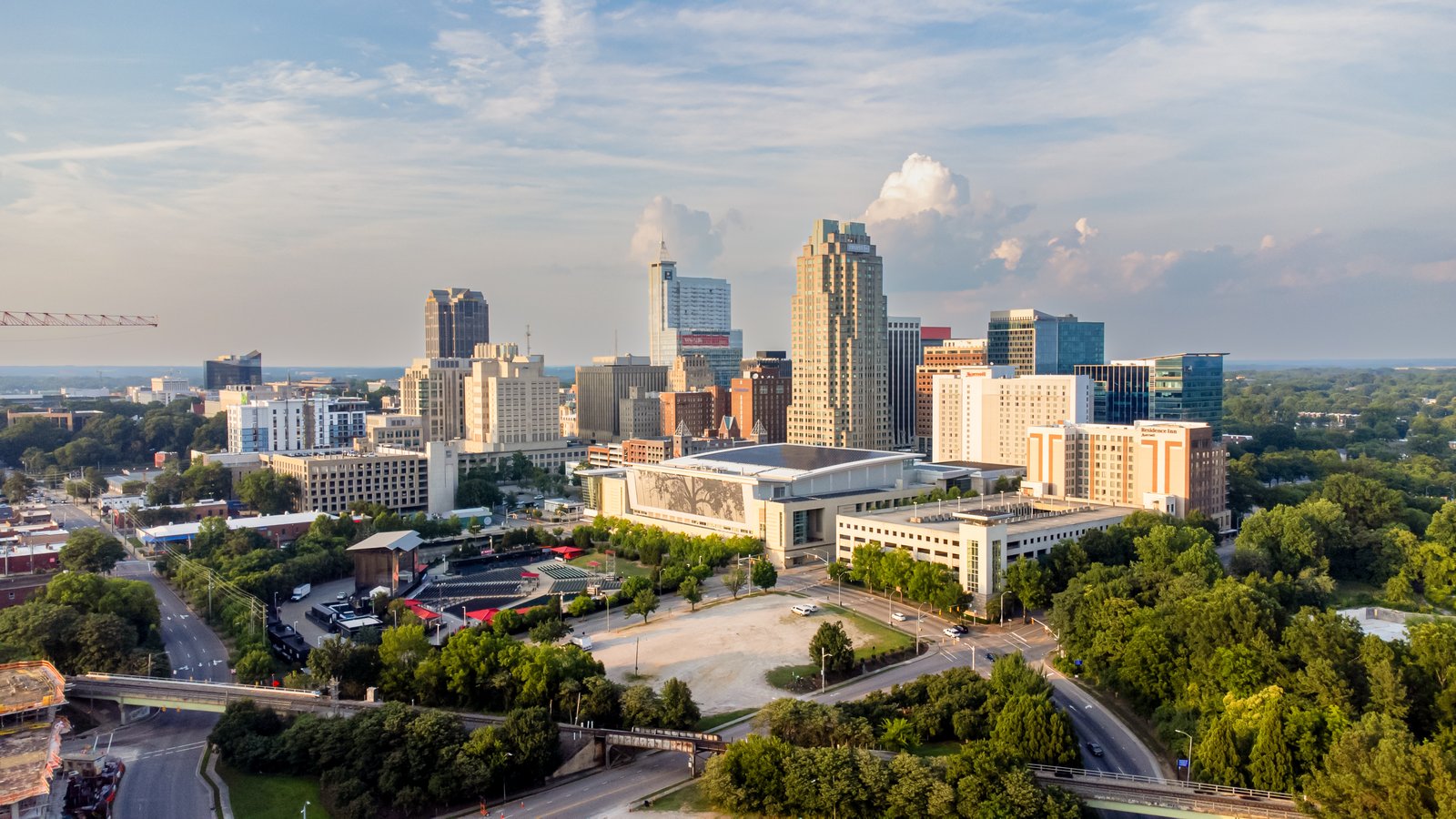
Raleigh commercial roofing
Raleigh's commercial roof stock has grown up alongside the Research Triangle's explosion of office, lab, and life-sciences space, and those roofs carry a workload set by North Carolina's humid, storm-prone climate. The Piedmont delivers long, hot, humid summers of heat and UV that age membranes and dry sealants, frequent heavy thunderstorms, a real hail season, and the outer reach of Atlantic tropical systems that push inland rain and damaging wind into the Triangle when a hurricane tracks up the coast or through the Carolinas. Owners here hold the office and R&D campuses around Research Triangle Park, the labs and cleanroom buildings that anchor Durham-Raleigh's biotech corridor, the distribution and manufacturing growth toward Interstate 40 and the Selma and Clayton submarkets, and the downtown, North Hills, and suburban office stock across Wake County. We advise those owners, REITs, and asset managers on documented condition, funded capital plans, and vendor-neutral contractor oversight.
Humidity, storms, and the tropical reach
The steady driver in the Triangle is heat and moisture. Long Piedmont summers of intense UV and high humidity age single-ply and modified-bitumen membranes from the top down, while the region's heavy thunderstorm rainfall overwhelms undersized or debris-clogged drainage and turns shallow low spots into chronic ponding. High ambient humidity and wide day-to-night temperature swings drive condensation into the assembly, and where vapor control was poorly detailed, insulation quietly takes on water.
The sharper hazard is convective and tropical. Spring and summer bring hail and straight-line wind that bruise membranes and lift edges on roofs whose perimeter attachment was never verified, and when an Atlantic system tracks inland, the Triangle catches tropical rainfall and gusts strong enough to test edge metal, parapets, and rooftop equipment far from the coast. A roof here has to survive both the slow humid grind and the occasional violent afternoon.
The owners and buildings we cover
Raleigh's roof stock is unusually weighted toward technical buildings. The lab, cleanroom, and life-sciences properties around Research Triangle Park carry roofs where interior humidity control and tenant uptime are non-negotiable, and a leak over sensitive equipment is a business emergency rather than a maintenance ticket. The office campuses and corporate build-out across Wake County add large low-slope fields, while the newer distribution and manufacturing roofs along I-40 and out toward Johnston County are single-ply systems where a small unrepaired detail compounds unseen across acres. The older downtown and inner-suburb inventory carries aging assemblies on tighter footprints. An owner spread across these profiles cannot manage them to a single assumption.
An independent report before you approve a bid
After a Carolina storm season, roofing solicitations arrive in waves, most offering a free inspection that ends in a replacement quote. Because we sit only on the owner's side, our condition report is not built to sell a re-roof. We document membrane type and age, seam and attachment condition, flashing and penetration detailing, drainage performance, insulation moisture where humidity damage is suspected, and realistic remaining service life, then photograph and locate every defect so this year's report is directly comparable to next year's. On a lab or R&D building, that baseline is what protects sensitive interior space from an avoidable leak; on any roof, it lets an owner file a legitimate storm claim inside the required window and reject a manufactured one. It is part of our North Carolina commercial roof advisory coverage, and it keeps the replace-or-maintain decision with the owner who carries the capital risk.
Capital planning and warranty exposure
Triangle portfolios mix young, high-value lab and office roofs with older suburban inventory, and the two demand opposite strategies: protect and extend the new ones through disciplined maintenance and warranty compliance, and sequence the older ones so replacements land deliberately rather than as emergencies. We build multi-year capital forecasts that put every roof on a funded timeline, so budgeting reflects real condition instead of last season's surprise, and so a re-roof over an occupied lab is planned around tenant operations rather than forced by a failure.
Warranty exposure carries real weight here. Manufacturer coverage on single-ply systems sets strict conditions, and Raleigh roofs routinely put them at risk: ponding beyond warranty limits during the heavy rain season, tropical-storm damage that goes undocumented past the filing window, and the constant rooftop work of equipment-heavy lab and office buildings that voids coverage on the affected areas when tenants and trades cut penetrations without authorization. We track warranty terms, expiration dates, and compliance obligations across the portfolio and flag the routine actions that keep coverage intact, so a high-value roof is not silently uninsured when the next system moves up the coast.
Raleigh market coverage
We provide owner-side commercial roof advisory across Raleigh, North Carolina and the surrounding metro.