
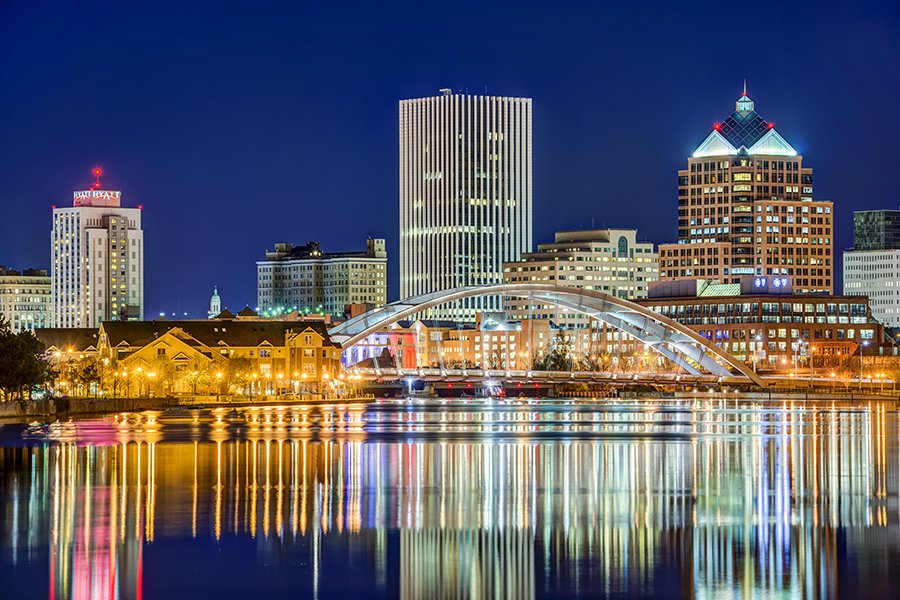
Rochester commercial roofing
Rochester sits on the south shore of Lake Ontario in one of the snowiest metros in the country, and snow load is the single most important thing an owner here can plan around. Lake-effect bands drop heavy, wet snow that accumulates on low-slope roofs and imposes real structural load, and the region's long, cold winters keep that snow and ice in place while relentless freeze-thaw cycling works every seam and flashing loose. The commercial building stock reflects the city's optics, imaging, and advanced-manufacturing heritage: large industrial and R&D campuses tied to the region's technology and photonics economy, the warehouse and distribution product along the Interstate 90 and Interstate 390 corridors, and the office, medical, and institutional inventory around downtown, the University of Rochester, and the region's hospitals. Many are broad low-slope membrane roofs carrying heavy winter loads. For owners and asset managers holding that stock, we provide documented condition, capital planning, and contractor oversight built for the lake-effect climate.
Snow load, ice dams, and drainage in a hard winter
Rochester's winter is a structural problem, not just a weather one. Deep, wet lake-effect snow adds substantial load to low-slope roofs, and where drifting piles it against parapets and equipment the load concentrates unevenly. Meltwater refreezes at eaves, drains, and cold edges to form ice dams that force water back under flashings and into the assembly, and the constant freeze-thaw cycling of a long winter opens seams and cracks aged membranes a little more with each swing. Internal roof drains and scuppers that freeze or clog turn a manageable snowmelt into ponding and backup.
Summer is short but not idle. Heat and UV age the membrane and accelerate seam breakdown, convective storms bring hail and heavy rain that overwhelm drainage, and humidity swings drive condensation and trapped moisture inside assemblies whose vapor control was poorly detailed. Insulation that took on water over the winter loses R-value and rots the deck below long before the surface shows it.
Owner-side condition reporting built for load
For a Rochester owner, the foundational deliverable is a standardized condition report on every roof, with particular attention to drainage capacity, structural condition, and moisture given the winter load: membrane type and age, seam and flashing integrity, drainage and internal-drain performance, insulation moisture where investigation is warranted, and realistic remaining service life. We photograph and locate every defect so this year's report is directly comparable to next year's, which is what lets an owner watch a roof deteriorate rather than simply learn it has failed after a heavy-snow winter.
Because we sit on the owner's side and never sell or install a roof, that reporting is not built to sell a re-roof. A roof with serviceable life left should be maintained, kept drained, and monitored, not replaced because a crew is available, and knowing which roofs can safely carry another winter and which cannot is the core of a defensible plan.
Capital planning and warranty exposure
Warranty conditions are where Rochester owners quietly lose money, because the local climate stresses exactly the terms manufacturers care about: ponding and drainage limits, snow and ice concerns, and maintenance-record requirements a manufacturer enforces before honoring a claim. We track warranty terms, expiration dates, and compliance obligations across the portfolio and flag the routine actions, including keeping drains clear through the winter, that keep coverage intact. This is part of our broader New York commercial roof advisory coverage, and it feeds directly into multi-year capital forecasts that put every roof on a funded timeline instead of leaving replacements to land as winter emergencies.
Rochester market coverage
We provide owner-side commercial roof advisory across Rochester, New York and the surrounding metro.