
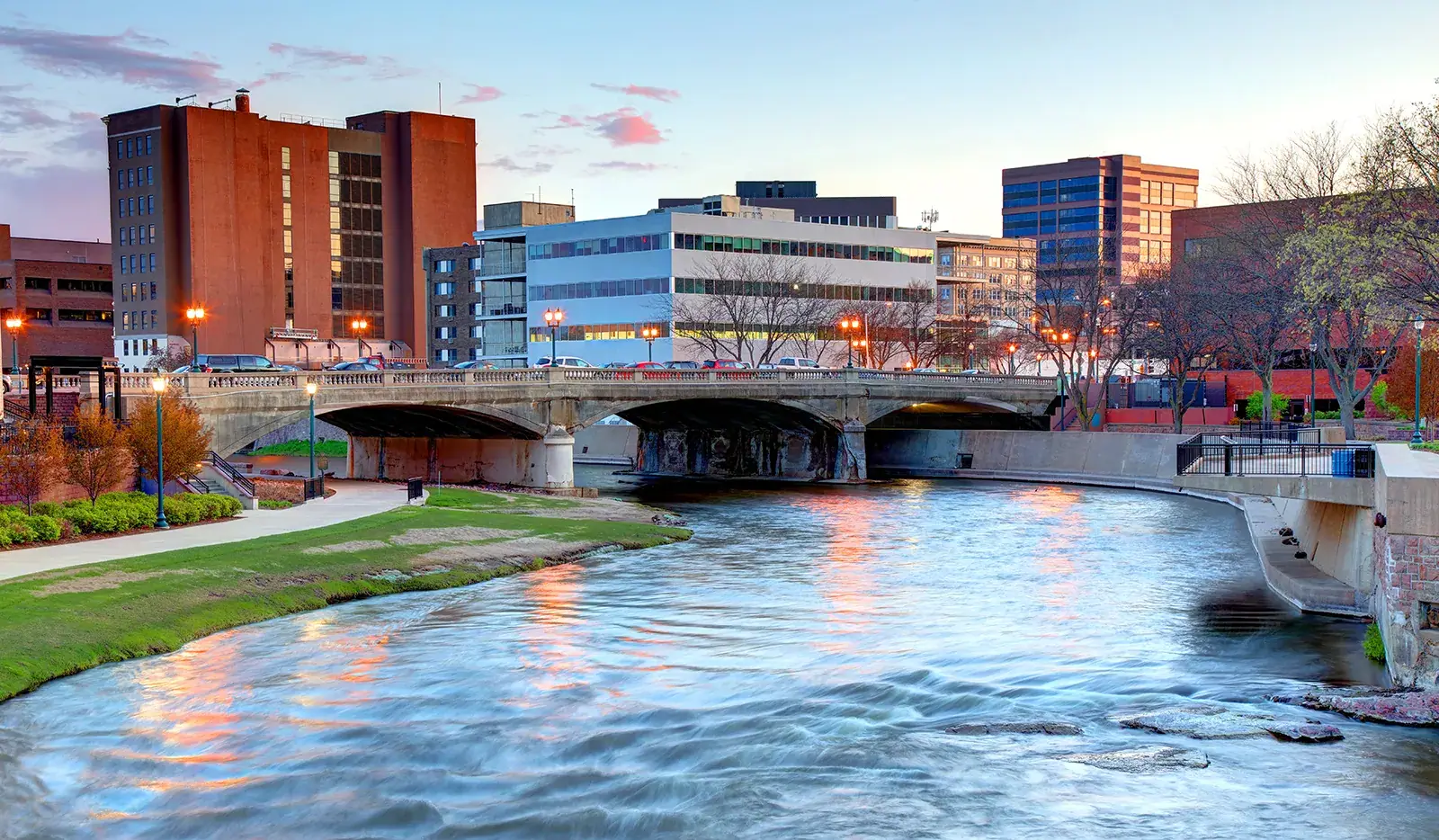
South Dakota statewide
A commercial roof in South Dakota lives through a climate of extremes. Sitting in the center of the continent, far from any moderating ocean, the state swings from summer heat into deep winter cold, and a roof must carry heavy snow, survive repeated freeze-thaw, and shrug off some of the largest hail in the country. We advise building owners, REITs, and asset managers on the roofs they hold across the state, working strictly on the owner's side. We are not a roofing contractor and we sell no membrane. Our work is condition assessment, capital planning, warranty oversight, and the disciplined judgment of when a roof needs work and when it is sound enough to leave alone.
Commercial roofing markets we serve in South Dakota
Explore owner-side commercial roof advisory in these South Dakota cities:
The markets we cover across South Dakota
South Dakota's commercial roof stock concentrates in two anchors at opposite ends of the state, with smaller markets in between. Sioux Falls, by far the largest city, is the economic center: a deep base of food processing led by Smithfield's pork operation, two major health systems in Sanford and Avera, and a notable cluster of financial firms drawn in part by the absence of a state corporate income tax. That mix produces large processing plants and refrigerated facilities, hospital campuses, office and operations centers, and the distribution buildings that feed off the I-29 and I-90 interchange.
Rapid City anchors the west, gateway to the Black Hills, with a tourism-driven hospitality base, the Monument Health system, and long-running cement production. Between the two sit smaller commercial markets in Aberdeen, Brookings, Watertown, and Mitchell, serving agriculture, light manufacturing, and regional trade. The climate divide between east and west is real: the eastern plains around Sioux Falls and the higher, snowier Black Hills around Rapid City load a roof differently, and we plan for each accordingly.
What actually drives roof failure here
South Dakota's weather punishes roofs in ways that mild-climate buildings never see. Most of the state averages at least thirty inches of snow a year, and parts of the Black Hills receive far more, with March often the snowiest month. Snow load is a structural and drainage problem at once: accumulation stresses the deck, and the melt-and-refreeze cycle drives water under flashings and into seams. The continental position produces enormous temperature swings, including the famous Spearfish event where the temperature jumped nearly sixty degrees in two minutes, and that thermal cycling expands and contracts a membrane until seams and fasteners fatigue.
Severe summer storms add hail to the mix, and South Dakota holds the national record for hailstone size, set near Vivian. The forces we plan against across South Dakota include:
- Heavy snow load and drifting that stress the structure and force water toward seams, drains, and parapet flashings during melt.
- Freeze-thaw cycling that opens membrane seams, splits sealants, and works moisture into and beneath the roof assembly.
- Ice damming and refreeze at eaves, drains, and low points, where standing meltwater backs up under the membrane.
- Severe summer hail and high wind, capable of bruising or puncturing single-ply membranes and damaging rooftop equipment.
- Wide daily and seasonal temperature extremes that fatigue materials through constant expansion and contraction.
The owner-side advisory difference
A contractor's inspection naturally points toward work the contractor can sell. Our position is the opposite: we represent the owner, and our only deliverable is honest judgment about the asset. We document each roof against its realistic remaining service life, separate the defect that truly threatens the building from cosmetic wear that can be watched, and tell an owner plainly when the right answer is to wait another season rather than spend.
For South Dakota owners and asset managers, that posture is practical. We build condition reports an asset manager can underwrite against. We produce multi-year capital plans that sequence repair, restoration, and replacement across a portfolio so capital lands where exposure is greatest, often on the largest low-slope roofs over processing plants and distribution buildings, where a snow-load or drainage failure does the most damage. And we read the actual building stock an owner holds, whether that is a Sioux Falls food-processing facility, a hospital campus, or a Black Hills hospitality property.
Warranty exposure and capital planning
Manufacturer warranties on commercial membranes are narrower than most owners assume, and in a snow-and-hail climate the exclusions bite. Coverage often hinges on drainage performance, on freedom from ponding, and on rules about who is permitted on the roof, conditions easily compromised when snow removal crews or HVAC trades walk a membrane in winter. After a hail event, the line between a covered manufacturing defect and excluded impact damage decides whether a claim is paid. We help owners understand what their warranties actually cover, maintain the documentation that protects coverage, and avoid the routine mistakes that quietly void it.
Capital planning in South Dakota means budgeting for the winter and the storm season at once. A roof that looks fine in October may carry drainage or seam weaknesses that the first heavy snow exposes, and hail can age a membrane years overnight. We help owners weigh restoration against full replacement, schedule major work into the narrow warm-weather window the state allows, and avoid the deferred-maintenance trap where a small unaddressed defect becomes an emergency in February when no crew can safely work the roof.
How we work with owners and asset managers
We serve as the owner's standing roof advisor across a single building or an entire South Dakota portfolio. Engagements usually begin with a baseline condition survey of each roof, a remaining-service-life estimate, and a prioritized capital plan. From there we provide recurring inspections timed to the seasons that matter most here: a fall assessment before snow arrives, a spring inspection to catch what winter did, and prompt evaluation after a significant hail or wind event.
When work becomes necessary, we help owners scope it, evaluate bids on the merits rather than the pitch, and verify that what gets installed matches the specification and satisfies the warranty. Because the working season is short, sequencing matters, and we plan so that critical repairs are completed before the weather closes the window. The result is an ownership group that always knows the true condition of its roofs, the exposure each one carries, and what comes next, whether the asset sits in Sioux Falls, Rapid City, or one of the regional markets across the state.