
Roof Systems
Modified bitumen, often shortened to mod-bit, is one of the most widely installed low-slope roof systems in North America, and for good reason: it descends directly from the old built-up roof but trades on-site kettles and layered felts for factory-made rolls that go down faster and more predictably. For owners who manremember the tar-and-gravel era, mod-bit feels familiar; for newer owners, it sits as a middle ground between traditional asphalt systems and the single-ply membranes that now dominate the market. This guide explains what the system actually is, where it earns its keep, and the tradeoffs we ask owners to weigh before committing capital to it.
What Modified Bitumen Is and How It's Built
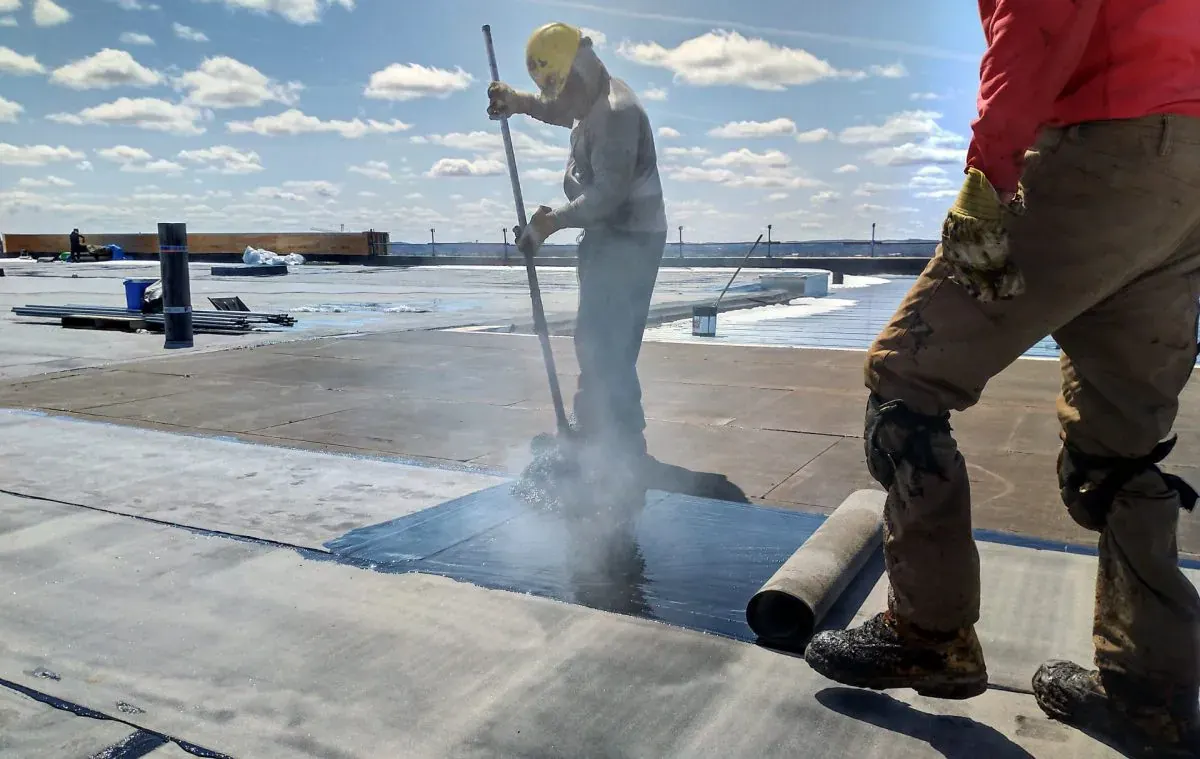
Modified bitumen is asphalt that has been chemically modified with polymers to improve flexibility, weathering, and temperature tolerance, then manufactured into rolls reinforced with fiberglass or polyester mats. The two dominant chemistries are APP (atactic polypropylene), which produces a stiffer, more plastic-like sheet typically torch-applied, and SBS (styrene-butadiene-styrene), which yields a more rubbery, elastic sheet that can be installed with hot asphalt, cold adhesive, or self-adhered membranes. A finished mod-bit roof is almost always a multi-ply assembly: a base sheet anchored to the deck or insulation, one or more interply sheets, and a cap sheet that carries the surfacing.
That layered construction is the system's defining trait. Where a single-ply membrane relies on one continuous sheet and its seams, mod-bit builds redundancy into the assembly, so a flaw in one ply does not necessarily reach the deck. Cap sheets are frequently surfaced with mineral granules for UV protection, and white or reflective granules are available where cool-roof performance matters.
Typical Lifespan and Performance
A well-installed, properly maintained mod-bit roof typically lasts in the range of 15 to 25 years, with two-ply and three-ply assemblies on the longer end and single-ply-thickness mod-bit on the shorter end. Service life depends heavily on the number of plies, the quality of the surfacing, and how aggressively the building's foot traffic and rooftop equipment work the membrane. Mod-bit performs well underfoot and resists punctures better than thin single-ply membranes, which is part of why it remains popular on roofs that see frequent service access.
Thermal cycling is the system's long-term enemy. As the asphalt ages it loses oils and grows brittle, and seams and flashings are usually where failure begins. SBS sheets generally retain low-temperature flexibility longer than APP, which is one reason SBS has gained share in colder climates.
Where Modified Bitumen Fits Best
Mod-bit is at home on low-slope commercial roofs where durability and traffic resistance outweigh the desire for the lightest or most reflective assembly. It is a strong candidate in several situations:
- Roofs with heavy or frequent foot traffic, such as buildings with rooftop mechanical equipment requiring regular service.
- Smaller and mid-sized roofs with many penetrations, parapets, and transitions, where the self-adhered and torch-down sheets detail cleanly.
- Plaza decks, balconies, and other areas where a robust, redundant membrane is wanted under pavers or overburden.
- Re-roof projects where an owner wants a proven, repairable system that local crews know well.
It is a less obvious choice on very large, simple roof fields where a single-ply membrane can be installed faster and lighter, or where building codes and insurers push hard toward high-reflectivity cool roofs.
Strengths and Limitations for an Owner
Mod-bit's appeal is its toughness and the broad pool of contractors who can install and repair it. Its drawbacks tend to surface around installation method and surfacing. We summarize the tradeoffs this way:
- Strength: multi-ply redundancy and good puncture resistance, forgiving of rooftop traffic.
- Strength: repairable with widely available materials and familiar to most regional roofers.
- Strength: detailing at curbs, drains, and penetrations is straightforward and reliable.
- Limitation: torch-applied APP carries a real fire risk during installation and is restricted or prohibited on some occupied and combustible-deck buildings.
- Limitation: darker, granule-surfaced sheets run hotter than reflective single-plies unless a cool-roof cap is specified.
- Limitation: heavier than single-ply, which can matter on weight-sensitive structures.
Warranty and Maintenance Realities
Manufacturer warranties on mod-bit commonly run 10 to 20 years and are tied tightly to approved assemblies and certified applicators. Owners should read past the headline term: most warranties cover material defects and, in their stronger forms, labor to repair leaks, but they almost always exclude ponding water, damage from foot traffic, and consequential damage to the building interior. A warranty is only as good as the documentation behind it, so we advise keeping the approved assembly details, applicator certification, and inspection records on file.
Maintenance is modest but not optional. Twice-yearly inspections, prompt sealing of opened laps and flashings, drain clearing, and keeping traffic off unprotected field areas will extend service life materially. Mod-bit rewards routine attention because small problems are cheap to repair before water tracks between plies.
How We Advise Owners Evaluating Modified Bitumen
When an owner is weighing mod-bit, we start with the building's use and the roof's complexity rather than the brochure. If the roof carries heavy equipment and sees regular service traffic, mod-bit's durability often justifies its weight and cost. If the roof is a large, simple field on a weight-sensitive structure in a hot climate, we usually have the owner compare it honestly against a reflective single-ply. We also press on installation method: where a combustible deck or occupancy is involved, we steer toward self-adhered or cold-applied SBS rather than open-flame torching, and we confirm the contractor's fire-watch and safety protocols in writing. Finally, we recommend specifying a reflective cap where energy codes or cooling loads make it worthwhile, and budgeting for the inspection cadence that keeps a redundant system performing for its full expected life.
Put the system choice into an owner decision
Before approving a roof system, align field condition, moisture findings, drainage, attachment, warranty terms, operational constraints, and hold period. Commercial Roofing Advisors can review those inputs without tying the recommendation to one material or contractor.