
Decision Guide
A roof coating can cost a fraction of a full replacement and extend a serviceable membrane for years, which makes it one of the most attractive numbers an owner will see all year. It is also one of the most misapplied. A coating buys time on a roof that has time left to buy; it does nothing for a roof that is already wet beneath the membrane. The return on either decision depends almost entirely on the condition you are starting from, and the goal of this guide is to help building owners and asset managers judge which path actually produces the better return rather than the lower invoice.
What a Coating Actually Does
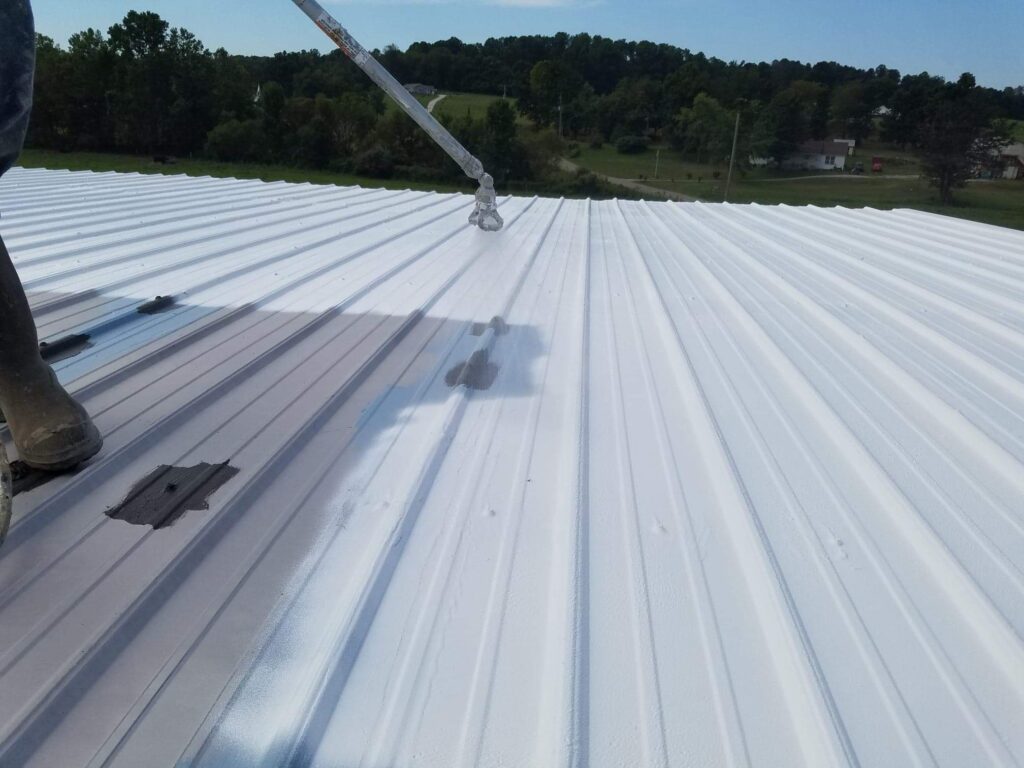
A fluid-applied coating, typically silicone or acrylic, is a monolithic membrane sprayed or rolled over an existing roof to seal seams and penetrations, restore reflectivity, and add a layer of waterproofing. On a sound but aging single-ply or modified bitumen roof, a properly specified coating can add a meaningful stretch of reliable service and, with the right system, carry a renewable manufacturer warranty. Silicone performs well against ponding water; acrylics are economical and breathable. Both depend on a clean, dry, adhered substrate, which is why surface preparation and infrared or capacitance moisture scanning are not optional steps but the entire basis of the decision.
What a coating does not do is replace insulation, correct an undersized drainage design, or rescue a deck that is corroding underneath. It is a restoration of a working assembly, not a substitute for a failed one.
When the Coating Wins on ROI
For the right roof, the math is genuinely favorable. The conditions that point toward coating as the higher-return choice are specific and checkable:
- The membrane is intact, adhered, and free of widespread blistering or splitting.
- A moisture survey confirms the insulation beneath is dry, with no more than isolated, repairable wet areas.
- The roof has meaningful structural life left and the building's hold period justifies extending rather than replacing.
- The existing assembly is compatible with the coating chemistry and warranty terms.
- Reflectivity gains will reduce cooling load on a conditioned building in a warm climate.
In that scenario, a coating defers a large capital outlay, often qualifies as a maintenance or repair expense rather than a capital improvement, and resets a usable warranty, all at a small share of replacement cost. The return is strong precisely because you are spending a little to protect a lot of remaining value.
When Replacement Is the Honest Answer
Coatings get oversold, and the failure mode is predictable: a coating applied over wet insulation seals the moisture in, accelerates deck corrosion, and produces a roof that looks restored while quietly deteriorating beneath a warranty that excludes the very condition causing the damage. If the moisture survey shows saturation across a significant percentage of the field, the responsible recommendation is replacement, full stop. The same is true when the membrane is at the end of its mechanical life, when the deck shows corrosion, or when energy code or drainage deficiencies can only be corrected by tearing off and rebuilding the assembly with new insulation, tapered to drain, and a new cover board and membrane.
Replacement costs more, but on a failed roof it is the only spend that produces a return. Coating a roof that needs replacing is not a savings; it is a deferral that adds the wasted coating cost to the eventual replacement bill.
Run the Numbers Over the Hold Period
The clean way to compare the two is cost per year of reliable service across your ownership horizon. Divide the all-in cost of each option by the years of dependable performance it realistically delivers, and weigh that against how long you intend to hold the asset. A coating that adds several years at a low cost per year is the better decision for an owner planning to sell or refinance inside that window. A replacement with a long warranty and decades of service may be the better decision for a long-term hold, even at a higher cost per year, because it removes the roof from the risk register entirely.
Two factors sharpen the comparison. First, the accounting treatment differs: a restoration coating is often expensed while a replacement is capitalized and depreciated, which changes the after-tax picture and the effect on reported NOI. Second, the warranty position differs, and warranty is risk transfer that has real dollar value at sale and at insurance renewal.
The Documentation That Protects Either Choice
Whichever path an owner takes, the evidence behind it is what protects the value. A coating decision should be backed by the moisture survey, adhesion or pull testing, the specified system and mil thickness, and the registered warranty. A replacement should be backed by core cuts, deck condition reports, the approved assembly detail, and closeout documentation. Either way, the file is what convinces a buyer, a lender, or an insurer that the spend was sound and the roof is in the condition you represent.
How We Help Owners Decide
We work owner-side and carry no allegiance to a coating line or a replacement crew, so our recommendation follows the condition rather than the sale. We commission or review the moisture survey and core cuts, judge whether the existing assembly is a genuine candidate for restoration, and build the cost-per-year comparison against your hold period and capital plan. When a coating is the right call, we specify it to a warrantable standard and document it; when replacement is the only honest answer, we say so and help you budget and time it. For owners managing a portfolio, we apply the same discipline building by building, so capital goes where it earns a return and nowhere it merely defers a problem.