
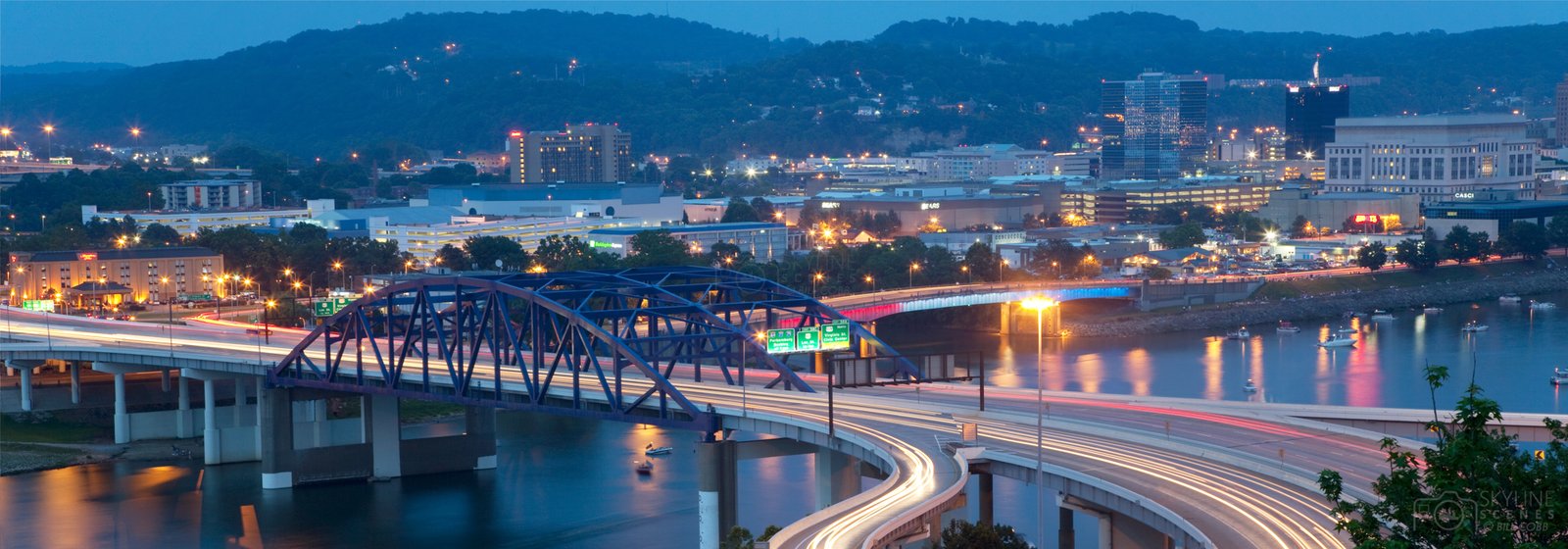
Charleston commercial roofing
Charleston sits in the Kanawha Valley, where the commercial roof stock ranges from the state capitol complex and downtown government and office buildings to the medical district around CAMC, and out along the river to the chemical and manufacturing plants of the corridor toward Institute, Nitro, and South Charleston. The valley's terrain shapes the weather load: humid Appalachian summers with strong UV, heavy rainfall that funnels through steep drainage and can flood low ground along the Kanawha and Elk rivers, and winters cold enough for snow load, ice, and hard freeze-thaw cycling. For the owners, public agencies, and industrial operators holding this property, that mix ages roofs unevenly and largely out of sight. We advise the owner's side with documented condition, capital planning, and independent contractor oversight built for the region.
Valley rain and freeze-thaw
Two forces dominate here. The first is water. The Kanawha Valley gets substantial rainfall, and the surrounding terrain concentrates runoff, so a flat commercial roof with undersized or debris-clogged drains ponds quickly and stays wet, working moisture into every marginal flashing and seam. The second is freeze-thaw. Appalachian winters cycle above and below freezing repeatedly, and each cycle pries a compromised seam or lap a little further open. Heavy tree canopy across the valley adds organic debris that clogs drains and holds moisture against the membrane. Together these turn small, ignorable defects into active leaks over a season or two.
Because that failure is slow and hidden, an owner usually learns of it only when interior water appears, by which point the conversation has already shifted from repair to replacement.
Government, medical, and industrial roofs
Charleston's commercial inventory is weighted toward long-held institutional and industrial property: state and county government, healthcare, and the plants and warehouses of the chemical corridor. Those owners need standardized reporting and deliberate planning rather than reactive spending. A young single-ply roof on a corridor warehouse and an aging built-up roof on a government building demand opposite strategies, and we track membrane type, age, and remaining service life for each so the owner sees the whole portfolio on one honest timeline. Industrial roofs in particular carry rooftop equipment and process penetrations that need disciplined oversight to keep both the roof and its warranty intact.
Independent oversight protects your capital
A contractor's free inspection ends in a sales recommendation; an owner-side condition report does not. We document what is actually on the roof, photograph and locate every defect so each year's report is directly comparable to the last, and separate the roofs that genuinely need work from the ones that need only maintenance and monitoring. When work is warranted we scope it, competitively bid it, and hold the contractor to the documented condition rather than to their own estimate. In a market where severe-weather seasons bring waves of roofing solicitations, an owner with baseline data holds the stronger hand. This is part of our West Virginia commercial roof advisory coverage, serving owners across Charleston and the Kanawha Valley.
Charleston market coverage
We provide owner-side commercial roof advisory across Charleston, West Virginia and the surrounding metro.