
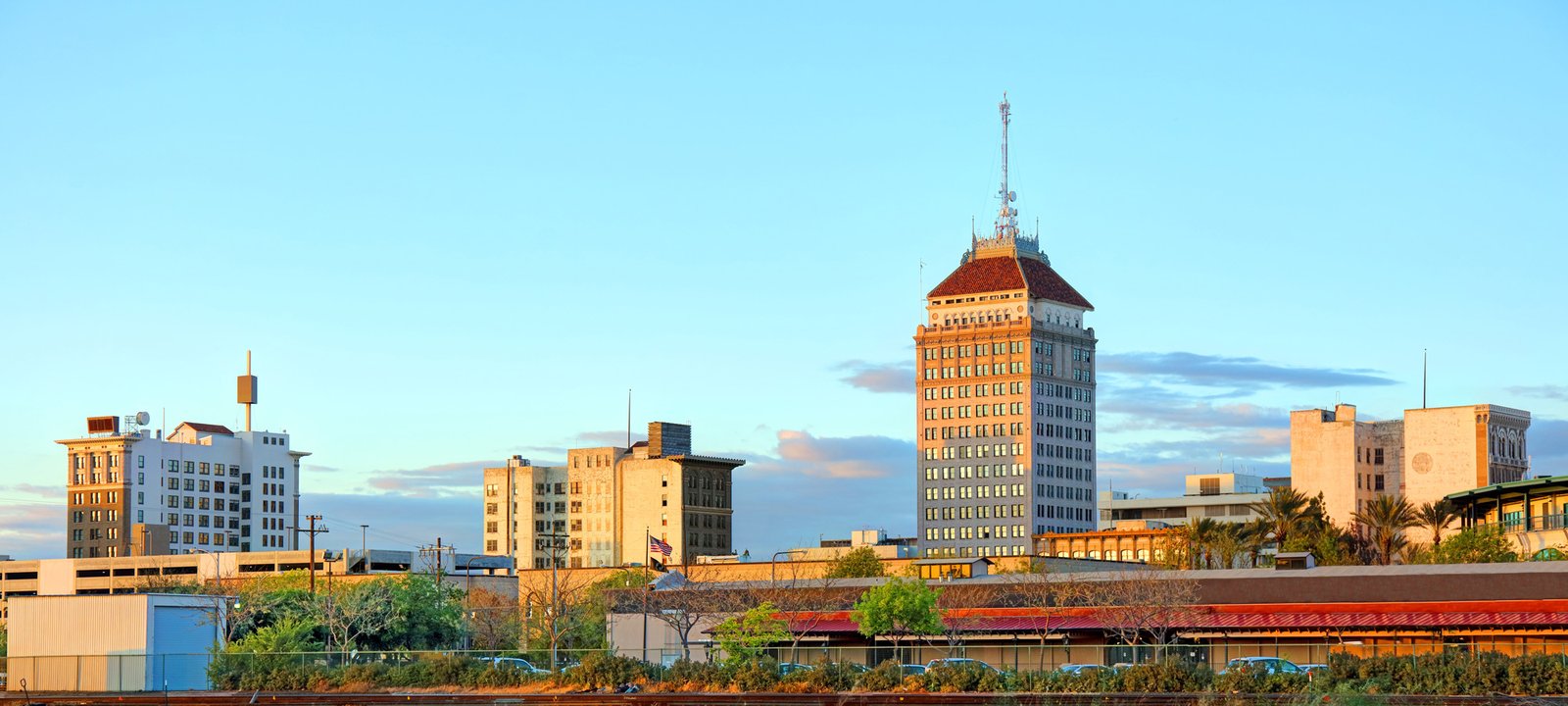
Fresno commercial roofing
Fresno sits at the heart of the San Joaquin Valley, and its commercial roofs live under one of the most punishing thermal loads in California. Summers here are long, dry, and severe, routinely stacking weeks of triple-digit heat with unrelenting ultraviolet exposure, and the valley's stagnant air traps agricultural dust and, during fire season, dense wildfire smoke that settles onto rooftops and dulls reflective surfaces. Winters bring tule fog, real freeze nights, and the occasional atmospheric-river deluge that tests drainage built for an arid norm. For owners holding food-processing plants, cold storage, packing houses, and distribution buildings across the industrial districts south and west of downtown, along Golden State Boulevard, and out toward the Highway 99 and 41 corridors, that climate ages membranes fast and attacks the very details that keep a low-slope roof watertight.
Central Valley building stock and what it needs
Fresno's commercial inventory is shaped by agriculture and logistics. Enormous low-slope roofs cover food-processing facilities, cold-storage warehouses, and packing operations, and these are not ordinary buildings: refrigerated interiors and process humidity make the roof assembly's vapor behavior a serious matter, because condensation and trapped moisture inside a cold-storage deck can quietly ruin insulation and rot structure long before anyone sees a drip. Add the general-industrial and distribution stock along 99 and the older downtown and Tower District commercial buildings, and an owner faces a portfolio where a new tilt-up roof and a decades-old built-up roof demand opposite strategies.
The scale of the industrial roofs changes the math of roof management. On a processing plant or distribution building covering hundreds of thousands of square feet, a deferred repair is not a small line item, and an emergency replacement can dominate a year's capital budget. That is precisely where documented condition and a funded plan earn their keep.
What actually drives roof failure here
The valley's dominant failure driver is sustained heat and UV. Long, intense summers degrade membranes, bake seams and adhesives, and shorten the realistic service life of any roof that is dark or poorly maintained. Agricultural dust and wildfire ash compound the problem by coating reflective coatings and raising surface temperatures. When the rains finally come, they come hard and concentrated, and drainage that sat dry for months is suddenly overwhelmed, exposing ponding, clogged drains, and weak flashing. On refrigerated buildings, the interior-exterior temperature differential drives condensation risk that ordinary warehouses never face, making moisture inside the assembly a first-order concern rather than an afterthought.
Because these mechanisms act slowly and out of sight, the trajectory matters more than any single visit. Creeping seam failure and hidden wet insulation rarely announce themselves until the deck is compromised or a tenant reports damage, and by then the fix is a replacement rather than a repair. Our role is to catch the trend early, while it is still cheap, which is the same discipline we bring across our California commercial roof advisory coverage.
Owner-side condition reporting and reserves
For an owner or asset manager, the foundational deliverable is a standardized, honest condition report for every roof in the portfolio. We document membrane type and age, seam and attachment condition, flashing and penetration detailing, drainage performance, and insulation moisture where investigation is warranted, with particular attention to the vapor and condensation realities of Fresno's refrigerated and process buildings. We photograph and locate defects so this year's report compares directly to next year's, letting an owner watch a roof decline rather than simply discover it has failed.
Because we sit on the owner's side of the table, our reporting is not built to sell a re-roof. A roof with life left should be maintained and monitored, not replaced because a crew is available. Across a valley portfolio of mixed ages and types, that distinction is the difference between a defensible multi-year capital plan and a reactive scramble, and it is where the real money is saved.
Why owners bring in an independent advisor
Warranty exposure is where Central Valley owners quietly lose the most. Manufacturer warranties on single-ply and coating systems carry strict conditions, and Fresno's realities put them at risk: rooftop equipment and refrigeration penetrations added without authorization that void coverage, ponding after a rare heavy storm that exceeds warranty limits, and missing maintenance records the manufacturer demands before paying a claim. We track warranty terms, expiration dates, and compliance obligations across the portfolio and flag the routine actions that keep coverage intact. When work is genuinely needed, we scope it, competitively bid it, and hold the contractor to the documented condition rather than to their own estimate, so a high-value processing or cold-storage asset stays understood, budgeted, and protected by the people who carry the risk.
Fresno market coverage
We provide owner-side commercial roof advisory across Fresno, California and the surrounding metro.