
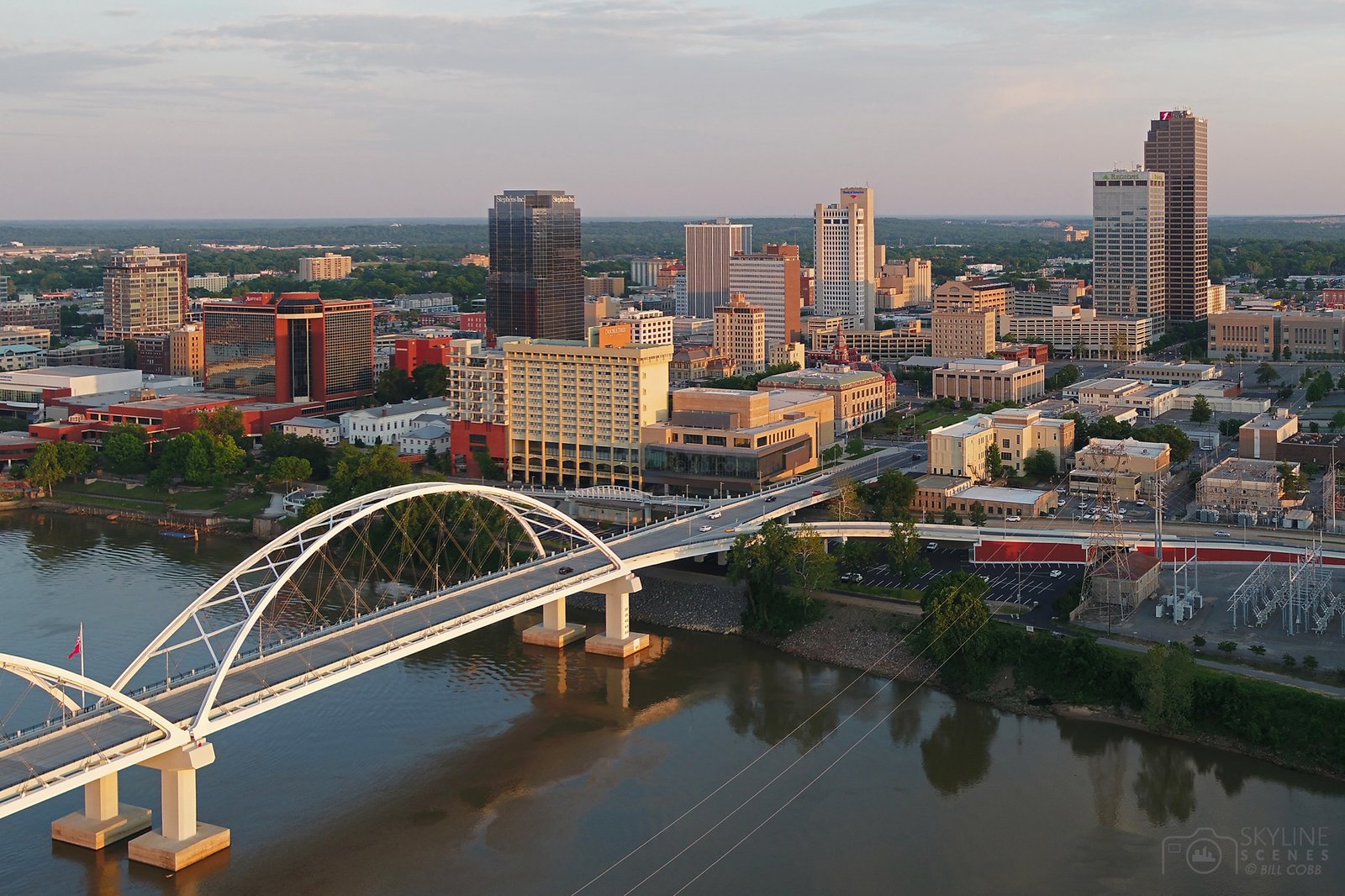
Little Rock commercial roofing
Little Rock sits where the humid South meets the storm-prone lower Great Plains, and its commercial roofs face one of the more volatile hazard mixes in the country: violent spring severe weather, damaging hail, the occasional tornado, and winter ice storms that load and crack roofs the warm months have already fatigued. The downtown office core and the River Market district along the Arkansas River, the state government complex around the Capitol, the medical corridor anchored by UAMS and Baptist Health, and the warehouse and distribution belt around the port, the airport, and the I-30 and I-40 interchanges all carry low-slope membrane and metal that absorb hot, humid summers and then take the punishment of the region's storm seasons. We advise Little Rock owners, REITs, and asset managers with independent condition reporting and capital planning built for that reality.
What the central Arkansas climate does to a roof
The signature threat is severe convective weather. Spring and early summer bring supercell storms that drop hail large enough to bruise membranes, fracture aged coatings, and split seams in minutes, along with straight-line winds and tornadoes that lift edges and parapets on any building whose perimeter attachment was never verified. Hail damage in particular is often invisible from the ground and only surfaces as leaks months later, which makes documented pre-storm and post-storm condition the difference between a paid claim and a denied one.
The rest of the year works on the roof too. Hot, humid summers age membranes and adhesives under sustained UV, heavy rainfall ponds on flat roofs wherever drainage is undersized, and winter delivers the freeze-thaw cycling and occasional heavy ice storms that open the seams summer baked and add load the structure has to carry. A roof in Little Rock is worked from every direction across the year, and small failures compound quickly.
The owners and buildings we cover here
Little Rock's commercial stock spans several sectors. Institutional owners hold distribution and light-industrial footprints near the port and the interstate crossroads, where roofs span acres and a deferred repair is never small. Others carry downtown and midtown office, a large state-government portfolio, a major medical cluster, and retail and mixed-use across the metro and into North Little Rock. Each type ages differently under this climate, so we track each asset as its own risk profile rather than applying one assumption across a portfolio. This work is part of our Arkansas commercial roof advisory coverage, shaped by the severe-weather exposure of central Arkansas.
An independent report before you approve a bid
The foundational deliverable is a standardized, honest condition report for every roof you hold. We document membrane type and age, seam and attachment condition, flashing and penetration detailing, drainage performance, and trapped moisture where investigation is warranted, then locate and photograph defects so this year's report is directly comparable to next year's, and so hail or wind damage after a storm can be measured against a real baseline. Because we sit on the owner's side of the table, that report is not built to sell a re-roof. A roof with serviceable life left should be maintained and monitored, not replaced because a crew is available after the storms roll through.
From that baseline we build a multi-year capital forecast that puts every Little Rock roof on a funded timeline and sequences replacements deliberately instead of as emergencies. We track warranty terms and the storm-documentation, ponding, and unauthorized-rooftop-work conditions that quietly void coverage. After a severe-weather event passes over a portfolio, we inspect, scope, and competitively bid the work that genuinely needs doing, and hold contractors to the documented condition rather than to their own estimate. In a market that reliably draws storm-chasing solicitations after every hail season, an owner with real condition data and a standing plan protects their capital far better than one fielding reactive bids with no baseline of their own.
Little Rock market coverage
We provide owner-side commercial roof advisory across Little Rock, Arkansas and the surrounding metro.
Commercial Roof Maintenance in Little Rock
Little Rock owners need a roof plan that accounts for long humid seasons, intense thunderstorms, hail, tornado exposure, and the freeze-thaw swings that arrive after a wet winter system moves through. The buildings across the central Arkansas market range from downtown office and healthcare properties to distribution, manufacturing, retail, education, and municipal facilities. Each has a different consequence when water enters, but the common requirement is a current condition record before the next storm turns a deferred detail into an emergency.
Our Little Rock reporting focuses on drainage, edge metal, penetrations, rooftop equipment, membrane seams, flashing, interior leak evidence, and the maintenance history that supports a warranty claim. We help owners separate storm damage from age and deferred maintenance, document repair priorities, and decide when a roof should be maintained, restored, or placed in a replacement budget.
Little Rock Roof Planning for Owners and Portfolios
For owners with buildings across Arkansas, a city-level roof review should connect to the broader portfolio. Comparable reports make it easier to rank Little Rock roofs alongside assets in Northwest Arkansas, schedule inspections before severe-weather season, and fund work before several roofs reach the same failure window. The result is practical commercial roofing support for Little Rock properties without treating every roof as an emergency replacement.
Little Rock, North Little Rock, and Central Arkansas Coverage
Our Little Rock coverage extends across the metro, including North Little Rock, Sherwood, Jacksonville, Benton, and Conway, where owners face the same storm, hail, and freeze-thaw exposure on office, industrial, retail, healthcare, and municipal buildings. Because we advise rather than install, our role on a commercial roof installation or replacement in Little Rock is to write the scope, run a competitive bid, and verify the contractor's work, so the owner gets the right system installed correctly rather than the roof a single bidder happened to be selling.
Storm, Hail, and Warranty Documentation
Central Arkansas roofs benefit from a baseline taken before the next severe-weather event. That baseline should document membrane age, seams, flashings, drains, edge metal, penetrations, rooftop equipment, interior staining, and any existing repairs. After a storm, the owner can compare the new observations with the prior record and distinguish wind or hail damage from an older condition that the storm simply made visible. This distinction matters for insurance, warranty claims, contractor scope, and the decision to repair rather than replace.
Maintenance planning in Little Rock should also account for access and timing. Seasonal inspections before spring storm activity and before winter freeze-thaw conditions can catch blocked drainage, loose perimeter details, open pitch pockets, and deteriorated sealants while the correction is still manageable. For occupied offices, retail, healthcare, and industrial properties, the report should state how the recommended work affects tenants, inventory, production, and roof access.
An Owner-Ready Little Rock Roof Record
A good local roof record gives a property manager a practical answer to three questions: what changed, what is urgent, and what belongs in the capital plan. We connect field photographs and locations to a clear priority, note the warranty or maintenance obligation involved, and identify the next review date. That record can then be compared with other Arkansas buildings instead of being trapped inside a single emergency work order.
That continuity is especially useful when a property changes management or a storm produces several competing repair requests. The owner can hand the contractor a documented baseline, request a focused scope, and preserve the evidence needed for warranty or insurance review.