
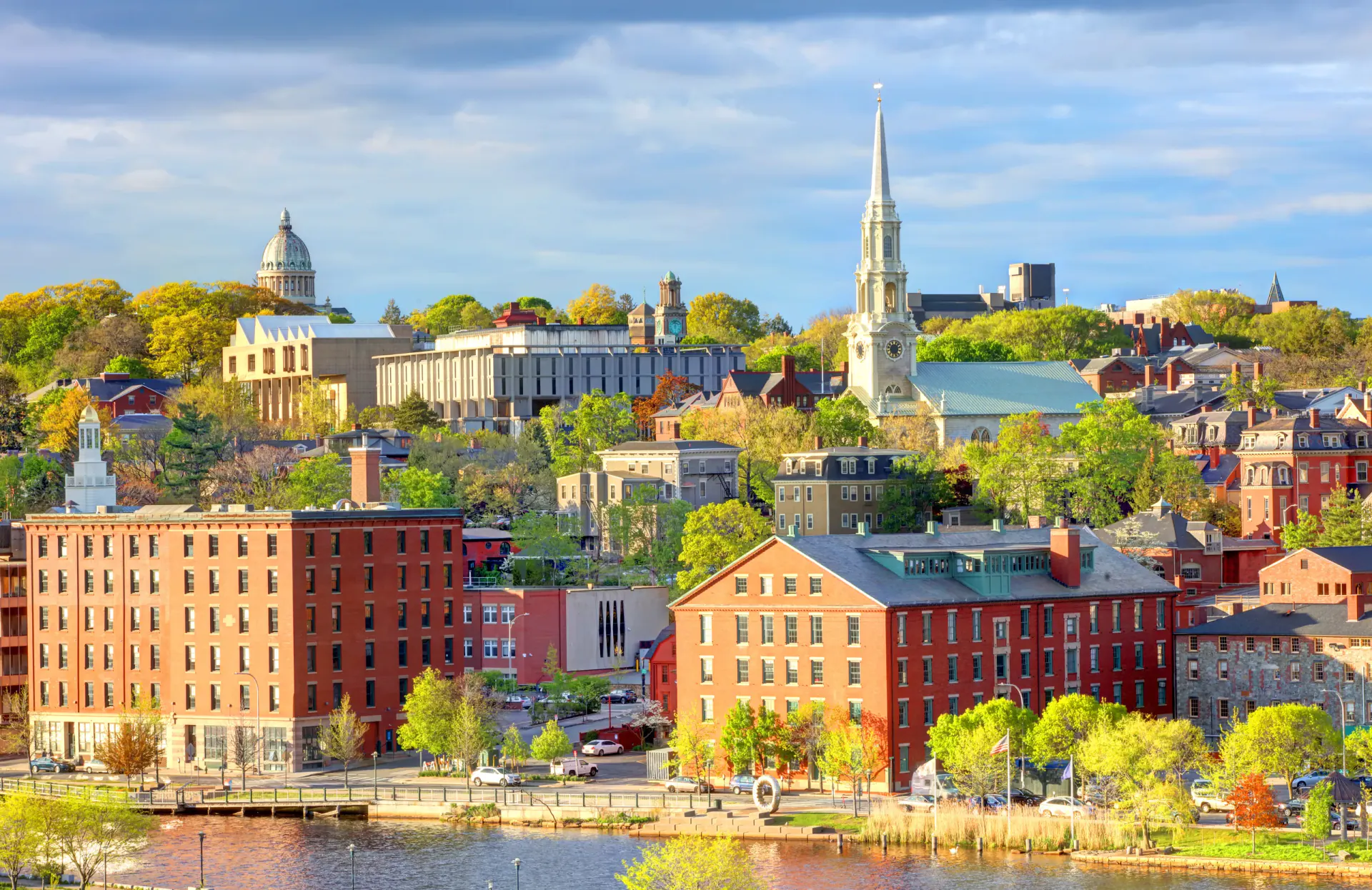
Providence commercial roofing
Providence carries an unusually old and varied commercial roof stock for its size. The downtown financial and government core, the hospital and university district around the Jewelry District and the College Hill medical campuses, and above all the region's dense inventory of converted textile mills and masonry manufacturing buildings along the Woonasquatucket and Providence rivers all sit near the head of Narragansett Bay. That coastal-New England position means a full four-season load with a maritime edge: humid summers and UV, nor'easters driving wind and heavy rain off the bay, winter snow load and ice damming, and salt-laden air that corrodes fasteners and edge metal faster than an inland site. For the owners, developers, and institutions holding this property, those forces age roofs unevenly and out of sight. We advise the owner's side with documented condition, capital planning, and independent contractor oversight.
Old buildings, complex roofs
Providence's mill-conversion stock is a distinct challenge. These are large, older buildings whose roofs have often been recovered, patched, and re-detailed across decades, with parapets, penetrations, and transitions that predate any current standard. On assemblies like these, freeze-thaw is punishing: meltwater works into aged seams and masonry-adjacent flashings through the winter, and each freeze widens the breach. Nor'easters add wind uplift on edges and parapets, and the bay's salt air corrodes fasteners and metal that inland roofs never worry about. Understanding the actual construction history of one of these roofs is often the difference between a targeted repair and a needless tear-off.
Because this deterioration is slow and hidden, an owner typically learns of it only when a tenant reports interior water and the problem has already reached capital scale.
The owners and institutions we serve
Providence's commercial property is heavily weighted toward long-term institutional holders, healthcare and university systems, and developers managing converted mill assets, rather than short-cycle flips. Those owners need a strategy of protecting and extending what they hold, sequencing replacements deliberately, and keeping older roofs serviceable as long as they safely can. We track membrane type, age, and remaining service life for every roof so the owner sees the whole portfolio on one honest timeline instead of reacting building by building, and so scarce capital goes to the roofs that genuinely need it.
Independent reporting protects the owner
A contractor's free inspection ends in a sales recommendation; an owner-side condition report does not. We document what is actually on the roof, photograph and locate every defect so each year's report is directly comparable to the last, and separate the roofs that need work from the ones that need only maintenance and monitoring. When work is warranted we scope it, competitively bid it, and hold the contractor to the documented condition rather than to their own estimate. For historic mill assets in particular, that independence guards against the reflexive tear-off of a roof that could be repaired. This is part of our Rhode Island commercial roof advisory coverage, serving owners across Providence and the wider Narragansett Bay region.
Providence market coverage
We provide owner-side commercial roof advisory across Providence, Rhode Island and the surrounding metro.