
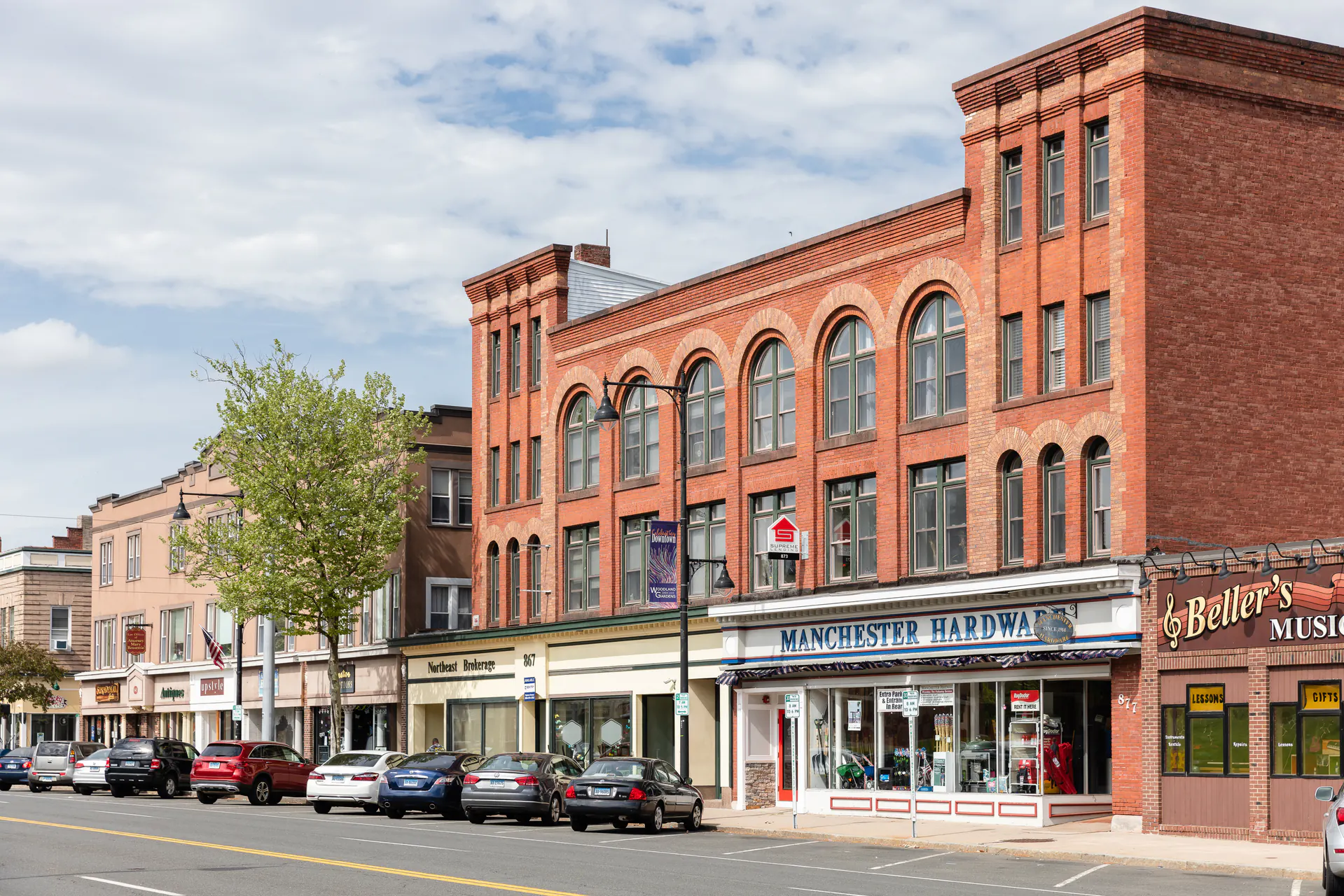
Manchester commercial roofing
Manchester's commercial roof stock is defined by the Amoskeag Millyard, the vast run of red-brick textile mills along the Merrimack River that now house offices, technology tenants, and institutions, alongside the downtown business core and the newer distribution, flex, and light-industrial buildings spread along the Route 3, F.E. Everett Turnpike, and airport corridors to the south. These roofs carry a full northern New England load: humid summers with strong UV, and hard winters with heavy snow accumulation, ice damming, and repeated freeze-thaw cycling that pries seams open across the cold months. For the owners, developers, and institutions holding this property, that cycle drives deterioration that is both severe and largely invisible. We advise the owner's side with documented condition, capital planning, and independent contractor oversight.
Snow load and the Millyard roofs
Winter governs roof risk in Manchester. Heavy snow adds real structural dead load, and as it melts and refreezes it drives ice damming and standing meltwater that backs up behind parapets and against drains. On the large, older mill roofs of the Millyard, that meltwater finds aged seams and masonry-adjacent flashings, and each freeze widens the breach. These converted mills have often been recovered and re-detailed across many decades, so the actual construction history of a given roof matters as much as its visible surface. Summer heat and UV then age the membrane from the other direction, so the roof deteriorates in slow motion across seasons.
Because that failure is hidden, an owner typically discovers it only when a tenant reports interior water and the problem has already reached capital scale.
Mill conversions and long-term owners
Manchester's property is heavily weighted toward long-term holders: developers and institutions managing Millyard conversions, and facility teams running downtown offices and southern-tier distribution buildings. Those owners need a strategy of protecting and extending what they hold, keeping older roofs serviceable as long as they safely can, and sequencing replacements deliberately. We track membrane type, age, and remaining service life for every roof so the owner sees the whole portfolio on one honest timeline, and so capital goes first to the roofs that truly need it rather than to whichever one leaked most recently.
Why an independent report beats a free inspection
A contractor's free inspection is a sales call that ends in a recommendation to buy; an owner-side condition report does not. We document membrane type, age, seam and flashing condition, drainage performance, and realistic remaining service life, and we photograph and locate every defect so this year's report compares directly to next year's. For historic mill assets especially, that independence guards against the reflexive tear-off of a roof that could be repaired. When work is genuinely warranted, we scope it, competitively bid it, and hold the contractor to the documented condition rather than to their own estimate. This is part of our New Hampshire commercial roof advisory coverage, serving owners across Manchester and southern New Hampshire.
Manchester market coverage
We provide owner-side commercial roof advisory across Manchester, New Hampshire and the surrounding metro.