
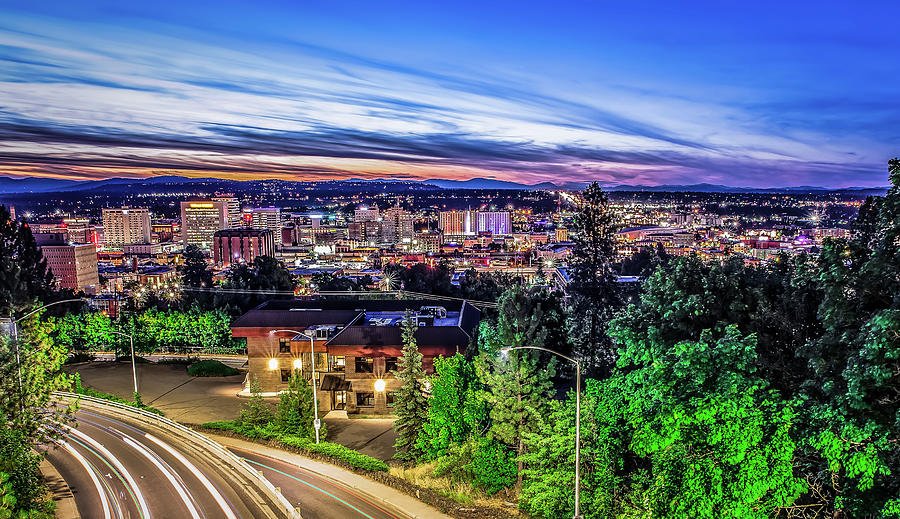
Spokane commercial roofing
Spokane anchors the Inland Northwest, and its commercial roofs work through a semi-arid continental climate that swings harder between seasons than the coastal side of Washington ever does. Cold, snow-laden winters load flat roofs and drive relentless freeze-thaw cycling, while hot, dry summers with intense high-elevation UV bake membranes and coatings. The building stock that carries this load runs from the downtown office and medical core around the University District and the growing Sacred Heart and Providence health campuses, to the industrial and distribution belt in the Spokane Valley and out toward the airport and the West Plains logistics corridor. For owners holding warehouse, office, retail, and institutional property across the metro, the defining problem is not a single hazard but the annual round trip from deep snow load to dry summer heat, which stresses a low-slope assembly at both ends of the calendar.
The Inland Northwest markets we cover
Spokane's commercial inventory is concentrated in a few distinct submarkets that age differently. The Spokane Valley carries the region's densest run of industrial and flex buildings, where large single-ply footprints and older built-up roofs sit on manufacturing and distribution stock. The West Plains around Spokane International Airport and the Amazon and freight facilities out that direction has added newer, larger membrane roofs geared to logistics. Downtown and the medical district hold older office, institutional, and mixed-use roofs, many with complex penetration and equipment loads from HVAC and hospital systems. We treat each of these as its own risk environment: a snow-drifted valley warehouse roof and a downtown medical roof crowded with rooftop units do not fail the same way or on the same schedule.
What actually drives roof failure here
The dominant failure drivers we plan around in Spokane come from the extremes of a continental climate, and the winter half of the year does most of the damage.
- Snow load and drifting that stress structural capacity and drainage, then melt and refreeze into ice dams at eaves, valleys, and low points where standing meltwater backs up under membrane and flashing.
- Aggressive freeze-thaw cycling that opens seams, cracks aged coatings, and works moisture into any detail that was poorly sealed the previous season.
- Intense summer UV at Spokane's elevation that degrades membranes and accelerates coating and adhesive aging during the hot, dry months.
- Blocked or undersized internal drains and scuppers that cannot clear meltwater fast enough during a rapid thaw, turning snowmelt into chronic ponding.
- Wildfire smoke and ash during regional fire seasons, which settles on roofs and in drains and can accelerate surface fouling on membranes that are not kept clear.
None of these are unusual for the Inland Northwest, but they act slowly and out of sight. A roof that sheds snow fine for years can develop an ice-dam pattern the winter a drain finally clogs, and by the time meltwater shows up on a tenant's ceiling the deck may already be wet. Our role is to catch the trajectory early, while the fix is still a maintenance item rather than a replacement.
Owner-side condition reporting and capital planning
For a Spokane owner or asset manager, the foundational deliverable is an honest, standardized condition report on every roof. We document membrane type and age, seam and attachment condition, flashing and penetration detailing, drainage and scupper performance under thaw conditions, insulation moisture where investigation is warranted, and realistic remaining service life. We photograph and locate defects so each year's report is directly comparable to the last, which is what lets an owner see a roof trending toward failure rather than discovering it mid-winter. This is part of our Washington commercial roof advisory coverage, and because we sit on the owner's side of the table, a roof with life left gets maintained and monitored, not replaced because a crew is available. Across a Valley-and-downtown portfolio, that discipline turns competing roof ages into a funded, sequenced capital plan rather than a series of winter emergencies.
Why an independent advisor protects owners here
Every hard winter in Spokane brings roofing solicitations, and a contractor's free snow-season "inspection" is a sales call. An owner with documented condition and a standing maintenance schedule is far better positioned than one fielding storm-driven bids with no baseline. We time inspections to the seasons that matter, scope and competitively bid only the work that genuinely needs doing, and hold contractors to documented condition rather than to their own estimate. That independence matters most in a climate where a single ice-dam event can be spun into a full re-roof pitch, and it sharpens transactions: when an Inland Northwest asset is bought, sold, or refinanced, a current roof record built to snow-load and freeze-thaw realities removes a recurring point of friction and keeps a six- or seven-figure roof from being mispriced.
Spokane market coverage
We provide owner-side commercial roof advisory across Spokane, Washington and the surrounding metro.