
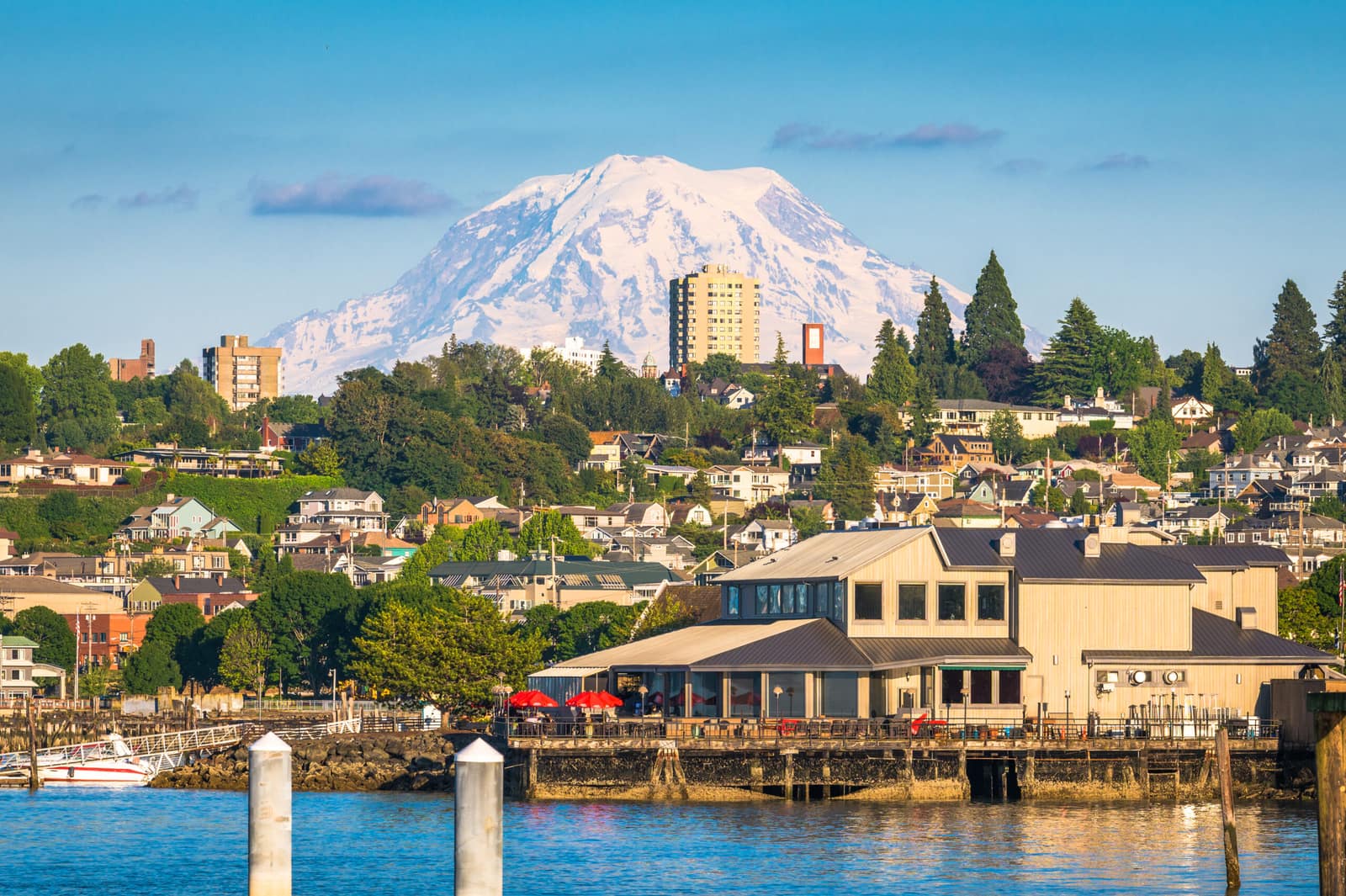
Washington statewide
Washington is two roofing climates inside one state line, and an owner who manages property on both sides of the Cascades is really managing two different risk problems. West of the mountains, the enemy is water that never quite stops; east of them, it is snow load, sharper temperature swings, and intense summer sun. We advise building owners, REITs, and asset managers on the owner's side of that problem: we inspect, document condition, build capital plans, and manage roofs across portfolios, and we do not bid or self-perform the installation. Keeping those roles separate is what lets our recommendations serve the asset rather than a sale.
Commercial roofing markets we serve in Washington
Explore owner-side commercial roof advisory in these Washington cities:
The markets we cover across Washington
The state's commercial roof inventory clusters around a few distinct economies. The Puget Sound region is the center of gravity: Seattle's technology and corporate base, the aerospace manufacturing rooted in Boeing's Everett operations, and the deep-water logistics of the Ports of Seattle and Tacoma. That mix produces enormous low-slope roofs over manufacturing halls, distribution and warehouse space, and tech campuses, many of them carrying heavy rooftop mechanical and process equipment that complicates every assessment and every repair.
East of the Cascades the building stock and the weather both change. Spokane anchors the Inland Northwest with regional distribution, healthcare, and commercial inventory, while the Tri-Cities and the Columbia Basin add agricultural processing, cold storage, and warehousing tied to the state's farm economy. We treat Western and Eastern Washington as separate planning environments, because a roof assembly and maintenance schedule that makes sense in Tacoma is the wrong answer in Spokane, and the reverse is just as true.
What Washington's climate does to commercial roofs
West of the Cascades, the marine climate is defined by persistent, long-duration rainfall through the wet season rather than dramatic storms. Greater Seattle sees on the order of thirty-seven inches of rain a year, most of it concentrated from late fall through early spring. That pattern punishes drainage above all else: ponding water, undersized or clogged drains and scuppers, and chronically saturated insulation are the failures we find most often, and constant moisture combined with limited drying time accelerates membrane and flashing deterioration and feeds rooftop biological growth. Once water enters the assembly here it rarely leaves on its own; wet insulation in a marine climate stays wet, quietly losing thermal value and corroding the deck beneath long before the first stain shows up on a tenant's ceiling.
East of the mountains the drivers invert. The Cascades wring most of the moisture out of incoming systems, leaving Eastern Washington with a drier, more continental climate: real winter snowfall and snow-load demand on flat roofs, repeated freeze-thaw cycling, and hot, high-ultraviolet summers that age membranes and fatigue seams. Across the whole state, owners also have to reckon with seismic exposure, the Puget Sound region in particular carries meaningful earthquake risk, which bears on rooftop equipment anchorage and on how a roof and its penetrations move. The conditions we plan around include:
- Persistent wet-season rainfall west of the Cascades overwhelming drainage and saturating insulation
- Ponding, clogged drains and scuppers, and biological growth on Puget Sound low-slope roofs
- Winter snow load and freeze-thaw cycling across Spokane, the Tri-Cities, and Eastern Washington
- Hot, high-UV inland summers aging membranes and fatiguing seams
- Seismic activity in the Puget Sound region affecting rooftop equipment anchorage and penetration detailing
The owner-side advisory role
For an owner or asset manager, a commercial roof is a large, slow-moving liability that stays invisible until water reaches a tenant, a server, or a production line. Our engagements start with condition reporting: documented, photographed assessments of membrane, flashings, drainage, penetrations, and rooftop equipment, scored consistently so a roof in Bellevue can be compared against one in Spokane on the same scale. Those reports feed multi-year capital plans that tell an owner what to fund, in what order, and on what timeline, so a reroof is a budgeted decision rather than a response to a leak during the rainy season. That same record carries weight in a transaction: when an asset trades or refinances, a documented view of remaining service life and planned spending keeps the roof from surfacing as an unpriced liability late in diligence.
Warranty exposure deserves particular attention in this state. Manufacturer and workmanship warranties carry inspection, maintenance, and notification requirements, and Washington's wet climate makes drainage-related neglect a common and avoidable reason for denied claims. We read the warranty terms, identify the conditions that put coverage at risk, and keep the maintenance documentation that an owner needs to hold a manufacturer to its obligation when something does fail. On the aerospace and advanced-manufacturing roofs around the Puget Sound, where process equipment, exhaust, and frequent rooftop access are part of daily operations, the conditions that quietly void a warranty are easy to trip and expensive to discover only after a claim is denied.
How a reporting cadence protects the asset
A single inspection is a snapshot; what protects an asset is a rhythm. We recommend a baseline assessment when we take on a roof, then scheduled inspections timed to Washington's seasons, before and after the long western wet season to confirm drainage is clear and intact, and after the freeze-thaw winter and snow load in Spokane and the Columbia Basin, plus a directed inspection following any significant weather or seismic event. The aim is to catch the small failure while it is still a repair: a clogged drain, a split seam, a lifting flashing, before it admits water into the assembly and forces a tear-off.
That cadence gives an owner something to manage from: a trend line for each roof instead of a string of disconnected service calls. We track how each assembly is aging against its expected service life, revise the capital plan as conditions change, and tie every recommendation to a documented reason. For an asset manager holding aerospace, logistics, office, and institutional roofs on both sides of the Cascades, the value is consistency, every roof measured on the same scale and the same schedule, so the portfolio picture is real rather than anecdotal.
Managing roofs across a Washington portfolio
Washington concentrates owners into recognizable building types: aerospace and advanced manufacturing in the Puget Sound corridor, port-driven warehouse and distribution space in Seattle and Tacoma, technology and office campuses on the Eastside, agricultural processing and cold storage in the Columbia Basin, and healthcare and regional commercial inventory around Spokane. Each fails on its own schedule and under its own loads, and an owner holding several of these categories needs one consistent standard applied across all of them rather than a patchwork of one-off opinions.
That is the work we do. We standardize how every roof in a portfolio is inspected, scored, and reported; we sequence capital across the assets so a multi-site owner can forecast spending with confidence; and when a roof warrants work, we help scope it, write the specification, qualify contractors, and verify that the finished installation matches what was specified and what the warranty demands. Because we never hold the installation contract, our reporting answers to the owner's stake in the building, not to a crew's interest in selling a system. For owners and asset managers operating from the Puget Sound ports to the Inland Northwest around Spokane, that independence is exactly what makes the advice actionable.